
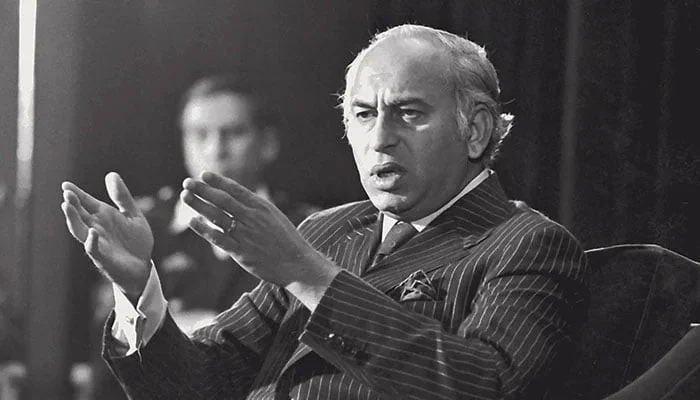
Shaheed Zulfikar Ali Bhutto defied the suffocating politics of his time, nurturing a new consciousness rooted in human rights, dignity, equality and justice. Rejecting absolutism, he sought to transform politics into public service. As we mark his death anniversary, we reflect not only on a remarkable leader but on the enduring imprint he left on Pakistan’s identity and democratic imagination.
Long after his passing, his light refuses to dim, his voice refuses to fade and his vision of an inclusive, just, united, prosperous, strong and dignified Pakistan continues to guide our great nation. I take pride that my own political journey was shaped and inspired by the ideology and ideas of Quaid-e-Awam. His conviction that power belonged to the people has been a guiding light for me through every office I have held. Today, as I preside over the Senate, I see his vision embodied in the constitution he gave us and in the institution he conceived to protect our federation.
Shaheed Bhutto’s journey to leadership was shaped early by the towering figure of Quaid-e-Azam Muhammad Ali Jinnah. At just seventeen, he wrote to the Quaid, declaring that he would one day sacrifice his life for Pakistan. And true to his word, he sacrificed his life for Pakistan exactly thirty-four years later in April 1979. Jinnah wrote back, advising him to study politics thoroughly but not neglect his education. That exchange marked the beginning of a relationship that would define Bhutto’s political philosophy. He carried Jinnah’s memory with him throughout his life.
Boasting an illustrious academic career at Berkeley and Oxford, where he completed a demanding law degree in just two years, Bhutto returned to Pakistan. He soon represented the country at the United Nations, and by 1958, at the age of 30, he became the youngest cabinet member in Pakistan’s history.
His diplomatic skills were evident early. When he met US president John F Kennedy in the White House in 1963, Kennedy remarked that if Bhutto were American, he would be in his cabinet. Bhutto’s response was characteristically sharp: “Be careful, Mr President, if I were American, I would be in your place”.
Razor-sharp wit, a formidable intellect and an unshakeable commitment to Pakistan’s sovereignty made him a towering figure on the world stage. As foreign minister, he brought balance to Pakistan’s foreign policy, forging closer ties with China and advocating for an independent course that served the nation’s interests. He supported China’s entry into the UN, a bold move that laid the foundation for the “higher than the Himalayas and deeper than the oceans” relationship that continues to benefit Pakistan today.
However, the true greatness of Shaheed Bhutto emerged like a phoenix from the very ashes of the 1971 war. Those were troubled times. Pakistan was a shattered nation. Half the country had been lost and five thousand square miles of territory was under occupation. The world had written us off. Yet within months, through sheer diplomatic acumen, Bhutto secured the release of our prisoners and the return of our land through the Simla Agreement. He had prepared meticulously, consulting opposition leaders, military commanders, and visiting fourteen Muslim countries to secure their support before entering negotiations with Indira Gandhi.
And, unquestionably, perhaps, his greatest gift to the nation and the country was the 1973 Constitution. Before Bhutto, Pakistan had never enjoyed a democratic constitution framed by the will of its people. He gave us a constitution that declared sovereignty belongs to Allah Almighty, but the people of Pakistan are its trustees. He created the Senate to ensure that every province, large or small, would have an equal voice.
Equally transformative and highly seminal were his domestic reforms. Within three months of taking office, he announced land reforms, distributing over 800,000 acres to landless peasants. He established Pakistan Steel Mills, built Port Qasim and laid the foundation for Quaid-i-Azam University. His government prioritised labour welfare and expanded educational access, making education free up to matriculation. These policies were part of a coherent vision encapsulated in his slogan Roti, Kapra aur Makan.
Years later, that commitment found its most powerful expression in the Benazir Income Support Programme, which I had the honour to launch as Prime Minister. Today, BISP is recognised globally as one of the most effective social safety nets, empowering women and lifting millions from poverty.
Shaheed Bhutto always had his fingers on the pulse of the masses. He understood the geopolitical and strategic alchemy that tied Pakistan’s destiny to the Muslim world. In February 1974, he hosted the Islamic Summit in Lahore, bringing together leaders from thirty-eight Muslim nations. King Faisal of Saudi Arabia, Anwar Sadat of Egypt, Colonel Qaddafi of Libya, and Yasser Arafat were among the distinguished guests.
Equally unwavering was his commitment to Pakistan’s defence. He had famously declared that Pakistan would “eat grass” if necessary to acquire nuclear capability. As prime minister, he initiated the nuclear programme. That programme, completed after his martyrdom, has ensured Pakistan’s security for all time.
And then darkness descended when his democratically elected government was overthrown in July 1977. What followed was a judicial process that the world recognised as a travesty and, ultimately, a ‘judicial murder’. Despite international appeals from leaders across the globe, he was sent to the gallows on April 4, 1979. His daughter Benazir’s account of their final meeting, with iron bars separating father from daughter, remains one of the most poignant passages in Pakistan’s history.
The Bhutto family paid an extraordinary price – the Quaid-e-Awam, his sons Shahnawaz and Murtaza, and his beloved daughter and the first female prime minister of the Muslim world and Pakistan Shaheed Mohtarma Benazir Bhutto, all gave their lives for the cause of the people. Today, President Asif Ali Zardari and Chairman Bilawal Bhutto Zardari carry this legacy forward with unwavering dedication.
Through my political and parliamentary journey, I have endeavoured to honour that vision. The 18th Amendment, passed during my tenure as prime minister, was a historic step towards realising Bhutto’s dream of provincial autonomy.
Shaheed Bhutto once said, “We are not merely the heirs of a party, we are the custodians of a vision”. That vision was of a Pakistan where the poor are not forgotten, where the provinces are not silenced, where democracy is not a slogan but a way of life.
As we remember him today, let us renew our commitment to that vision. His light continues to guide us. May his soul rest in eternal peace. May his vision continue to inspire generations.
The writer is the chairman of the Senate of Pakistan.
Disclaimer: The viewpoints expressed in this piece are the writer’s own and don’t necessarily reflect Geo.tv’s editorial policy.
Originally published in The News
