

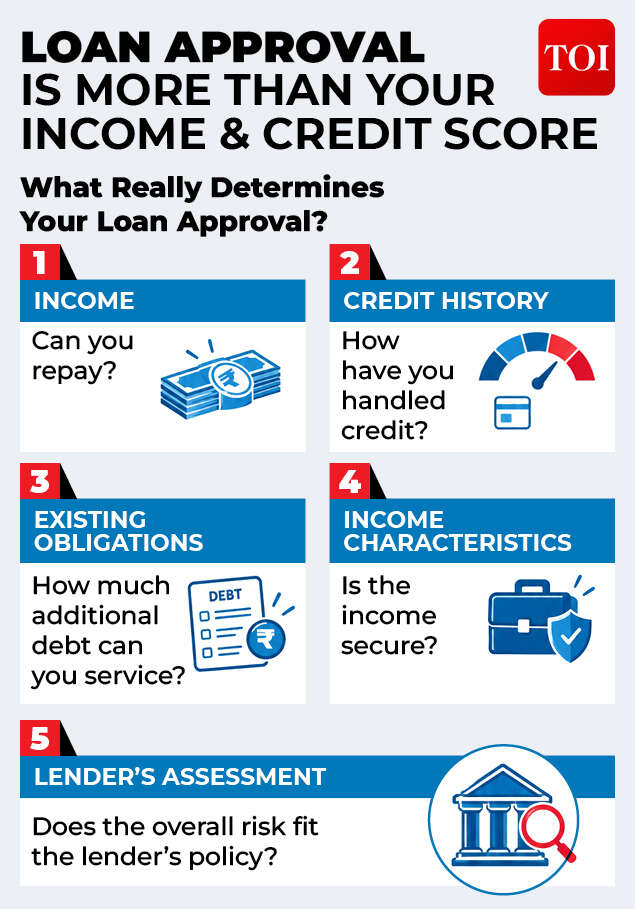
The author is CEO of PaisabazaarBuilding awareness on how a lender assesses a loan application can help prospective borrowers plan better and stay eligible for suitable offers. Lenders conduct a thorough risk assessment while approving your loan. The policy and underwriting criteria are broadly based on your ability to pay and your intention to pay, and include factors like your monthly income, credit history, current obligations, income stability, employer, current debt, etc., to name a few.The lender runs this analysis to understand if the borrower has demonstrated responsible credit behaviour in the past, can repay the loan on time and if the risk adheres to the lender’s credit policy. The past credit behaviour is summarised in the credit history, repayment capacity is assessed through the income and the risk is ascertained using the existing debt and income profile.
Impact of Your Income
Your income is an important criterion that determines your loan approval, but lenders look beyond your gross income while analysing your loan application. Your income stability and continuity, employer profile, employment type, industry type, etc. are also considered.The loan amount requested, age, and the proposed loan tenure may also impact your loan approval or the sanctioned loan amount. A higher income can improve your eligibility for a larger loan amount.
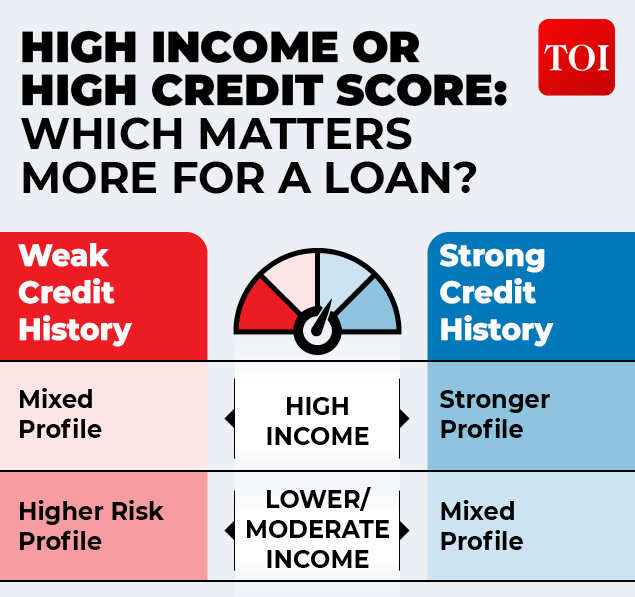
High income or High Credit Score: What Matters More?
Impact of Your Existing Debt
Higher income can improve the borrowing capacity of an applicant, but it should not be confused with affordability.An important factor that lenders consider is the existing EMI obligations and financial commitments. Lenders prefer responsible borrowing, and an applicant’s existing financial commitments play an important role in the loan approval process. Instead of only evaluating whether the applicant earns enough, lenders want to know whether the applicant can comfortably service the proposed loan.Your existing debt, calculated through Fixed Obligation to Income Ratio (FOIR), is a big factor. Ideally, your fixed obligation, including the EMI of the new loan you are applying for, should be less than 55% of your net monthly income.Two applicants with the same credit score earning Rs. 1 lakh monthly and having existing EMIs of Rs. 15,000 and Rs. 55,000 respectively may be evaluated differently. While the first applicant, having an opportunity to service a loan of Rs. 40,000 monthly, can get the loan approved quite comfortably, the other applicant, whose liabilities are already stretched, may not be able to get the loan approved due to a limited incremental borrowing capacity.
Impact of Your Source of Income
With shifting income avenues, lenders are also swiftly moving towards the current scenarios of sources of income. They have started to analyse whether the income is identifiable, sustainable over the long term and sufficient to service the proposed debt.Salaried borrowers still have the most predictable and documentable income pattern, making them the most preferred borrowers as the risk assessment is fairly easy in their case. Within salaried consumers too, those employed in government or large multinational companies have higher approval chances.The profile of your employer and the industry may also be a crucial factor for some. For instance, despite a high income, your loan application may get rejected if the company you are employed in is new, like a start-up, or works in a sector which may have certain risks associated with it in the future.
Self-employed/business owners are assessed based on their financial statements, income consistency, business vintage, banking behaviour and other parameters. In many cases, lenders observe inconsistencies and thus risk assessment can become challenging in those cases. However, an established business and a strong business model, along with healthy personal financial health, can help increase chances of approval and get the best offers.Self-employed Professionals such as doctors, lawyers, CAs, financial consultants, architects, etc. may also have variable income patterns even after an established professional profile. This can lead to challenges during loan approval in some cases.Freelancers or those working in unorganized sectors may have less conventional earning profiles, and the income patterns can also be inconsistent. This can make documentation and assessment very important in such cases and may lead to stricter scrutiny by most lenders.
Impact of Your Credit Score on Your Loan Approval Chances
A strong credit score indicates the borrower’s disciplined credit behaviour and lowers the risk of default. However, lenders still have to evaluate the applicant based on the income, existing obligations, loan amount and other eligibility parameters.Similarly, an applicant with a poor score is unlikely to get a loan, despite meeting other eligibility conditions. The reason behind the low score also matters; unpaid debt and defaults from the past are detrimental to your credit profile and almost guarantee a rejection.
The Way Forward for Borrowers
It is important to analyse one’s current financial situation and creditworthiness. Applicants with high income, a high credit score, and limited liabilities can be the most suitable applicants for lenders. But maintaining all three parameters in the green zone is not possible for all applicants, especially those in need of credit during emergencies.All lenders have their own eligibility criteria, which may be based on their risk appetite, product policies, existing relationship with the borrower, internal credit models, income assessment methodologies, etc., to name a few.A borrower may not be fit based on the eligibility requirements of one lender but can be accommodated by another lender depending on their policies. A financial marketplace can be very helpful in such situations where the applicant can compare available loan offers from multiple lenders and identify those where his chances of loan approval are the highest, depending on the lenders’ eligibility criteria and his financial situation and creditworthiness.Credit marketplaces today have evolved from simply offering loans to helping consumers make informed borrowing decisions.
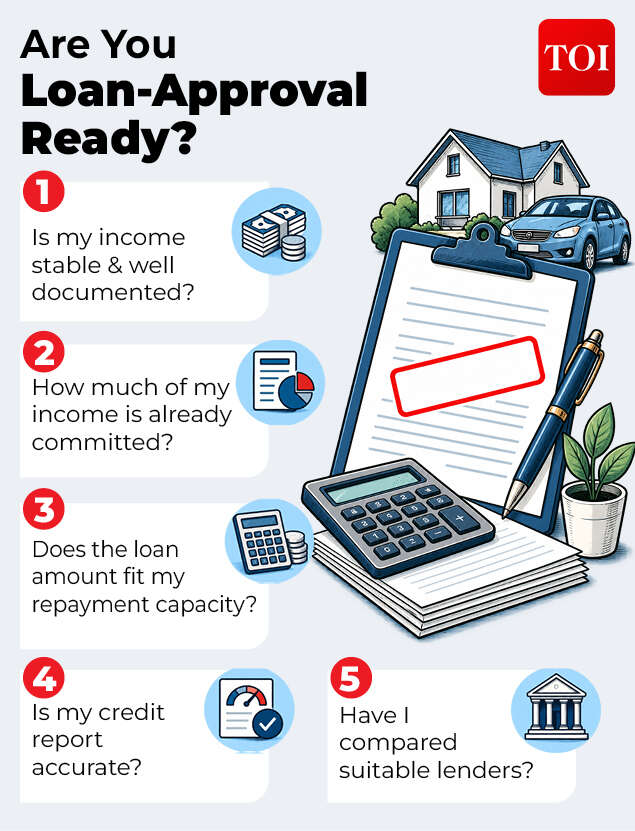
Are you loan-approval ready?
In the End
Income establishes repayment capacity, and credit history provides evidence of how the borrower has handled credit in the past, whereas existing obligations determine how much additional debt the borrower may be able to service.Lenders check these parameters in the borrower’s profile to assess overall risk. Borrowers should not aim to optimise one parameter to secure a larger loan. Instead, they should evaluate their complete financial profile and try to match it with the most suitable offer that is affordable and sustainable in the long run.Applicants can create a 5-point “Loan Approval Readiness” checklist that answers 5 simple questions – is my income stable and well documented, what is my current debt, can I afford the new EMI over the long-term, is my credit report healthy and accurate and have I compared offers to find the best one.

