

War next door. Markets on edge. Commodity prices swinging. Yet India’s growth engine continues to run strong, clocking a 7.8% GDP growth for the April-June quarter.The Q1 numbers for the financial year 2026-2027 are particularly significant as they beat expectations and comfortably exceeded the Reserve Bank of India’s 7% projection for the quarter.Though the pace was slower than the revised 8.6% growth recorded in the previous quarter, it was well above the 6.9% expansion in the year-ago quarter, according to government data released on Monday.The latest numbers also mean that India retains its tag of being the world’s fastest-growing major economy. For the full 2026-27 fiscal, the RBI has projected GDP growth at 6.7%, but the strong first quarter print may lead the central bank to revise its estimates upwards in the next policy review.The strong performance is particularly significant because it comes against a backdrop of heightened geopolitical risks. The Iran conflict and wider turmoil in the Middle East have rattled energy markets, disrupted supplies and raised concerns over inflation, weaker global demand and further commodity-price volatility. Yet, so far, these shocks have failed to derail India’s growth momentum.
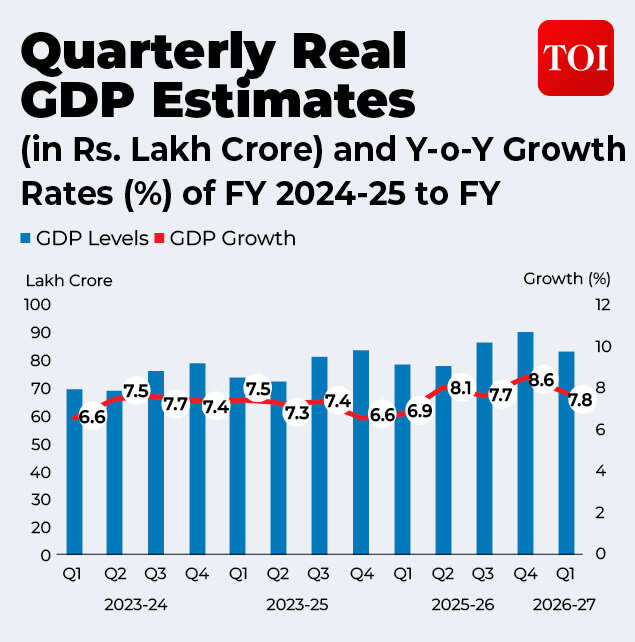
Real GDP estimates
Chief economic adviser V Anantha Nageswaran said India was now reaping the benefits of structural reforms in a highly uncertain global environment. He said all three broad sectors, primary, secondary and tertiary, contributed to GDP growth in the first quarter.So, what is keeping India’s economy on a strong footing despite the global turbulence?
Seven engines, behind 7.8% growth story
Domestic demand remains the biggest cushionIndia’s large domestic market remains one of its biggest buffers against external shocks. Private Final Consumption Expenditure, a key measure of consumer spending, grew 7.1% in real terms in Q1 FY27, suggesting households continued to spend despite an uncertain global environment.Other high-frequency indicators also point to sustained domestic activity. Vehicle sales, GST collections, electricity demand and fuel consumption continued to show healthy growth. In July, GST revenue rose 15.4 per cent, while digital-payment volumes increased 16.6 per cent. Electricity demand grew 10.7 per cent, with petrol and diesel consumption rising 9.2 per cent and 10 per cent, respectively.July passenger-vehicle retail sales reached 4.58 lakh units, up 34.3% from a year earlier and the highest level for the month. Tractor retail sales rose 28.1% to 1.17 lakh units, while two-wheeler sales increased 28.3% to 18.18 lakh units. Commercial-vehicle sales also grew 24%.The strength of consumption gives India an important buffer because a large share of growth is being driven by activity within the domestic economy rather than external demand alone.Services continue to leadServices remain one of the strongest pillars of the economy, growing 10% in real terms in Q1 FY27.Financial, real estate, IT and professional services recorded 12.1% growth. Trade, hotels, transport, communication and related services grew 8.5%, while public administration, defence and other services expanded 7.5%.
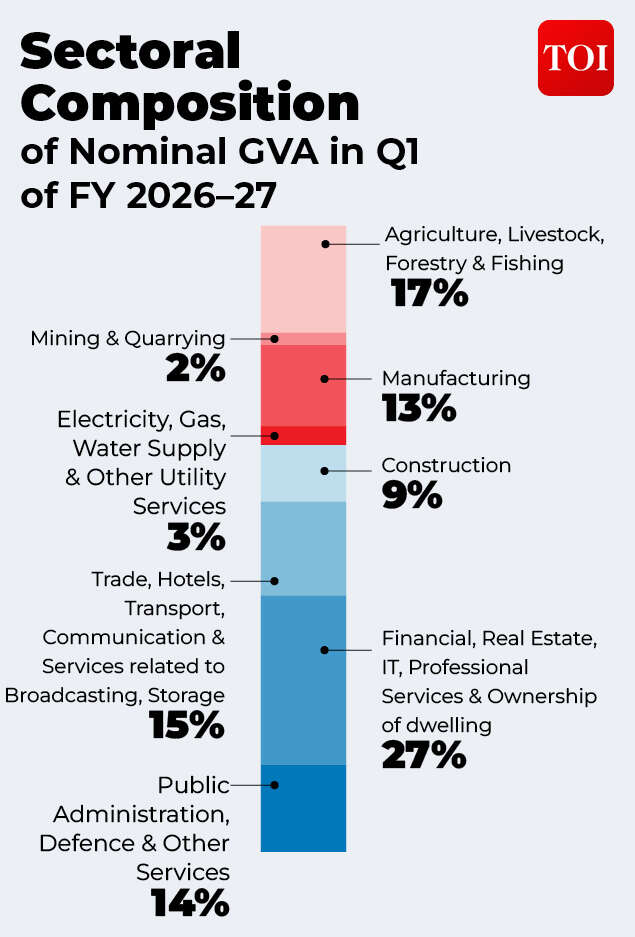
Sectoral composition of Nominal GVA in the first quarter of financial year 2026-27 (Information credit: PIB)
The momentum is also visible in monthly services data. Eight of 19 services sub-sectors recorded double-digit growth in June 2026, while 18 posted positive growth.Real estate led the expansion with 24.7% growth, followed by retail trade at 18%, wholesale trade at 15.1%, administrative and support services at 14.4%, and IT and computer-related services at 13.5%.This broad-based performance has helped offset weakness or uncertainty in other parts of the global economy and reinforces the role of services as a key driver of India’s growth.Manufacturing holds its groundManufacturing has also remained resilient despite the risks posed by higher energy and input costs.The secondary sector grew 8.6% in Q1 FY27, with manufacturing expanding 9.2%. Electricity, gas, water supply and other utilities grew 8.9%, while construction rose 7.7%.Industrial indicators point to continued momentum. Production of electrical equipment rose 27% in Q1, while computer, electronic and optical products grew 12.4%. Machinery and equipment expanded 9.1%.The performance is significant because a prolonged Middle East shock could push up energy and input costs and squeeze manufacturers. So far, however, Indian industry has been able to maintain production and meet demand.Agriculture provides another layer of supportAgriculture may not be growing as rapidly as services or investment, but it remains important for economic stability. The primary sector grew 2.9% in Q1, with agriculture, livestock, forestry and fishing expanding 3.6%.Nageswaran said the monsoon situation had turned out better than feared, with sowing activity only marginally below last year across several crops.A relatively favourable agricultural season can support rural incomes and consumption while helping contain food-price pressures, giving the broader economy another layer of support.According to Nageswaran, agriculture contributed slightly less to growth, but manufacturing and services performed well despite the uncertainties related to the West Asia conflict, partly because the government ensured that input supplies were not disrupted.Investment shifts into a higher gearInvestment has emerged as another major driver of the strong GDP print. Gross Fixed Capital Formation grew 11.9% in real terms in Q1 FY27, more than double the 5.8% growth recorded in the same quarter last year.The acceleration points to a strengthening investment cycle, with private-sector capital expenditure picking up alongside continued government spending on infrastructure.MoSPI secretary Saurabh Garg said the roughly 12% growth in fixed capital formation, driven by both private and public investment, indicated continued momentum in the coming quarters.The improvement is also visible in industrial indicators. Capital-goods production grew 15.2% in Q1, according to MoSPI data, while infrastructure and construction goods also recorded stronger growth.That combination of consumption and investment is important for sustaining growth beyond a single quarter, as investment expands productive capacity while creating demand in the economy.More output, less input The Middle East conflict has raised concerns over global trade, logistics, supply chains and demand. Yet India’s exports continue to be in focus of diversification.Exports grew 12% in real terms in Q1 FY27, up from 6% a year earlier. At the same time, imports contracted 1.1% in constant-price terms, compared with 5.3% growth earlier, according to MoSPI data.The strength was visible across key export categories. Engineering-goods exports rose 17.7%, electronics exports jumped 57.4% and chemical exports increased 14.4%. Merchandise exports also reached a record monthly value of $44.24 billion in July.The export story is not simply about higher volumes. India is also trying to diversify its export markets and product basket.Nageswaran said stronger manufacturing exports in a difficult global environment reflected the benefits of free trade agreements, export diversification and potentially improving competitiveness, innovation and productivity.“If that is the case, it augurs very well for output and employment growth in the coming quarters and years,” he said.Such diversification could become increasingly important if global trade conditions remain difficult.Growth is broad-basedPerhaps the biggest takeaway from the Q1 GDP numbers is that India’s growth is not dependent on a single sector.Real GVA grew 8.2% in Q1 FY27. The tertiary sector grew 10%, the secondary sector 8.6%, while agriculture and allied activities expanded 3.6%.On the expenditure side, private consumption grew 7.1%, while fixed investment surged 11.9%.The broad-based nature of the expansion gives the economy some protection against individual shocks. If one segment slows because of external pressures, strength elsewhere can partly offset the impact.
Inflation, foreign investment and more support
India’s relatively contained inflation is giving the economy some breathing room even as global conflicts threaten to push up crude oil and other commodity prices.Retail inflation stood at 4.45% in July, while core inflation eased to 4.15%. This gives policymakers some room to focus on supporting growth rather than responding to an immediate inflation crisis.The macro picture is also being supported by strong foreign investment. Gross inward foreign direct investment reached about $30.7 billion in April-June 2026, described as the strongest quarterly inflow in at least 15 years.The inflow suggests global companies continue to view India as an attractive investment destination despite geopolitical uncertainty. Foreign investment can also bring capital, technology and access to global supply chains, strengthening the domestic investment cycle.The government’s fiscal position offers some comfort as well. The Centre’s fiscal deficit stood at Rs 4.55 lakh crore during April-July, equivalent to 26.8% of the full-year target of Rs 16.96 lakh crore.
India stands out among major economies
India’s growth looks even stronger when compared with other major economies.The 7.8% Q1 growth was significantly higher than China’s 4.3% and the US’s 2.1%. The UK also grew 2.1%, while Canada expanded 1.5%. Germany, Italy and France grew 1%, 0.8% and 0.5%, respectively, while Japan recorded 0.5% growth.
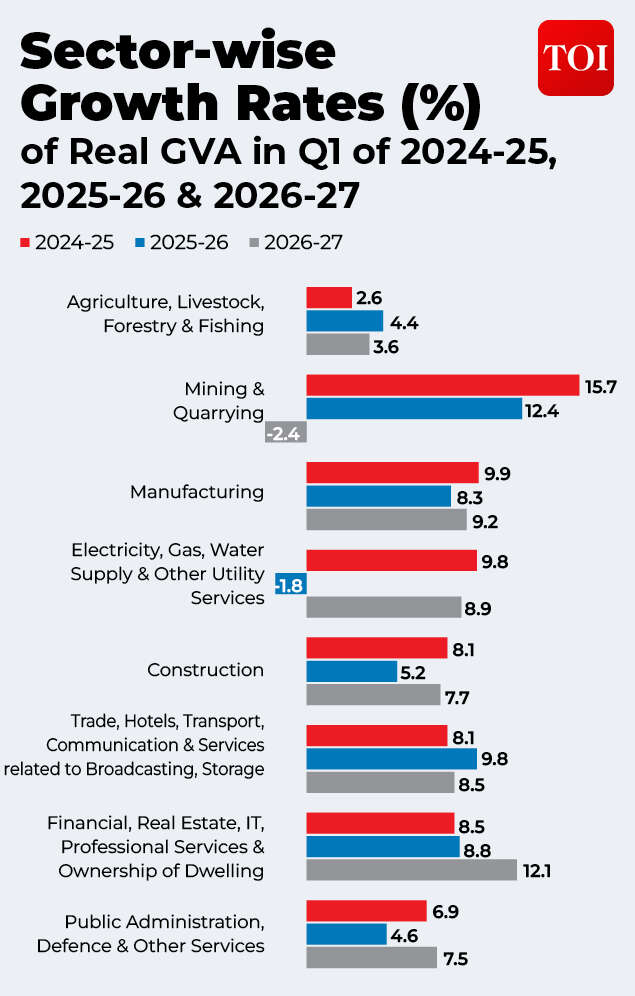
How different sectors grew in past three years
The comparison underlines the scale of India’s current momentum. The economy is entering a period of global uncertainty from a position of relative strength, supported by a large domestic market, resilient consumption, stronger investment, a rapidly expanding services sector, improving manufacturing activity, healthier banks and rising foreign investment.
What about the Middle East risk?
The strong Q1 GDP print does not mean India is insulated from the conflict. Energy remains the biggest vulnerability.India is heavily dependent on imported crude oil. A prolonged disruption in the Middle East could push up crude prices, raise transportation and production costs, widen the import bill and put pressure on inflation and the current account.There is also a risk of weaker global demand. If the conflict hurts growth in major trading partners, Indian exporters could eventually face weaker orders.Global interest rates, food prices and supply-chain disruptions are additional risks. Nageswaran has cautioned that uncertainty around interest rates, energy commodity supplies and food prices could weigh on India’s growth going forward.The impact may also take time to show up in GDP. A quarter that has already been completed cannot fully capture the consequences of a prolonged external shock.
What’s next for the growth engine?
The next phase of India’s growth story will depend on whether the domestic investment and consumption cycle remains strong enough to offset external weakness.Industry will need to maintain its manufacturing momentum, while exporters will have to remain competitive if global demand weakens. Policymakers, meanwhile, will need to keep a close watch on crude oil prices, food inflation and the fiscal position.
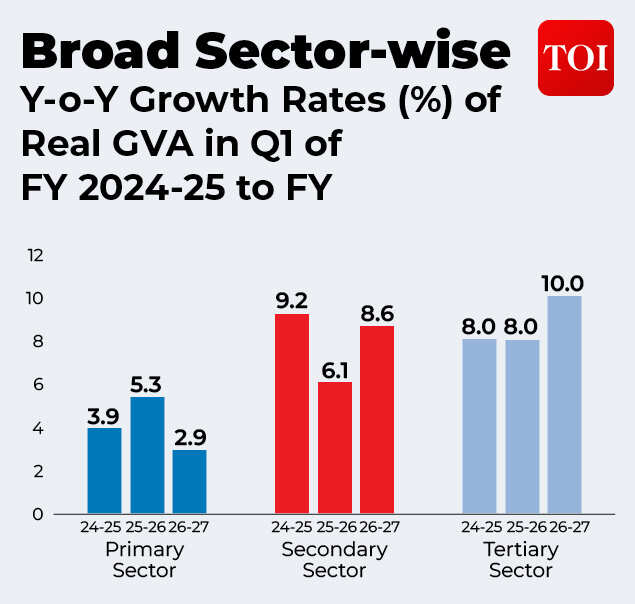
Annual growth across sectors
Industry leaders have broadly welcomed the Q1 performance but stressed that sustaining growth close to 8% will require stronger private investment, productivity growth, manufacturing, exports and employment generation.Nageswaran said near-term domestic economic momentum remained very strong, but warned that global uncertainties persisted.“…the near term, the domestic economic momentum is very strong, but globally, we are continuing to see uncertainties. We have flagged it in the Economic Review for August. There is concern with respect to the level of interest rates and potential disruptions on energy commodity supplies and also what will happen to the food prices, et cetera,” he said.The CEA added that several issues remained unresolved globally and could eventually affect economic activity in India.“And at some point, they may have an impact on economic activity in the country. But as of now, the domestic momentum and export performance have both combined to deliver another quarter of very strong growth, vindicating the beneficial effects of macroeconomic structural reforms that have been implemented over the last 12 years,” he added.
Bottom line
India’s 7.8% GDP growth does not mean the Middle East conflict has had no economic impact or that the country is insulated from a prolonged global shock. Instead, it shows that its domestic growth engines are currently strong enough to absorb the initial pressure.The real test will come if geopolitical tensions persist and energy prices remain elevated for an extended period.For now, the Q1 numbers point to an economy that is not just growing rapidly, but is becoming more diversified.The Middle East shock remains a risk. It has not, at least so far, become a growth-stopper for India.

