

The author is CEO of PaisabazaarBuying a home is more than a financial decision for most households in India. Along with a lifegoal, it is probably one of the biggest financial commitments they would make. Hence, the decision to purchase a home involves more than just choosing the property or getting a competitive interest rate on the home loan. Deciding the loan amount, whose income should support the loan, structuring of the liability and planning for the household’s other financial goals play an important role too. This is where a joint home loan becomes increasingly relevant.When two earning members of a household apply together for a loan, their combined income can potentially improve loan eligibility and help manage repayment burden more efficiently. Most banks and HFCs reiterate that adding an earning family member as a co-applicant can improve their borrowing eligibility. However, higher loan eligibility should not necessarily mean higher affordability. A household may become eligible for a larger loan amount when two incomes are considered, but it does not mean that they should avail the maximum loan amount.Also Read | Economics of buying versus renting a home: What makes sense?The home loan should coexist with emergency savings, investments, daily and lifestyle expenses. Thus, instead of contemplating “Should you take a joint home loan?”, you should introspect if “Taking a joint home loan would make your household’s overall financial position stronger and more resilient?”
Understanding the nuances of a Joint Home Loan
Two or more co-borrowers take a joint home loan, and all co-borrowers are jointly responsible for repayment. Any default or missed repayments will impact the credit score of all borrowers. It is also imperative to understand that a guarantor of a joint home loan may not be a co-borrower of the loan or a co-owner of the property.Different lenders prescribe their own set of requirements, and borrowers should not presume that the eligibility or ownership structure offered by two lending institutions would necessarily be the same. The distinction between co-borrowers and co-owners also becomes worth considering when claiming tax benefits, as the ability to claim these deductions largely depends on the borrower’s ownership and repayment structure.Most lenders require all co-owners of a property to be co-applicants of the home loan.
How Can Joint Home Loans Improve Affordability?
A joint loan can sometimes make it easier for a household to strike a balance because repayment capacity is supported by more than one income.– Combined incomes can strengthen the borrowing capacity: Lenders evaluate the repayment capacity of proposed borrowers through their income, existing obligations, age, financial position and credit score, to name a few. When two earning members apply together, lenders may consider both incomes subject to their underwriting policies. This can increase the household’s borrowing capacity. However, the additional borrowing capacity should be treated as an option, not as an invitation to borrow more.
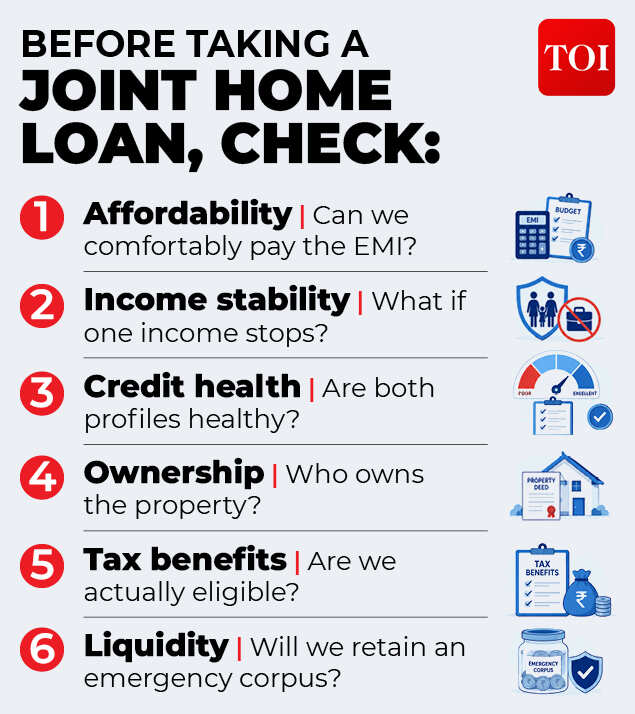
Before taking a joint home loan, check these things
– Joint borrowers can share the EMI burden: A joint home loan allows all co-borrowers to participate in servicing the loan. This can be particularly useful for dual-income households where all co-borrowers intend to contribute towards the household’s housing costs.– Joint borrowing can help maintain liquidity: Homebuyers often try to reduce their loan cost by making the maximum down payment, which in many cases can impact the household’s liquidity. In such cases, the right balance could be– Adequate down payment + sustainable EMI + adequate emergency corpus + continued investments: A joint loan can sometimes make it easier for a household to strike a proper balance because repayment capacity is supported by more than one income.– Female co-applicants can improve affordability: Many lenders provide interest rate concessions in case there are female co-borrowers. This can help save a significant amount during the loan tenure. Various government housing programmes promote female joint ownership, such as PMAY-Urban, which requires a female member of the family to be co-owner of the property.
Tax Advantages for Joint Home Loan Borrowers
A number of dual-income households opt for joint home loans to benefit from home loan tax exemptions. However, double tax benefits make sense only when applicable conditions are fulfilled.Under the Old Tax Regime, one can claim a deduction of up to Rs. 2 lakh on interest paid for a self-occupied property under section 24(b) and up to Rs. 1.5 lakh for principal paid under section 80(c). For joint home loans, all-co-borrowers can claim a deduction up to a maximum of Rs. 3.5 lakh each, subject to the amount they have contributed towards the repayment. However, this relaxation is not provided to borrowers who file income tax returns under the new regime. Under the new tax regime, section 24(b) has separate provisions for let-out property.Hence, borrowers should consider three parameters – loan liability, property ownership and actual repayment contribution to arrive at the optimum savings value rather than treating joint borrowing as an automatic tax-saving tool.
Who can benefit most from a joint home loan?
The usefulness of a joint home loan depends on the household’s income, liabilities, credit profiles, ownership structure and financial objectives. Dual-income couples with stable income profiles can increase eligibility, redistribute the EMI burden, improve repayment resilience and avail maximum tax benefits, if applicable. A parent-child joint home loan may help where the younger borrower has limited income or a relatively short credit history. However, the parent’s age can affect the available loan tenure and therefore needs to be factored in while assessing loan affordability.Some lenders also permit siblings to apply jointly, but this is not a universal rule across the industry. Joint borrowing can also be relevant where an NRI is purchasing property with a resident family member, provided they fulfil all required criteria set by the lender.
When to be wary of a joint home loan?
However, a joint home loan may not always be the right choice simply because you are eligible for it or the lender allows it. If the co-applicant has a weak credit profile, adding the co-applicant can influence the interest rate, making your loan costly or even leading to an outright rejection, which jeopardizes the entire home buying plans. A co-applicant with an uncertain income may also increase the risk for the lender, which can translate into a higher interest rate.When one of the co-applicants is near retirement, the current combined income can create a false sense of affordability. Also, the joint home loan may increase financial vulnerability when the joint home loan is used to buy a much more expensive property. Co-borrowers should understand the legal ownership requirements, repayment responsibilities and loan liabilities before signing the agreement.

How Lenders Perceive Joint Home Loans
Lenders fundamentally consider income and repayment capacity along with the credit history while assessing loan applications. An earning co-borrower can potentially strengthen the repayment profile, but lenders also assess the risks associated with the applicants and the property.Multiple incomes are beneficial only when they represent sustainable repayment capacity. The household needs to reassess beyond gross income and examine its net financial resilience for the loan.
In the end!
A joint home loan can be suitable for two financially healthy borrowers who combine stable incomes, share repayment obligations proportionately, structure ownership appropriately and use tax benefits efficiently. It may not be suitable for those households that may borrow a huge sum and stretch their finances beyond their sustainable budget. Assess your loan eligibility, repayment capacity and align your budget with your long term financial goals before opting for a joint home loan as an unplanned loan can increase your overall cost of the loan significantly.

