
Not long ago you could buy an N.B.A. team in the country’s second-largest city for just $2 billion.
Yet those days are already a thing of the past.
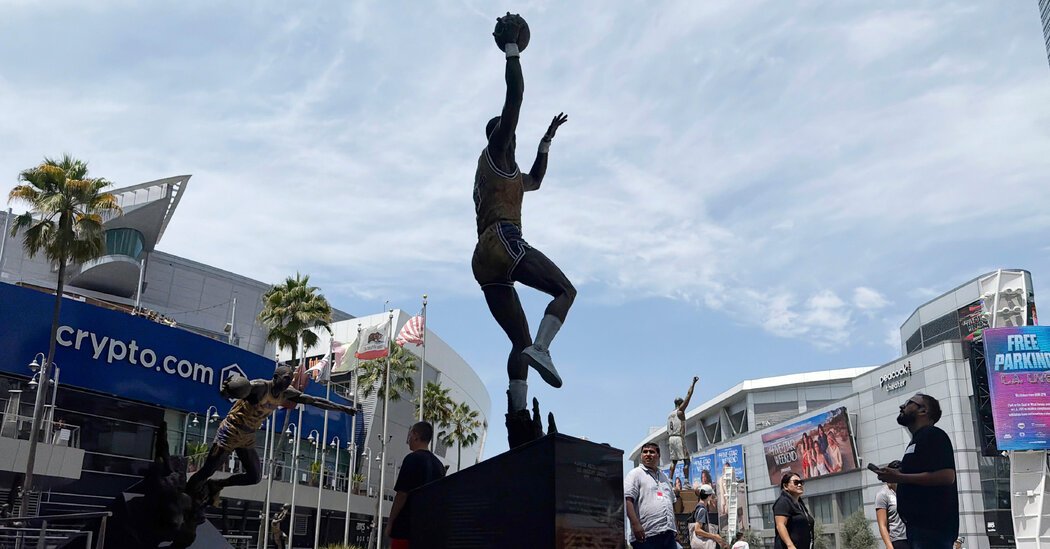
Bob Iger and Joshua Kushner announced this week that they had bought control of the Los Angeles Lakers in a deal that priced the franchise at $12.5 billion. It was a record figure for a National Basketball Association team, eclipsing the $10 billion paid for the Lakers just last year — and was the latest in a pattern of skyrocketing sale prices for sports franchises.
Is it mania or just a reasonable resetting of the market?
“Like anything else, it’s worth what someone is willing to pay,” Mark Cuban, the former owner of the Dallas Mavericks, said in an email.
Mr. Cuban bought the Mavericks from Ross Perot Jr. in 2000 for $285 million. When he sold a majority stake of the N.B.A. team to Miriam Adelson and her son-in-law Patrick Dumont in 2023, the team was valued at around $3.5 billion.
That same year, the N.B.A.’s Suns and the W.N.B.A.’s Mercury, both in Phoenix, were sold to Mat Ishbia, who had made his fortune in mortgage lending, for a valuation of $4 billion. Also in 2023, Michael Jordan, the N.B.A. legend, sold a majority stake in the Charlotte Hornets that priced the team at $3 billion — $2.7 billion more than he paid in 2010.
At the time, those numbers seemed outlandish, especially given the size of those teams’ markets.
It was only the start.
In 2025, Bill Chisholm led a group that bought the Boston Celtics at a $6.1 billion valuation, just a few months before Mark Walter, a financier, bought a majority stake in the Lakers with the team valued at $10 billion. N.F.L. teams sell much less frequently, but the Seattle Seahawks sold for $9.6 billion last month.
“I am absolutely convinced that we have not reached anything close to a ceiling,” said Irwin Kishner, a partner at the law firm Herrick and co-chair of its sports law division. And particularly with the most recognizable teams, he said, “you could only envision the numbers going further north.”
By that he means teams like the N.B.A.’s New York Knicks, the N.F.L.’s Dallas Cowboys and the New York Yankees of Major League Baseball. Indeed, the Yankees received a $2.6 billion investment this week that valued the franchise at close to $10 billion.
People in the sports industry said at least a few things had contributed to the rising prices.
Sports is one of the last big draws to live television, and as a result leagues — and therefore the teams — are being paid far more for the rights to air their games.
Mr. Kishner pointed to the N.B.A.’s recent TV rights package: an 11-year agreement with broadcasters worth about $77 billion.
The legalization of sports betting has also opened a new revenue stream for franchises, Mr. Kishner said. And then there’s the feeling that sports, as well as other live and in-person events, may be insulated from the impact of artificial intelligence. The deal for the Lakers was made by an arm of Joshua Kushner’s investment company that focuses on businesses it believes will not be significantly disrupted by the technology.
It probably doesn’t hurt, either, that billionaires have more money than ever — although many of the recent deals have involved investor groups, not individual buyers. On Friday, Jeff Bezos, the founder of Amazon and one of the richest men in the world, was part of a crowded investment group that joined forces to buy about a third of Liverpool Football Club.
“I do think that going forward, one individual writing a check for a team will be rare,” Mr. Cuban said. “Which brings its own inherent changes.”
Not everyone agrees this influx of cash is a good thing.
“Sport is the goose that laid the golden egg,” said David Andrews, a professor at the University of Maryland who studies the sociology of sport. He has wondered if fans will become disillusioned if sports leagues and teams become too commercialized or financially driven.
“But that doesn’t seem to have happened,” he said. “For whatever reason, the goose is kind of still alluring, and we’re still enchanted by the game despite its hyper-financialization.”
Bill Simmons, a media mogul and prominent Boston sports fan, has lamented that the superwealthy increasingly view sports teams as investments, rather than prized civic entities to protect.
“You still want to think that the people running the best teams actually care about those teams,” Mr. Simmons said during a recent episode of his namesake podcast. He said there seemed to be an era approaching where sports teams were “just giant hedge fund plays.”
He added: “Watching somebody flip the Lakers over a year and half, like he’s flipping a mansion in Bel Air or something, is bonkers. This is the crown jewel of the league.”
Mr. Simmons argued that Mr. Iger, the recently retired chief executive of Walt Disney, and Mr. Kushner, a venture capitalist, would also view the Lakers as simply a financial asset.
Mr. Kushner and Mr. Iger tried to soothe such concerns in a statement released after announcing their purchase. They said they were “deeply honored for the opportunity to become stewards of the Los Angeles Lakers.”
Some experts, including Mr. Kishner, said they would be surprised if Mr. Iger and Mr. Kushner sold quickly, or if many other primary owners of teams sold their majority stakes.
“I don’t think like the people that own these teams, that their motivation is to buy and flip,” said Diane Gotua, who led the N.B.A.’s global business strategy for almost five years and is now the chief commercial officer for the start-up Pro Padel League. “It’s almost like a legacy asset. It’s how they want to be known and remembered.”
Ms. Gotua lives in New York and saw the way the Knicks’ recent championship run captivated the city. She said that kind of response was what made an investment in sports teams different from other kinds of business deals.
“The eyeballs, the influence, the bringing communities together I think is really hard to replicate,” Ms. Gotua said, “because everything is so fragmented now.”

