
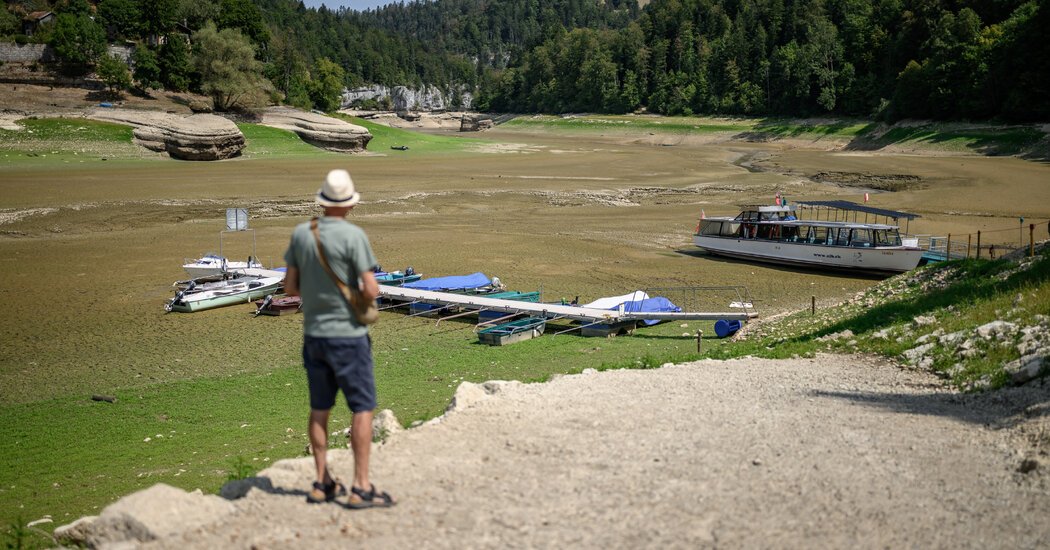
Europe is sweating through its fifth round of dangerously high temperatures since May, and for climate scientists, the only surprise is that anyone is surprised.
“We’ve said for years that the burning of fossil fuels will continue to warm the planet,” said Matt Patterson, a research fellow in climate science and machine learning at the University of St. Andrews in Scotland. “It’s the fossil fuels that’s causing this,” Dr. Patterson said. “In some sense, it’s that simple.”
But he and other scientists are also trying to crack a tougher puzzle. While it’s clear that global warming is adding extra heat to heat waves, researchers are also working to figure out how the atmospheric patterns that produce heat waves might be changing, and whether human activities are to blame.
Climate change, in other words, might not just be intensifying hot weather. It may be warping it as well, with Western Europe in particular suffering the effects.
For Europeans, this summer might be remembered for heating up early and barely letting up.
In France, temperatures broke daily heat records in late May before shattering monthly records in June and July. At its peak, the country’s two-week heat wave in June was hotter than an infamous 2003 hot spell that killed nearly 15,000 people in France and tens of thousands more in other European nations. And France’s latest heat wave, which began on July 28, has now surpassed the 2003 one in duration.
In England and Wales, average daily maximum temperatures were above normal every day in July, according to Britain’s Met Office. The number of days this year when temperatures exceeded 30 degrees Celsius, or 86 degrees Fahrenheit — a daunting threshold for Britons, less so for many Americans — had already set a record by early August, with several weeks of summer still to come.
The worst of these hot spells are the result of heat domes: giant masses of high-pressure air that become stuck in place, clearing the clouds and heating the land beneath them for days or even weeks at a time. When they alight on Western Europe, these systems block cool air from flowing in from the North Atlantic and can draw in more hot air from North Africa.
The weather patterns that create heat domes aren’t new, but today they arise on top of the warming caused by greenhouse gas emissions. That makes it more likely that heat waves reach record-shattering temperatures for long stretches.
But other environmental changes — natural, human-influenced or both — might also be causing heat domes to become more frequent and longer lasting. And it’s these changes that scientists around the globe are trying to puzzle out.
One change has to do with the Arctic. The differences in temperature between the hot Equator and the frigid far north help keep weather moving around the Northern Hemisphere. But with the top of the world now warming at several times the pace of the rest of the globe, those temperature gradients are narrowing. That might be causing the movements of weather systems to become more sluggish, producing more persistent heat waves.
In Europe, reduced air pollution could be having a similar effect. Industrial emissions can contain particles called aerosols that reflect sunlight. Curbing aerosols has improved air quality, but it may also have altered the way air moves across the continent.
Scientists haven’t come to firm conclusions about how these shifts might be affecting European summers, said Antje Weisheimer, a climate scientist at the University of Oxford. The complex, fine-scale interactions in the atmosphere that drive weather dynamics are tough to capture in computer simulations, Dr. Weisheimer said. “It’s tricky,” she said. “We’re making small progress.”
Dim Coumou, a professor of climate science at the Dutch university VU Amsterdam, sees artificial intelligence as one way forward. In a recent study, he and his colleagues used an A.I. algorithm to help a weather model better predict summer temperatures in Europe. They not only improved the model’s forecasts; they also discovered why some of the model’s predictions had been off: It misrepresented the way conditions in the western Pacific Ocean influenced atmospheric patterns that eventually made their way to Europe.
With A.I., “we can also learn what the climate models are missing,” Dr. Coumou said.
Ultimately, all this research is aimed at answering a vital question for Europe’s future: How often can the continent expect to be thrashed each summer by long hot spells? And how long might they last?
“If it’s a heat wave of a few days, society can cope much, much better,” Dr. Weisheimer said. But when extreme heat drags on for week after scorching week, “it’s a problem for agriculture, for water supply, for everything you can imagine.”

