
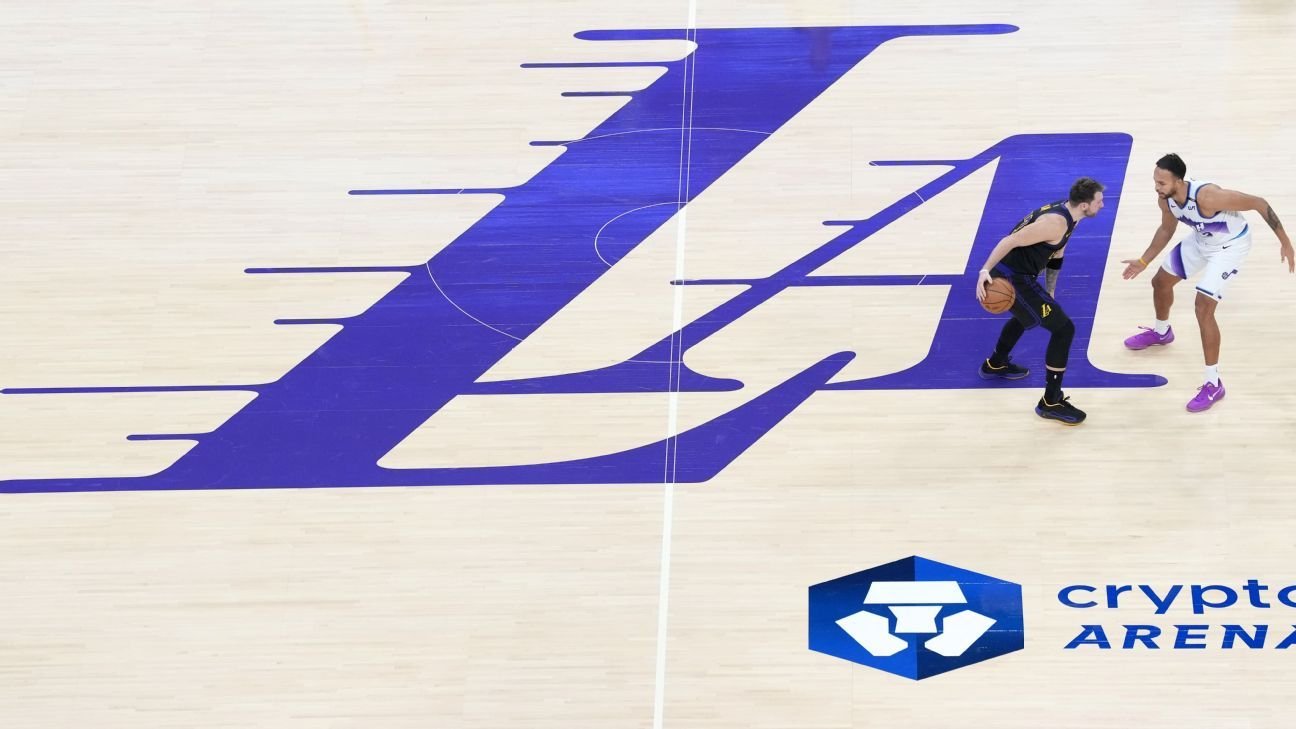
FIVE GAMES INTO last season, ownership of the Los Angeles Lakers franchise changed hands for the first time in nearly five decades. On Oct. 30, 2025, the NBA’s board of governors approved the sale of the Buss family’s controlling stake in the team at a record $10 billion valuation to businessman and Los Angeles Dodgers owner Mark Walter.
It was a unanimous vote and celebrated as a watershed moment in the sport. The league’s glamour franchise had graduated from the mom-and-pop operation it had been since Dr. Jerry Buss purchased the team in 1979 and left it to his children and entered into the deep-pocketed world filled with tech giants, private equity firms and commodity brokers with a proven winner in Walter as their guide.
Walter, whose TWG Global group had since 2021 owned 26% of the team, was welcomed with open arms. Not only were his Dodgers on their way to back-to-back World Series titles — giving the Lakers a glimpse of what they could achieve with his resources — but he demonstrated a reverence for the past, vowing to keep Jeanie Buss as acting governor for at least five more years.
“On behalf of Lakers fans everywhere,” Buss said in a statement, released shortly after the BOG meeting ratified the sale, “I am beyond excited about what our future has in store.”
That future ending up lasting less than 10 months.
Walter sold his interest in the Lakers on Wednesday morning to venture capitalist Josh Kushner and former Disney CEO Bob Iger at a $12.5 billion valuation, sources told ESPN’s Ramona Shelburne.
“Talk about a curveball,” one agent who has had clients on the Lakers roster within the last five years told ESPN.
“Josh and Bob obviously are very successful, but it’s a big equity check,” one member of a Western Conference team’s ownership group told ESPN. “Just curious how the deal is structured.”
The deal will still need to be approved by the league and the other owners, but it’s worth noting Iger and NBA commissioner Adam Silver have known each other for years.
The two worked closely over the years in negotiating the league’s television rights deals with ESPN and were praised for their partnership in restarting the 2019-20 season with a “bubble” hosted on Disney properties in Orlando, Florida, after a four-month hiatus because of the COVID-19 pandemic.
“Bob and Adam are close,” one league office source told ESPN. “They’re not just business close. They’re vacation-together close.”
Still, the idea that Iger would lead a group to buy the NBA’s marquee franchise wasn’t on anyone’s radar.
“The news shocked all of us,” another agent who currently has a client on L.A.’s roster, told ESPN.
For a franchise that has done its best to dull the shock receptors of its fanbase in the last decade by making the unexpected a regular occurrence — Magic Johnson’s abrupt resignation in 2019 and the Luka Doncic trade immediately come to mind — this still registered high on the scale.
“People don’t buy teams and turn around and sell them,” an Eastern Conference executive told ESPN. ” So there are obviously other factors driving this decision outside of just the mere fact that somebody showed up to pay $12.5 billion. Those factors have to be well outside of basketball.”
ESPN spoke to more than a dozen sources from around the league to try to make sense of the Lakers’ franchise flip and what the sale could mean for both the team and the NBA at large.
Why is Walter selling now?
Shortly after the sale was announced, Walter issued a statement to ESPN:
“Owning the Los Angeles Lakers has been one of the great honors of my life — an extraordinary investment, but what I will carry with me is the community, the fans, and a city that treats this team as family,” the statement read, in part.
It was extraordinary on various levels, chiefly that Walter was able to turn a $2.5 billion profit in just 14 months from the time he agreed to purchase the team in June 2025 to the sale this week.
Based on the timing and the enormous profit Walter made, multiple sources wonder what, if any, impact the ongoing federal investigation into his company, TWG Global, had on his decision to sell.
The Wall Street Journal reported last month that Walter was subject to a federal probe, which alleged his company had not disclosed $16 billion in loans funneled to Walter’s insurance firm, Delaware Life.
The Wall Street Journal also reported that Walter has been aware of the SEC probe since at least September and already had an electronic device seized as part of the search, so selling to Kushner and Iger could be motivated by the necessity to liquidate his prize asset, not just the opportunity to do so.
“It’s the ultimate trophy,” one prominent NBA agent told ESPN. “This isn’t like a building or a complex. Like, these are the L.A. Lakers. I almost laugh that he says, ‘It was an honor and a privilege to own the Lakers.’ Like, you didn’t own the Lakers! You rented them. You made a great business decision.”
What does this mean for the Lakers’ current leadership?
Shortly after the sale was reported, one longtime NBA executive wanted to know how the Lakers would be run under Iger and Kushner.
“The questions I’d ask all center around the Buss/[Rob] Pelinka roles moving forward,” the executive said to ESPN.
One of those questions was quickly addressed by Iger. In an interview with The California Post on Wednesday afternoon, Iger said Buss would remain in her post for now.
“We have every intention to honor the agreement that was made between Mark and Jeanie,” Iger said. “If things change, they’ll change, but we’re going into this with enormous respect and appreciation for who she is and what she represents.”
Another longtime agent, who currently has a client on the Lakers, told ESPN he believes Iger’s statement bodes well for Pelinka, who in 2025 signed a multiyear extension with the franchise. “As long as Jeanie’s in a good position, I think Rob is in a good position,” the agent said.
But another agent latched onto the conditional concession by Iger.
“I am curious to see how it goes the next six months,” the agent said to ESPN. “You assume Rob has six months to see how the season goes.”
Over the course of last season, Pelinka worked closely with several Dodgers front office members — president of baseball operations, Andrew Friedman; Dodgers special adviser Farhan Zaidi; and Dodgers executive vice president and chief marketing officer, Lon Rosen, who was named the Lakers’ new president of business operations in February.
The Dodgers, at 73-48, once again have one of the top records in MLB as they try for a three-peat. Friedman and Zaidi’s value is established with the baseball team, even if Iger and Kushner might have no use for them with the basketball team.
Meanwhile, in projecting what a new Lakers front office could eventually look like, multiple sources around the league suggested to ESPN that the recently retired Chris Paul could have a role.
Paul and Iger became close while the point guard played for the Clippers and Iger was a season-ticket holder.
Their relationship has only strengthened over the years, sources said, with Iger hosting a book launch event at his house in 2023 for Paul’s memoir, “Sixty-One,” and Paul visiting Iger at his Disney office in Burbank, California, in March to support his friend when he cleared out his belongings to close out a 52-year run with the company.
How about Luka Doncic?
Iger and Kushner are acquiring a franchise that has 17 championships and is now led by a 27-year-old Slovenian superstar in Doncic who is still searching for his first.
Doncic was not consulted about the sale, sources told ESPN, but he plans to have a video conference call with Iger and Kushner next week from Slovenia as he prepares to host his teammates for a minicamp in his home country.
Doncic offered his immediate thoughts on the news with a post on X on Wednesday morning.
Being a Laker means everything to me, and I’m excited to get back on the court and bring a championship to LA. I’ve gotten used to big changes over these last few years, but I know that no matter what, there is no limit to the potential of this iconic franchise. I look forward to…
— Luka Dončić (@lukadoncic) August 12, 2026
Pivoting to new bosses is nothing new for the six-time All-Star.
“The only constant in life is change,” a source close to Doncic told ESPN. “He’s had five owners now.”
Indeed, Doncic’s former team, the Dallas Mavericks, were sold by Mark Cuban to Patrick Dumont and the Adelson family not long before he was traded to L.A. And since arriving to the Lakers, the franchise’s deed has passed hands from Buss to Walter and now to Iger and Kushner.
Another source close to Doncic told ESPN that Doncic’s adaptability to work under a rotating cast of owners above him is not necessarily a unique trait among NBA stars who increasingly change teams — whether through free agency or trades.
“I don’t think this type of thing is really noticeable to the players,” the source said. “They got their team, they got their coach, they got their GM. They meet as a group. So, it’s not like the owners really are peering in on things. You just assume that the owners have the funding and the desire to win. And I think that’s pretty much what all the players care about — whether it’s Walter or Iger or Kushner or whomever else. ‘Are you going to give us the resources to win?'”
Beyond the basketball, the sale’s record valuation can only help Doncic’s business dealings as the face of the franchise.
“It’s certainly clear as well that the value of the Lakers brand, including in his new era, is unmatched,” a source close to Doncic told ESPN. “I think going from $10 billion to $12.5 billion [proves it].”
While Doncic was already being positioned as the team’s future from the moment he was acquired in February 2025, that perch was solidified last month when LeBron James left to eventually sign with the Philadelphia 76ers.
ESPN asked a source close to James if the sale had gone through sooner whether it could have had any influence on James wanting to stay in L.A.
“Maybe,” the source said. “But that’s tough to answer. Communication could have been better [with Iger and Kushner, compared to Walter]. Just a different relationship. But the basketball piece was the most important, so maybe not from that standpoint.”
Could this impact expansion?
Iger and Kushner had been pursuing ownership of the league’s future NBA franchise in Las Vegas — one of two cities, along with Seattle, expected to grow the league’s teams from 30 to 32 through expansion in the coming years — when the Lakers opportunity prompted a change in plans.
“We were involved in pursuing the new franchise in Vegas,” Iger told The California Post. “And while that happened, it was suggested to us that maybe Mark Walter would be interested in selling his stake in the Lakers. And we immediately decided that given the value of the franchise and the iconic nature of the team, that we would be really smart to pursue it. The deal came together in three days.”
One league office source also told ESPN that the NBA is prioritizing a Vegas sale before a Seattle sale to lock in a premium franchise fee that will set a precedent of what the NBA expects going forward.
While there are still several groups in the running for Las Vegas, even with Iger and Kushner out, it remains to be seen if any sale will be approved at the next BOG meeting.
“We’ll see what happens in September,” the source said. “If they took a vote today, it wouldn’t pass. … It’s all about the [fee price].”
Furthermore, several sources told ESPN that Silver and many of the league’s owners still view NBA Europe — a 16-team league set to launch in October 2027 that still has to finalize which international cities it will compete in — as a bigger priority.
Meaning that even if Iger and Kushner had ended up winning the Vegas bid, there would’ve been a substantial wait compared to the Lakers scenario they landed.
This sale ends Walter’s unremarkable tenure as Lakers owner, one that included the team hiking up season-ticket prices, laying off a group of long-term employees and cramming in a second row of courtside seats while winning one playoff series. But he was a bridge to this new ownership group, one that has deep ties to the league.
How this all goes for the Lakers is still to be determined. But the Walter era was undoubtedly a win for the NBA.
“Any numbers like $12.5 billion for a team are good for owners of an NBA team,” the exec from an Eastern Conference team told ESPN. “Look, the NBA continues to grow in value as an asset. The teams continue to grow because the business is performing really well. It’s probably better with the new players that have come in and the parity in the league, it’s probably a better product than we’ve ever had. … So, there’s a ton of interest in the sport. I think that’s now reflected in the value.”

