
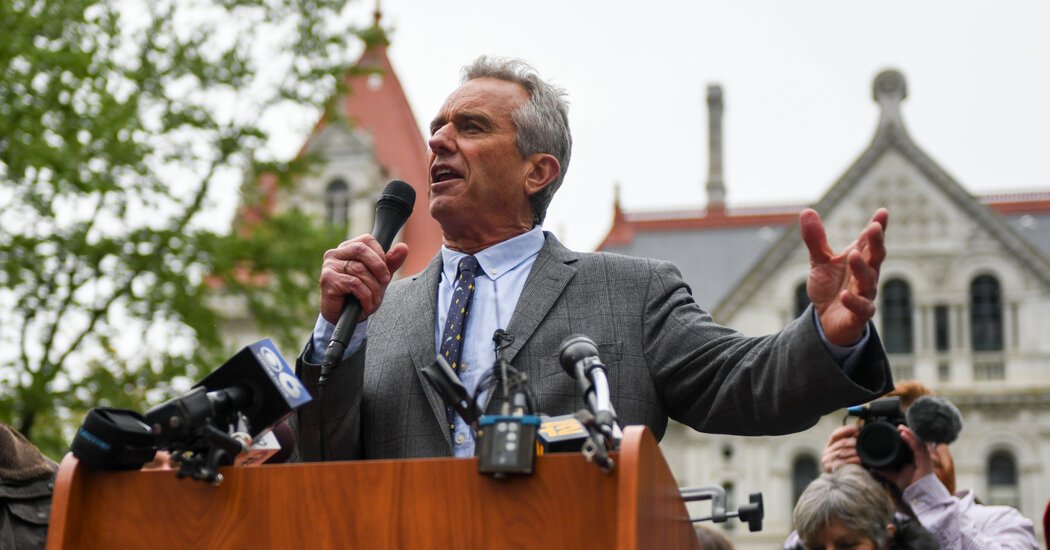
Pressed recently on whether he might accept responsibility for the resurgence of measles in the country, Health Secretary Robert F. Kennedy Jr. fended off any suggestion that his history of promoting vaccine skepticism might be partly to blame.
The groups facing these outbreaks were “almost all religious communities that just don’t vaccinate,” he told CNN’s Dana Bash.
“It’s hard to blame that on me,” he added.
But what Mr. Kennedy failed to acknowledge is his own role, and the role of Children’s Health Defense, the anti-vaccine group he once led, in stirring distrust in those very communities. That includes in Lancaster County, Pa., which is now at the center of one of the largest measles outbreaks in the country.
The state has reported dozens of hospitalizations and more than 230 cases, a number some local doctors consider to be a vast underestimate given that local Mennonite and Amish communities tend to avoid traditional health care.
Five years ago, Mr. Kennedy stood behind a wooden lectern on a farm in the county and delivered a warning to the local Amish community about the nation’s public health agencies.
“Those agencies are going to do everything in their power to make the Amish vaccinate,” he said. “Because they cannot stand the fact that you are healthy.”
A large crowd — 1,500 people according to a local paper’s account — spilled out from under a white tent at the annual farming fair to hear from Mr. Kennedy, then the leader of Children’s Health Defense. He turned to measles, a disease that was so horrible, he joked, that when he fell ill with it as a child he “had to stay home and watch TV the whole week.” The audience erupted with applause and laughter.
“The cure for measles is chicken soup and vitamin A,” he added.
Local leaders acknowledged that improving childhood vaccination rates has long been a challenge within the area’s Amish communities, where just a quarter of people have been vaccinated against measles, according to a 2025 estimate.
But they also said the work of anti-vaccine groups, including Mr. Kennedy’s visit with Children’s Health Defense, hadn’t made it any easier.
“All it takes is somebody like that, an anti-vaxxer, to make a personal appearance to a group who already has second thoughts about immunizations,” said Dr. Alan Peterson, a family medicine physician in the county and former medical director of a program that provided free vaccines to children in Lancaster County. “Some of them just say, ‘OK, that’s all I need to know and we’re not going to get our immunizations.’”
Emily Hilliard, a spokeswoman for the U.S. Department of Health and Human Services, said that under Mr. Kennedy’s leadership, the agency has mounted an aggressive measles outbreak response which has included investing more than $8.5 million to support affected communities and deploying experts to offer assistance.
She added that the department works “to ensure that all communities — including those who choose not to vaccinate — have access to appropriate medical care, including therapeutics.” Children’s Health Defense did not respond to a request for comment.
To those on the front lines of the Pennsylvania outbreak, Mr. Kennedy’s assessment of the current measles situation was off-base on several counts.
For one, area doctors pointed out that the virus wasn’t only spreading through insular religious groups, as he suggested on CNN, but also those in the broader community. The percentage of children vaccinated against measles has declined in the county — falling to 88 percent of kindergartners in 2025, down from 94 percent in 2019 — as it has in the United States overall.
Several local leaders who work with or are part of the area’s so-called plain communities — a group that includes Amish and Mennonite people, who often refrain from using consumer technology, dress modestly and adopt other lifestyle restrictions — also pushed back against the characterization that they simply refuse vaccines.
There are a variety of attitudes toward vaccines within these communities, though it’s true that vaccination rates tend to be lower. That is because of cultural skepticism toward secular authorities and because children often do not attend public schools, which require vaccinations, said Cory Anderson, who studies those groups at Penn State University.
But historically, the groups were more willing to accept vaccines when there were strong relationships with local doctors, community outreach and acceptance of the shots by local Amish leaders, said Dr. Jeffrey Martin, a physician at Penn Medicine Lancaster General Health.
“The Amish are not a group that simply doesn’t vaccinate,” he added.
Allen Hoover, an Old Order Mennonite, spent nearly two decades leading vaccination efforts as the administrator at Parochial Medical Center, a clinic that mainly serves the county’s plain community. Changing attitudes was a slow process that required gentle encouragement and frequent one-on-one conversations about the measles, mumps and rubella vaccine, which is highly effective at preventing infection and has an excellent safety record.
Gradually, as families saw children spared from the worst diseases, vaccination rates began to climb, he said. (The Pennsylvania Department of Health does not routinely collect vaccination data broken out by religion.)
“We had gained so much trust,” Mr. Hoover said.
Then the pandemic hit, bringing mask mandates, business closures and restrictions on church gatherings.
“It just really eroded the public trust, particularly in those communities, and really gave a stronger voice to those that were advocating for alternatives to the vaccination,” said Alice Yoder, the executive director of community health at Penn Medicine Lancaster General Health during that time.
Dr. Ken Brown, a retired scientist living in Lancaster County, remembered taking out an ad in 2021 to encourage vaccination in The Pennsylvania Busy Beaver, a publication that goes out to tens of thousands of Amish and Mennonite people in the region. Two trusted figures in the community had received their Covid-19 vaccines, he wrote, and “neither had a problem!”
The next month, Pennsylvania Coalition for Informed Consent — a partner organization of Children’s Health Defense’s Pennsylvania chapter — took out an almost identical advertisement captioned: “Vaccines can have unintended consequences.”
Distrust spread quickly from the Covid-19 vaccine to other routine shots.
“I would guess that we lost almost as much as we had gained in 20 years,” Mr. Hoover said.
Mr. Kennedy’s visit hammered home the message that public health officials — and the vaccines they promote — should not be trusted, said Dr. Peterson, the local doctor.
Dr. Richard Besser, former acting director of the Centers for Disease Control and Prevention, noted that Mr. Kennedy has a history of promoting vaccine skepticism in vulnerable communities.
He and other public health experts point to Mr. Kennedy’s visit to the Pacific island of Samoa in 2019, where he amplified doubts about the safety of the measles vaccine just a few months before an outbreak that killed more than 80 people. In the midst of a 2017 measles outbreak in Minneapolis within a Somali American community — where vaccination rates had fallen because of fears about autism — Mr. Kennedy visited to “discuss vaccine safety concerns,” according to a Children’s Health Defense post.
Even after Mr. Kennedy stepped away from Children’s Health Defense in 2023, the Pennsylvania chapter continued its outreach to the plain community at the same event he had attended.
The group posted a photo of their table at Family Days on the Farm in 2024, which displayed a poster titled “The Secret to Childhood Health Maybe as Simple As Just Saying No,” above graphs purporting to show better outcomes for unvaccinated children. Another poster advertised Mr. Kennedy’s book “Vax-Unvax: Let the Science Speak.”
The group purchased a table at the event again last month, even as measles cases were rapidly increasing.
“That is one of the modus operandi of the anti-vaccine movement,” said Dr. Peter Hotez, a prominent vaccine scientist who wrote a book about the rise of anti-science movements. “They try to take insular groups that may already be distrusting of either the federal government or health care and they’ll exploit that.”
As outbreaks rage on in the United States, Mr. Kennedy has offered stronger endorsements of the M.M.R. vaccine on social media and during TV interviews. But the Amish community in Lancaster — which does not use social media or own televisions — are unlikely to have heard that message.
Mr. Hoover said he thought that if Mr. Kennedy were to reach out directly to strongly encourage measles vaccination, it would “actually make a difference,” because of his influence with some community members.
Ms. Hilliard, the H.H.S. spokeswoman, declined to comment on whether Mr. Kennedy would do so, but said that the department’s measles response has involved reinforcing that “M.M.R. vaccination remains the most effective way to prevent measles.”
Public health experts said they thought a visit to Lancaster County was unlikely, given Mr. Kennedy’s track record as health secretary, which has included minimizing measles outbreaks, promoting unproven treatments for the virus and undermining confidence in childhood vaccines.
“Every now and then, Kennedy will be dragged in front of the camera and begrudgingly make some offhand positive comment about the M.M.R. vaccine,” Dr. Hotez said. “But that’s about the best you’re going to get out of him.”

