
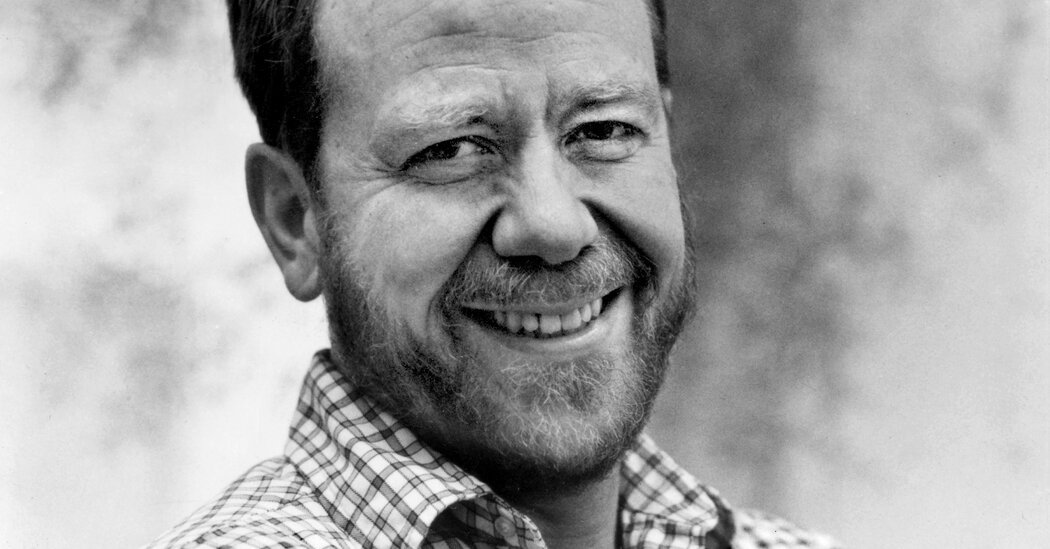
Richard Lingeman, a magazine editor who wrote an acclaimed study of small-town America and biographies of Theodore Dreiser and Sinclair Lewis that helped revive interest in those once-towering American novelists, died on July 5 in Manhattan. He was 95.
His death, at a hospital, was confirmed by his daughter, Jenifer Lingeman. He lived on the Upper West Side.
As a journalist, Mr. Lingeman had an eclectic career. In the late 1950s, he and Victor S. Navasky founded the satirical magazine Monocle. He went on to serve as an editor at The New York Times Book Review and, in 1978, was named executive editor of The Nation, the left-leaning political magazine then led by Mr. Navasky.
After 18 years as executive editor, Mr. Lingeman stepped down to become a senior editor at the magazine, a position that gave him more time to write books.
His most notable early work, “Small Town America: A Narrative History 1620-the Present” (1980), examined the development and decline of American towns, from the earliest Puritan settlements to the Midwestern trading centers and the cow towns and mining camps of the West.
Incorporating observations from authors like Mark Twain, Sherwood Anderson, Booth Tarkington, Edgar Lee Masters and Willa Cather, Mr. Lingeman showed readers what they might find in a Midwestern general store; how railroads filled countless towns with European immigrants; and how the industrial revolution bore down on those towns, spelling obsolescence for many small farmers and craftsmen.
The book was not a sentimental portrait of neighborly communities where residents gather around a piano in the parlor and eat peach ice cream in summertime. “Small Town America,” the critic John Leonard wrote in The New York Times, presented a world of “authoritarians and conformists, speculators and real-estate sharpies, absentee landlords and vigilantes, bankers without enough money and railroad entrepreneurs with too much money, bribery and racism and false fronts and a class system as oppressive as anything to be found in old Europe.”
Mr. Lingeman branched into biography with two volumes devoted to Mr. Dreiser, a fellow Hoosier whose early 20th-century novels “Sister Carrie” and “An American Tragedy” were initially denounced as blasphemous and obscene for plotlines that included premarital sex and premeditated murder.
Mr. Dreiser’s works often featured ruthless working-class social climbers and took readers to unrefined environs like flophouses and factories. They came to be regarded as contemporary classics, in part for bringing a new kind of realism to the exploration of class and the American success story.
In “Theodore Dreiser: At the Gates of the City, 1871-1907” (1986) and “Theodore Dreiser: An American Journey, 1908-1945” (1990), Mr. Lingeman praised Mr. Dreiser for his role in elevating American literature.
“Out of his passions, contradictions and suffering,” Mr. Lingeman wrote in the second volume, noting Mr. Dreiser’s bouts of debilitating melancholy and volatile romantic affairs, “he wrenched the art that was his salvation from the hungers and depressions that racked him.”
The novelist Cynthia Ozick, reviewing the first volume in The Times, complained that the biography did not sufficiently strive to resolve the great Dreiser riddle: How could “a workhorse daily journalist” possibly “transform himself into a novelist of such encompassing, gritty, recalcitrant power”?
Yet the writer and literary critic Alfred Kazin, also writing in The Times, called the complete work “a fascinating documentation of the most troubled life led by any important modern American writer.”
After his works on Mr. Dreiser, Mr. Lingeman pursued another biography — of Sinclair Lewis, a Minnesotan who was the first American writer to win the Nobel Prize in Literature and whose novels, set in the Midwest — including “Main Street,” “Elmer Gantry” and “Babbitt” — concerned conformity, provincialism, middle-class materialism, hucksterism and hypocrisy.
“Sinclair Lewis: Rebel From Main Street” (2002) was part of Mr. Lingeman’s lifelong pursuit to “understand the role of the small town in American history,” he said. It also attempted to repair Mr. Lewis’s reputation after Mark Schorer’s exhaustive 1961 biography, “Sinclair Lewis: An American Life,” seemed to Lewis admirers to unduly emphasize the author’s personal failings.
“It rather depressed me,” Mr. Lingeman said of the earlier biography in a 1995 interview with the Sinclair Lewis Society Newsletter. “I think Schorer showed a failure of sympathy, at times a simmering hostility, to both the man and his works, that now seems excessive.”
Allowing that “Lewis’s life was often sad and self-destructive,” he also noted that Mr. Schorer had overlooked what a first-tier satirist and political and social critic Mr. Lewis was: “He was a funny man, as well as a trenchant critic of American flaws, which he knew as well as a rejected lover knows his mistress’s body.”
By the time Mr. Lewis died in 1951, his literary style had fallen out of favor. Mr. Lingeman’s sensitive portrait, which highlighted Mr. Lewis’s intelligence and insight into human frailty, spurred a rethinking of his influence, especially in works like “Ann Vickers” and “Kingsblood Royal” that touched on feminism and race.
Writing in The Los Angeles Times, the author Keith Taylor called Mr. Lingeman’s book “the most important re-evaluation of Lewis in more than a generation,” adding that he demonstrated convincingly that Mr. Lewis had influenced writers as varied as Richard Wright and John Updike.
Richard Roberts Lingeman was born on Jan. 2, 1931, in Crawfordsville, Ind., about 50 miles northwest of Indianapolis. He was the younger of two sons of Byron Lingeman, an eye, ear, nose and throat doctor, and Vera (Spencer) Lingeman, who managed the home.
At Haverford College, near Philadelphia, he majored in sociology and minored in American literature. In college, he told the C-SPAN host Brian Lamb in 2002, he was surrounded by Eastern prep school graduates “who seemed somehow to my naïve eye to be suaver and more cultured.” Writing a biographical study of Mr. Lewis for his senior thesis, he said, was his way of developing his own “sense of identity” as a Midwesterner.
After graduating in 1953, he spent three years in the Army and was assigned to the counterintelligence corps, which he called “an appalling hotbed of McCarthyism.” He was also sent to Japan, he said, to spy on ultranationalist groups.
Following his discharge, he attended Yale Law School and quickly realized he was not cut out to practice law. During that time, he started Monocle with Mr. Navasky, a fellow law student. The first parody that Mr. Lingeman wrote was of T.S. Eliot’s poem “The Waste Land.”
Mr. Navasky raised the money to publish Monocle as a “leisurely quarterly” and set up shop in New York City, where it attracted contributors like the cartoonist Edward Sorel and the humorists Calvin Trillin and Dan Greenburg. It saw a brief swell of attention during the 1963 newspaper strike, when it produced parody issues of The New York Post and The Daily News under the names The Pest and The Daily Noose. But it could never quite establish itself on a sound financial footing.
Mr. Lingeman freelanced for other publications and wrote two books, about prescription drugs (“Drugs From A to Z,” 1969) and America’s home front during World War II (“Don’t You Know There’s a War On?,” 1970).
In 1969, he joined The Times Book Review, where he remained for nine years, assigning reviews and compiling a weekly column of publishing news, “Book Ends,” before Mr. Navasky recruited him to serve as the executive editor of The Nation.
Mr. Lingeman married Anthea Nicholson, a British graphic designer, in 1965. In addition to his daughter, she survives him.
His last book, published in 2012, was “The Noir Forties,” an examination of how a moody and often cynical film genre that flourished after World War II reflected the anxieties of battle-scarred veterans, a repressive political period and the Cold War in an atomic age.
Ash Wu contributed reporting.

