
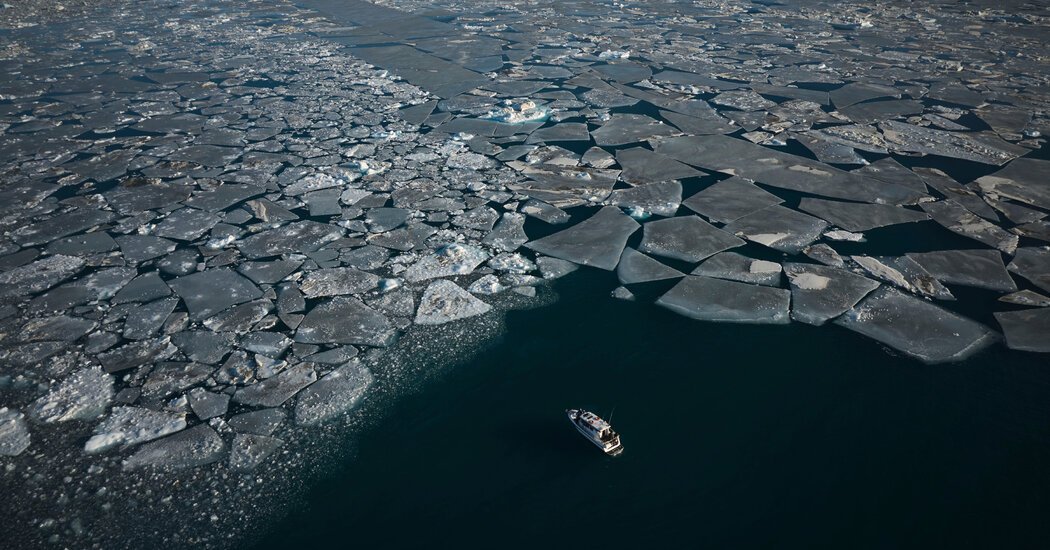
The Trump administration has pulled federal funding for an annual report chronicling the changing environment of the Arctic, where rapid warming is upending ecosystems, reconfiguring trade routes and scrambling Great Power strategy.
Every year for the past two decades, the Arctic Report Card has provided a checkup on the health of the region, which is heating up at several times the pace of the rest of the globe. Sea ice has dwindled. Snow cover has shrunk. Glaciers are thinning out. Tundra vegetation has grown more abundant, leading to wildfires that burn through huge areas.
Now, the report’s coordinator and publisher, the National Oceanic and Atmospheric Administration, is withdrawing its support for the report card. In a statement on Tuesday, Kim Doster, the agency’s director of communications, didn’t provide a reason.
“Coordination of the 2026 Arctic Report Card will not be facilitated through NOAA,” Ms. Doster said. “All data historically contributed by NOAA to the product will continue to be collected and will remain publicly available.”
In her statement, Ms. Doster said other NOAA programs would continue to support research in the Arctic that contributes to “national security, weather prediction, safety of navigation and the economic vitality of coastal communities.”
Politico first reported that NOAA was ending its support for the report.
Each year’s Arctic Report Card compiled data collected by many researchers and multiple agencies in addition to NOAA. It drew on the expertise of hundreds of scientists and other specialists around the world. Its aim was to document the extraordinary transformation of a region where human activities — fishing, shipping and mineral exploration, to name just a few — are uniquely dependent on environmental factors.
The broad importance of climate and ecological changes in the Arctic is why NOAA worked to ensure that each year’s report would be relevant to many kinds of people and organizations, including Indigenous communities, businesses and the military, said Rick Spinrad, the oceanographer who led NOAA during the Biden administration.
And yet, because the Arctic is such a bellwether of the effects of global warming, the report card was a natural target in the Trump administration’s efforts to root out what it calls climate alarmism, Dr. Spinrad said. “It’s another inane step in this administration’s turning a blind eye to climate change, among other environmental issues.”
Even if NOAA continues taking the measure of changing Arctic conditions, its withdrawal of funding for the report card leaves Americans without the context for understanding those observations, Dr. Spinrad said. “The taxpayers assume the data are there and really need the analysis and the interpretation,” he said.
President Trump’s second administration has undermined efforts across the federal government to study climate change and share information about its consequences.
It stopped updating a federal database that tracked the costs of hurricanes, floods and other disasters that caused more than $1 billion in damage. It killed a first-of-its-kind assessment of the health of nature in the United States. It dismissed the hundreds of scientists and experts who had been working on the latest National Climate Assessment, the government’s flagship report on how climate change affects the country. Later, the administration appointed a critic of mainstream climate science to lead the agency that compiles that report.
Several of those initiatives have since been reincarnated outside of government. Those examples suggest possible ways forward for the Arctic Report Card as well, said one of the report’s editors, Twila Moon, a climate and earth scientist at the National Snow and Ice Data Center, which is part of the University of Colorado Boulder.
Dr. Moon and the other editors will be working with the report’s lead authors to evaluate potential new homes for the Arctic Report Card, she said, “in hopes that we can find a way to still serve this information to people.”

