
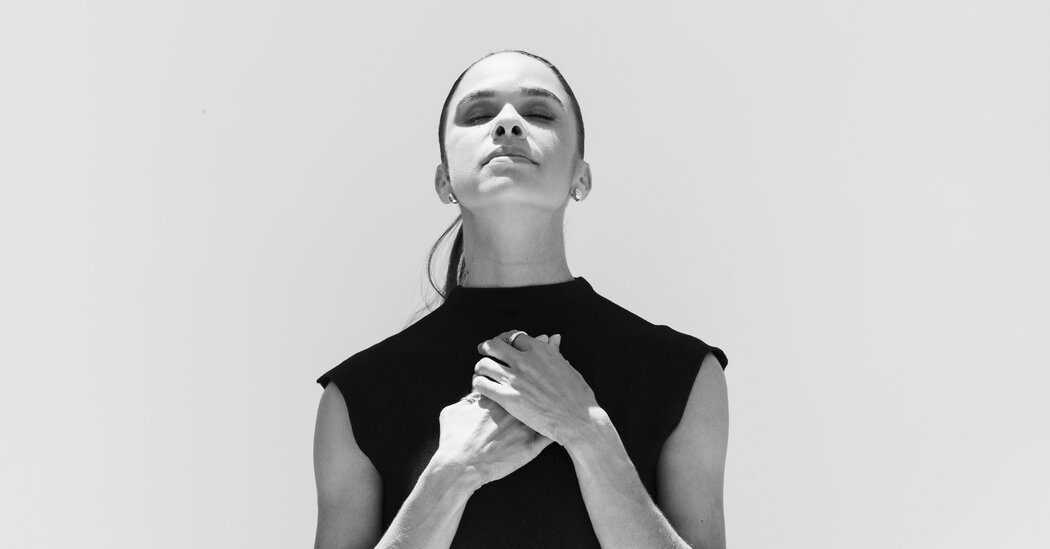
Misty Copeland may be one of the most recognized dancers in the world, but she still has new territory to conquer: curation. For the annual Ballet Festival at the Joyce Theater this year, Copeland, who recently retired from American Ballet Theater, is helming two weeks of dancing by a dizzying array of performers with established and up-and-coming choreographers.
“I think the goal here is not to define one path or future for ballet,” she said in a video interview. “It’s to show that ballet’s future can hold so many different voices and identities and aesthetics and experiences, and that it should be as rich as our world.”
This is Copeland’s first time organizing a festival, apart from Ballet Across America, which she programmed with the choreographer Justin Peck at the John F. Kennedy Center for the Performing Arts Center in 2017. “That was way less involved than this,” she said.
For the Ballet Festival, which opens Tuesday, she worked closely with Danni Gee, director of programming at the Joyce, and Ross LeClair, the theater’s producer. “I’m still new to curating and building in this way,” Copeland said. “I have my grand ideas, but to have them really help me shape it has made it what it is.”
Gee said: “The theme of the show is uplifting everyone. It’s about all of us together, not just all African-American or this or that.”
“I know it’s the world that I want to live in,” she added. “It’s the world that I want to see onstage.”
Copeland’s lineup includes the Paris Opera Ballet étoiles Guillaume Diop and Sae Eun Park in “Romeo and Juliet” and “Thaïs”; Taylor Stanley, the New York City Ballet principal, in solos by Kyle Abraham and Andrea Miller; selections from Dance Theater of Harlem’s “Firebird”; and Hubbard Street Dance Chicago’s Shota Miyoshi in Bob Fosse’s “Percussion IV.”
One goal was to showcase different generations of choreographers: Ingrid Silva, who recently retired from Dance Theater, and James Whiteside, a Ballet Theater principal, will show short works along with the veteran Alonzo King.
Copeland also chose to commission premieres by up-and-comers: There will be works by Ilo, an Atlanta-based choreographer, who works in house dance; and Aleisha Walker, a member of American Ballet Theater. “It was really important to me that I was giving opportunities to younger dancers,” Copeland said.
A driving focus, onstage and off, in her life after dancing is young people — including young readers. This fall Copeland has a book coming out for middle schoolers called “Firebird Waltz.” Set in a performing arts academy, the story is about students who find out that their school is magical; their mentor is secretly a firebird.
“They’re honing these skills in this performing arts school, but their art is their magical powers,” she said. “They’re like little superheroes.”
It’s part of her bigger plan. “I feel like everything I’m doing is connected to ballet in some way and will have different layers and levels of impact,” she said. “How are we using ballet in different spaces?”
But first: the Joyce festival. In a recent conversation, Copeland spoke about it and about ballet’s potential reach beyond it. What follows are edited excerpts from that interview.
What were you thinking for this festival?
I went into this coming out of my farewell performance. I was like, What is the point of this A.B.T. farewell performance? Initially, I wanted to do all these things around what I think the future of ballet should be. I was like, I don’t want my farewell performance to be about me. And everyone’s just like, “What are you doing? Let’s celebrate what you did do and close that.”
So this is an extension of your ideas for your farewell?
All of these thoughts were kind of manifesting during that time. This was just the perfect outlet to be able to do a lot of different things.
For example?
I really wanted to center Black, brown and queer artists. My initial thought was, how do we bring together artists from different worlds and backgrounds and generations? I just ran home from a lunch with Ilo, [who uses they/them pronouns]. I really feel like I’ve taken them under my wing. This is a big experience for them.
How did you get to know Ilo?
Maybe two years ago I was at Emory in Atlanta speaking. One of the highlights was getting to meet one of their star dancer-choreographers, and it happened to be Ilo, who showed one of their works. I was just so blown away. They were the first person I thought of when the Joyce came to me with this opportunity.
Do you find that you’re more drawn to contemporary ballet at this point?
Absolutely. And I definitely was pushed by Danni and Ross not to exclude the classics, which are such a big part of my journey and I think are important for the future of classical dance, clearly. But it was important to find the right pieces that would work with the vibe of who’s performing them as well.
Did the dancers choose their repertoire with you?
We started with a list of dancers that I was interested in having and then started assigning things. Of course that didn’t work! For a variety of reasons.
Logistically and time-wise, it can be difficult for dancers to learn new works.
It’s just so hard, the puzzle pieces of all of these dancers all over the world. But it’s also nice to have people be able to do things that are meaningful to them, that they have experience performing.
How much time will you spend at rehearsals?
There are rehearsals that I am attending. I also don’t want to get in the way. I want people to feel support, but I also don’t want them to feel like, I don’t know, any other thing. I’m not trying to like give my input or feedback. It’s like, do your thing.
In all this time, you’ve never produced a “Misty Copeland and Friends” show. Is that not your thing?
I definitely will never do a “Misty and Friends.” I think it implies that I would be at the center of it, dancing, and I definitely don’t want that. I’ve been thinking about curating something that’s broader, so it wouldn’t just be dancers; it could be visual artists, it could be vocalists.
And if I were to be a part of it, I would want to be very small, dip my toe in. I would like to be able to I use my connections and my platform to bring attention to it. I want to be able to use my influence in different ways.
What do you see as your responsibility toward dance?
It’s about creating opportunity. It’s about creating access. It’s about continuing to not just be a voice in my time, but how are we setting up the next generation? That’s been important to me throughout my whole career. How am I continuing to change the way people view it in other communities and other parts of our country? I hope I will be changing what access looks like in ballet.
You’re on the board of Ballet Theater. How else are you involved?
I’ve kind of been designated the ABTKids host for the kids show that they do. It’s such a fun experience. I mean, it’s full of kids, right? And they’re talking and yelling, and they’re in it. I did my very first bit of “Swan Lake” for a kids show.
How did it go?
I’ll never forget it. The host explains the different pieces and gets everyone excited, and then the dance happens. So they’re told a swan is coming, and I come out, and a little girl in the balcony starts screaming, “Where is the swan? Where is the swan?” Like thinking that a real swan was going to come onstage. She was so disappointed. [Laughs] I was like, Oh my God: If I can do this … I did it.

