
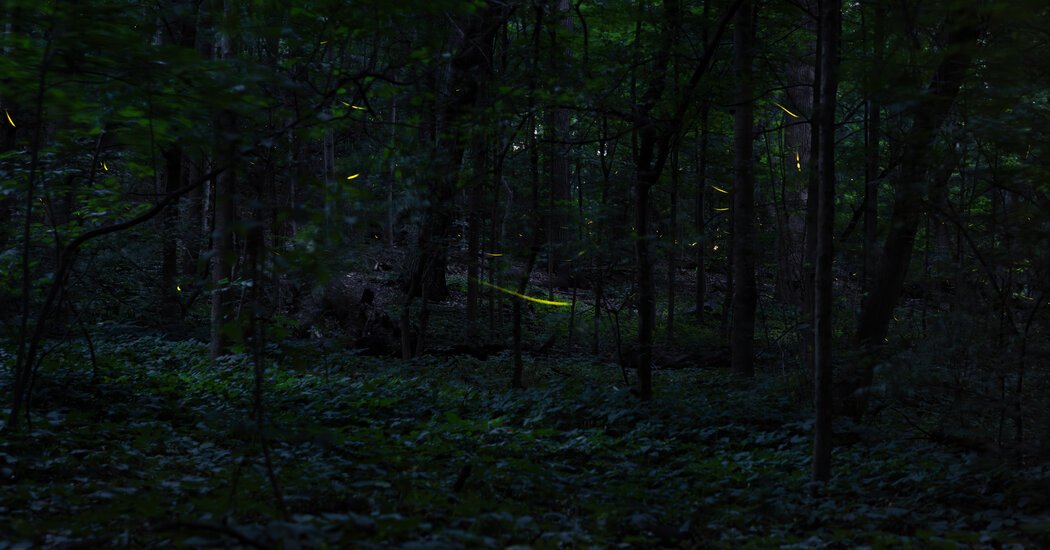
Recently at dusk, a small garden, which is tucked between the cacophonous congestion of the Brooklyn-Queens Expressway and the industrial hustle of the Brooklyn Navy Yard, has been aglow with fireflies.
Avvah Rossi, the director of horticulture at the Brooklyn Greenway Initiative, a nonprofit working toward a scenic waterfront path for walkers and cyclists that would go around the borough, noticed the spike in fireflies about three years ago. “And this summer has been no exception,” she said.
The fireflies have been congregating at the centerpiece of Brooklyn’s ongoing nature trail project. It’s called the Greenway Botanical Garden at the Naval Cemetery. The nearly two-acre green space, which still has about 500 military personnel from around the 19th century interred there, now features native plantings, including tall grasses and wildflower meadows, along with a wooden plankway encircling it.
Ms. Rossi attributes the fireflies’ summer light show to the initiative’s careful stewardship of the land, which involves letting much of its native vegetation decompose organically. Fireflies, which are technically beetles, thrive on the resulting rich soil, she said.
They spend most of their lives — two years — underground in their larval stage, “so the soil needs to have enough life in it to support them,” she said. By the time they are airborne adults, they are interested only in mating and don’t eat that much, occasionally sipping on water or plant nectars, she said.
Recent firefly swarms in the city are somewhat of a mystery. There is no official data to indicate whether the presence of fireflies is increasing, according to the Xerces Society, a nonprofit that advocates for insect conservation. Richard Joyce, a conservation biologist who coordinates the group’s tracking of the insects, said that he depended on volunteers across the country to help document them.
“What we have to work off of are the impressions of people,” he said. “And one thing that I think about sometimes is that decades ago, when habitats were less altered, when life was easier for fireflies, seeing them wouldn’t be something that you’d remark about.”
Fireflies thrive in a warm, moist environment. And although New York City’s recent designation as a subtropical climate may help explain their highly visual appearances over the past few years, climate change also poses a threat to them, said Jessica Ware, who leads the division of invertebrate zoology at the American Museum of Natural History.
“What’s happened is we’ve had a few moist springs,” Dr. Ware said. “Having a moist spring when the larvae can eat slugs and do their business before they get to the adult stage” is ideal, she explained. But hotter temperatures can also pose a problem for them, drying up or flooding their food sources during the larval stage.
About 18 of the 132 firefly species in North America that have been assessed are under threat, according to Xerces. The most vulnerable populations in the Northeast and mid-Atlantic regions tend to live in salt marshes, a rapidly disappearing habitat, Mr. Joyce said.
In New York State, there are about 40 known species. But the one most out and about in the city, including in industrial Brooklyn, is the Big Dipper, aka Photinus pyralis, aka the common eastern firefly. “It’s very tough and adaptable,” Mr. Joyce said. “You have to be tough to live in New York City, and that’s true for firefly species as well.”
Big Dippers adapt easily to human environments, and they also have a large range, from major cities such as Dallas and Atlanta, all the way down to Northern Mexico, Mr. Joyce said.
They light up around sunset, and “are calibrated to flash and find a mate,” he said. Many fireflies need complete darkness to light up, but not the Big Dipper, which seems to be unbothered by the city’s bright lights and honking horns.
Fireflies have only a few weeks to live after they emerge from the ground. “The males, once they’ve done their duty, that’s the end of their life cycle,” Ms. Rossi said. “The females are going to lay their eggs in the soil again.” Then, it’s lights out.
Robert F.C. Naczi, the curator of North American Botany at the New York Botanical Garden in the Bronx, has been conducting an inventory of beetles within the garden’s 50-acre forest since 2009 with a colleague. They have found at least four firefly species there.
Dr. Naczi observed that two species that do not light up are gone by late spring, while those that sparkle and glow, like the Big Dipper, tend to peter out by the first two weeks of August.
New Yorkers who want to see them should keep their eyes peeled in green spaces across the city around sunset, and hope to happen upon that two-week window, which will close soon for the season, when they are aloft.
Fireflies can have a magical and calming appeal, Mr. Joyce said: “It’s amazing that an insect in the night can just change our mood and affect our emotions in the way that they do.”

