
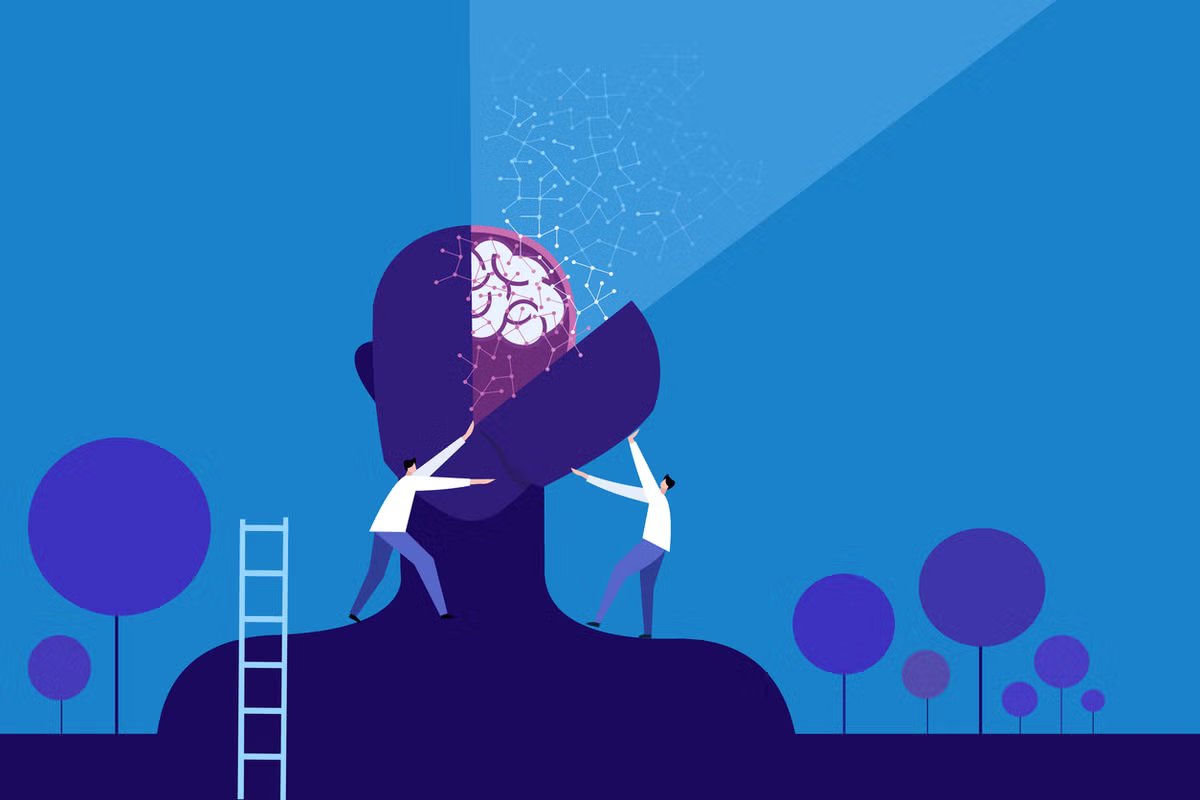
Have you ever heard the phrase “you only use 10% of your brain”? In reality, there is no way of measuring the percentage terms of consciousness – partly because the brain has no static baseline.
However, there is a general consensus among neuroscientists now that most of the brain’s processes are unconscious. That doesn’t mean you’re not using most of your brain though – it means there’s much more happening than you’re probably aware of.
Modern cognitive neuroscience has brought us right back to Sigmund Freud’s psychoanalytic view of the unconscious mind. This is partly because the once-thought untestable theories are gaining scientific ground.
Freud, in 1895, proposed that the unconscious mind hides sexual and aggressive wishes, in his book with his colleague Josef Breuer Studies in Hysteria. They wrote that mental health symptoms like anxiety, phobias and compulsions emerge from unresolved unconscious thoughts.
Freud’s model (conscious, preconscious, unconscious) – maps onto our current understanding of memory. Nobel laureate, neuroscientist and psychoanalyst Eric Kandell says we have declarative and non-declarative memory processes. Declarative memory recall is conscious, like trying to remember the sequence of numbers on your credit card. Non-declarative memories involve unconscious, automatic recall.
And Freud’s structural model of the mind again arguably fits in with our understanding of cognition.
Freud proposed id made up the primitive part of your psyche and that the superego stands for our moral consciousness. Last, your ego mediates between your id and super ego. His idea of the id could be equivalent to unconscious neural processes – although there are convincing arguments that pleasure processing in the id is conscious too. Ego could also be represented by metacognition (awareness of your own thought processes) which is linked to the brain’s prefrontal cortex, right behind your forehead.
The superego could be reflected in the brain’s limbic system, which regulates your emotions and behaviour, and tells you whether something feels good or not.
However, behaviourism became dominant in the 1920s, with psychologists like J.B. Watson, in his “behaviourist manifesto” championing the view that only measurable behaviour should be considered in science.
The unconscious brain is back
From the 1980s it became clearer that people’s decision making and behaviour could be influenced without their awareness.
Later, it was also clear with neuroscience experiments and brain scanners, as my team and I showed in two meta-analyses, that both unconscious memory and conscious memory play a role in brain processes. For example, neuroscientists can show study participants hidden flashes of “subliminal” happy or horrified faces and the person will have no conscious recollection of the faces. But their amygdala (the arousal region of the brain) will show increased activation, which can influence people’s decision making.
Psychologist Daniel Kahneman in his 2011 book Thinking Fast and Slow built on some of Freud’s ideas of primary and secondary processes. He proposed we have two modes of thinking where system 1 is a fast process that is impulsive and largely unconscious, whereas system 2 is a slow process that takes effort. The secondary process is reserved for when you need to pay attention to something new, dangerous or uncertain.
What neuroscience can tell us about the unconscious mind
Essential functions, like heart rate, body temperature, hunger and thirst regulation are unconsciously rooted. Similarly, coping strategies to diminish painful feelings, learned in early childhood, are not necessarily conscious. Infantile amnesia occurs until about three years old but remain in our unconscious brains for life. However, some aspects of unconscious processes could be brought into conscious awareness via talking therapy.
Other theories about how the conscious and unconscious brain areas interact, come from two prominent ideas. The Global Workspace Theory (GWT), and the Intergrated Information Theory (IIT).
GWT proposes that the mind is like a theatre stage, where the unconscious agents are busy behind the scenes making sure that the “conscious spotlight” on stage is in the right place.
IIT suggests that there are gradients of consciousness. The degree and complexity of integration between brain regions determines how “much” consciousness (“phi”) an organism has. So for example, a human with a complex network of brain regions has more “phi” than, say, a sea slug with far fewer connections. However, the problem with this theory, is how to validate the “amount” of consciousness different species have.
The founder of neuropsychoanalysis Mark Solms – along with neuroscientist and psychoanalyst Karl Friston – in 2010 pioneered a new theory integrating the idea that unconscious activity is the major force influencing our conscious decision making. In my view, it’s the best model we currently have.
This theory – called the Free Energy Principle (FEP) suggests the brain’s main role is to predict what will keep you alive and feeling good, within the predictable bounds we have evolved to survive in. Most of the time we do this unconsciously, with an internal model of the world, as well as pages of memories from our evolutionary rulebook.
Samantha Brooks is an Associate Professor of Cognitive Neuroscience, Liverpool John Moores University. This article was first published by The Conversation and is republished under a Creative Commons licence. Read the original article.
But when something uncertain or surprising happens, it is like free energy in the brain that is not bound to a prediction. This causes our brains to be ultra-conscious for a brief period of time to create a new prediction that binds our thoughts, costing the brain a lot of energy. As Kahneman stated, we do sometimes need our conscious brain to help make more difficult decisions for us, when there are many unknowns.
More recently, consciousness research has started to move away from humans altogether. Solms has argued it is possible to give AI consciousness. If he turns out to be right, then according to his own work, the unconscious processes of AI entities will be shaped by their interactions with us.

