
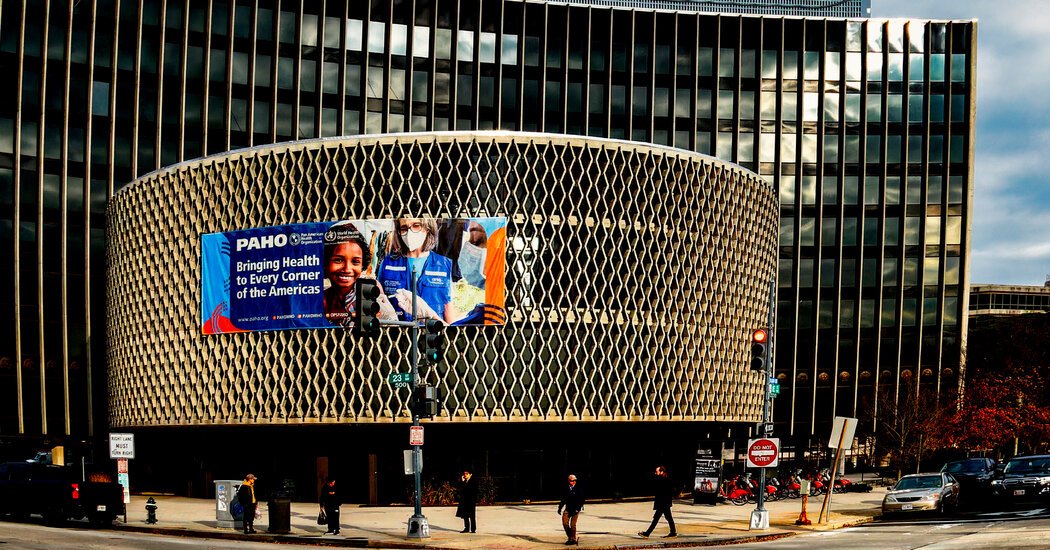
The Trump administration’s plan to stop funding the Pan American Health Organization, which coordinates public health efforts across dozens of countries including the United States, will leave Americans more vulnerable to infectious disease threats, more than 100 U.S. leaders in health and national security warned in an open letter to be released on Thursday.
They include former health secretaries, directors of health agencies, Pentagon and White House officials and surgeons general who have served in Democratic and Republican administrations.
Founded in 1902, the organization is supported by contributions from its 35 member countries. The United States, a founding member, owes nearly $135 million in overdue fees since late 2024.
On his first day in office, President Trump withdrew the United States from the World Health Organization and ended all U.S. funding for the agency. The administration’s proposed budget for next year now eliminates funding for P.A.H.O., which serves as a regional offshoot of the W.H.O.
That decision makes little sense given the rising threat of infectious diseases like dengue, bird flu and screwworm, the letter’s signatories argued.
“A nation that cannot detect and contain disease threats at their source cannot fully protect its people at home,” they wrote.
The U.S. Office of Management and Budget did not respond to a request for comment.
“The United States is committed to protecting American taxpayers by reforming international organizations and getting them back to basics,” the State Department said in an emailed statement.
“Any funding contributions to international organizations are dependent on real and significant reforms, and to ensure U.S. taxpayer dollars are not used in ways that are contrary to our nation’s interests” the statement said.
P.A.H.O. helped the Americas become the first region in the world to eliminate polio and other diseases and helped to to eradicate smallpox, the letter notes. The organization also assists member states in responding to emergencies like the earthquakes in Venezuela in June and to broker access to medications for diseases like cancer and H.I.V.
During the World Cup this summer, officials from Canada, the United States and Mexico met every day to plan in sessions coordinated by P.A.H.O. for potential threats from the influx of tourists, said Dr. Jarbas Barbosa, the organization’s director.
Officials from some other countries worry the Trump administration’s abandonment of P.A.H.O. will endanger more than just Americans.
The administration’s “denialist stance” will threaten people in the entire region, said Dr. Alexandre Padilha, Brazil’s health minister. “Leaving W.H.O., leaving P.A.H.O., weakening these multilateral institutions is a mistake for global health, and also it will impact the U.S.,” he said.
The United States’ contribution to P.A.H.O. represents just 0.001 percent of total federal spending, the letter noted, but it makes up roughly 20 percent of the organization’s budget. P.A.H.O. has received some additional money from Spain, an observing member of the organization, and other countries, but those contributions do not make up for the loss of support from the United States, Dr. Barbosa said.
“I am knocking on every door that I can,” Dr. Barbosa said, “but we need the U.S. to make the payment” to keep the organization running.
Some public health experts noted that countries in the Americas face many threats in common and benefit from collaboration. For example, one of P.A.H.O.’s assets is a network of labs that can analyze the genetic information from pathogens, particularly those that are still emerging as threats in the hemisphere, to track their movement.
“When they break this network, that makes it even more difficult to identify the virus that comes from birds or with the pork that arrives in United States, with risks for the American population,” said Dr. Paulo Buss, a former president of Fiocruz, Brazil’s agency for health research.
P.A.H.O. has been especially involved in the United States this year as it is evaluating whether the nation has lost its measles elimination status, a designation given to countries that have not had continuous spread of the disease for more than a year. The country has already recorded more cases of measles this year than in any other year since it eliminated the disease in 2000.
Dr. Barbosa said he did not believe the organization’s role in determining the measles elimination status had any impact on the administration’s decision to stop funding it.
He said he has written twice to Secretary of State Marco Rubio, once last year and once a few weeks ago, to make the case for continued support of the organization. He has not received a formal response, he said, but has met with other officials from the State and Health and Human Services Departments.
Dr. Barbosa said he agreed with the Trump’s administration’s push to make international organizations more accountable. Since he became the organization’s leader in 2023, he said, he has cut its budget by 19 percent by eliminating some positions, moving others from Washington to member countries, and cutting down on travel. In the interests of transparency, audit reports for each country are also now available to all other members.
“The general concerns that they have shared about international organizations — we are already implementing them,” he said.

