
Iris van Herpen, the visionary Dutch designer, is an inventor of wearable sculptures, clothes that look like a splash of water, an evaporation of smoke, a cloud of bubbles, a cluster of jellyfish, an exoskeleton. She draws inspiration from nature and science, from psychic and anatomical exploration, and her clothes are constructed using cutting-edge technologies as well as couture techniques.
But van Herpen has always insisted on the slow, handmade nature of her design process, and it is this aspect that she wants to emphasize to visitors to the exhibition “Iris van Herpen: Sculpting the Senses,” on view at the Brooklyn Museum.
The exhibition, which was shown in Paris in 2024 at the Musée des Arts Décoratifs, has traveled around the world, drawing on artworks, scientific artifacts and natural history specimens from each locale.
In Brooklyn, van Herpen has added another element: Herself.
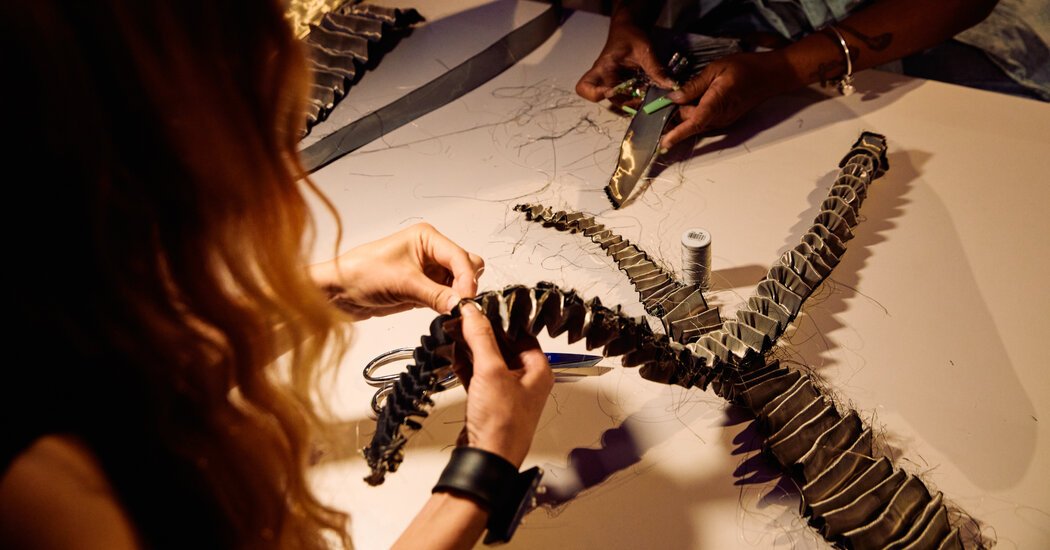
For the first time in her exhibition career, the designer is appearing periodically throughout the run in what she describes as “performances,” offering personal encounters in the art of the couturier. In the central rotunda area that evokes the designer’s Amsterdam atelier, she sits at a table, welcoming visitors who join her in pleating a piece of fabric, a technique she thought most people would find accessible.
“My process in one way seems very complex and highly technical and innovative, and this is a way to show how human it really is,” van Herpen said in a video call from Amsterdam a few days before arriving in Brooklyn for performances in July. “It’s ultimately about the craftsmanship and very personal and human.”
I would discover that intimacy for myself. On the opening day of the exhibition in May, I joined van Herpen at her table. One of the large, draped artworks that she occasionally fashions hung behind her, and in the center of the rotunda, billowing swathes of fabric extended upward to the cupola, showing projections of the hands of atelier workers, meticulously pinning and stitching in real time. Around us were hundreds of samples of fabrics, photographs, drawings and materials pinned to curved boards lining the room.
It was still member’s’ hour, and not too crowded, although a line had already formed to sit with van Herpen. The atmosphere was peaceful and contemplative, as visitors moved slowly around the gallery, sometimes stopping at a long table to look at materials through microscopes.
Van Herpen pulled some silver fabric from a bolt at a side table, and cut off a section, passing it to me. It was, she said, fine black silk woven together with even finer aluminum threads, “about one-fifth of a human hair.”
She showed me how the fabric would only pleat in one direction and said to do it as tightly or loosely as I liked. As we began to pleat (I discovered I was a tight pleater, clearly an indicator of personality), we started to talk about meeting the previous year, when I had interviewed her about the costumes she had created for a new work at New York City Ballet.
Despite her high-tech fabrics and innovative techniques, I had also seen the painstaking hand-finished, almost meditative nature of the work. Van Herpen nodded, saying that this was how she had started working 20 years ago.
“I wanted to give people a sense of the intimate part of the process,” she said, adding that for many designers, the concept is the focus, and then the design is handed over to others to be made. “For me, the making, the draping and the handwork is where the look evolves,” she said.
Matthew Yokobosky, a senior curator at the Brooklyn Museum, explained, “Each person pleating with her has their own history, their own dexterity and she is bringing those unknowns into making this dress.”
Amid the swirl of visitors around us, the hum was increasing slightly, as our fingers pleated almost unconsciously. “When you work on something together, there is a trust that is created and conversations become much more personal very quickly,” van Herpen said. “I have heard really beautiful personal stories, hopes and dreams.”
She added that when working with one’s hands, “your mind sort of relaxes; my most creative thought processes happen like this.”
I observed that each person leaves a different imprint on the fabric, much like handwriting. That textural variety was one of the wonderful aspects of the experience, Herpen said, testament to the individuality of each pleater.
“These conversations are recorded, and I am going to select moments that inspired and moved me and embroider those on the inside of the dress,” she said. “It will be a time capsule of this moment.”
This past weekend van Herpen also began draping fabric pieces on a mannequin. “I always do this alone, never with people around me, so it’s a little scary,” she said. “But that is a good reason to do it.”
She didn’t know what the final design would look like, but it will be “influenced by the people of New York — their conversations, their life stories. That will all be in the final outcome of this look.”
Van Herpen will return to the museum in late October for more performance sessions and the final stages of making the dress. “I don’t know what it will be, and I don’t want to know,” she said. “I want my hands to drape; I believe them more than my mind.”
Iris van Herpen: Sculpting the Senses
Through Dec. 6, Brooklyn Museum, 200 Eastern Parkway, Brooklyn, (718) 638-5000; brooklynmuseum.org. Van Herpen returns in October.

