
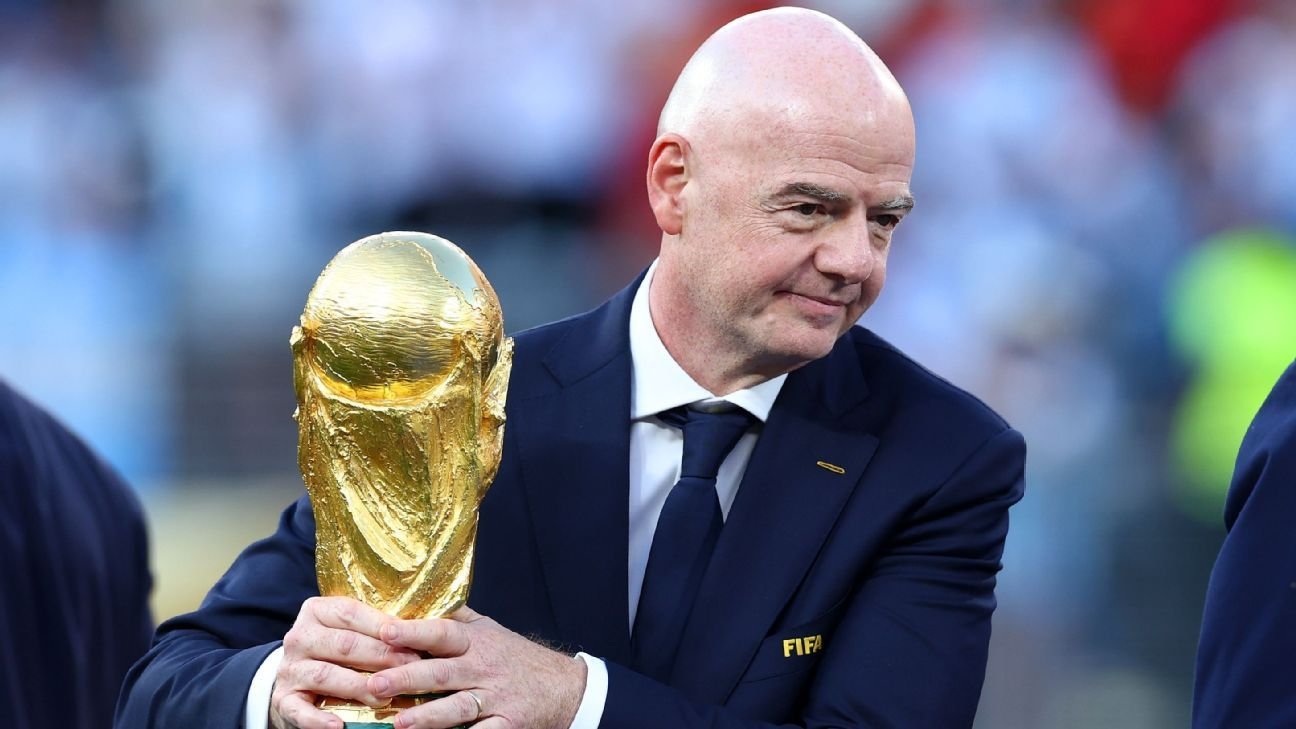
The future of the FIFA World Cup is now hanging in the balance, and the different factions are taking shape in a conflict that could see UEFA, the powerhouse confederation in charge of Europe, split from world governing body FIFA and boycott future tournaments.
FIFA president Gianni Infantino’s proposal to raise up to $20 billion through private investment through selling equity in the world’s biggest sporting tournament threatens to trigger a split in the game that will change the World Cup as we know it.
In exchange for allowing private investors to pay billions for involvement in the planning of future World Cups, Infantino is offering each of FIFA’s 211 member associations the chance to make an instant $20 million by voting through his plan, with a further $66 million per association before 2038.
– A decade on, what is Infantino’s legacy as FIFA president?
– This World Cup was like no other as it inspired and incensed
– Infantino clocked up over 65,000 miles on epic World Cup tour
But UEFA has hit back at Infantino, saying that the sport is “not FIFA’s to sell,” and sources have told ESPN that the 55 member associations of Europe’s governing body, including world champions Spain, will hold an emergency meeting this week to formalize opposition to the FIFA plans, with a World Cup boycott — the next men’s edition isn’t until 2030 — expected to be one option on the agenda.
Infantino’s move has generated widespread condemnation, but what is this push for private investment all about, and, crucially, what will happen next?
What is FIFA president Infantino’s plan?
In a statement released by FIFA to explain Infantino’s proposal, the FIFA president outlined his intention to “unleash the commercial potential and opportunity that FIFA has” because “parts of the game have turned [football’s] popularity into remarkable commercial value.” In the crudest possible terms, that means to cash in on the success of the 2026 World Cup — a tournament FIFA expects to generate an overall $15 billion in revenue when the financial figures are fully audited.
FIFA, a nonprofit organization based in Switzerland, plans to create a new subsidiary vehicle called FIFA Forward Enterprise that would take control of commercial and event operations, including broadcast, sponsorship, ticketing and licensing deals for tournaments, including the World Cup. In exchange for selling a stake in FFE to outside investors, FIFA would distribute the proceeds between its 211 associations with the promise of $20 million on approval and three further payments of $20 million, $22 million and $24 million between 2027 and 2038.
In its statement, FIFA said that a consultation process has begun following the receipt of a proposal that aims to unlock the full potential of FIFA’s broadcast rights and sponsorships across its tournament portfolio in men’s, women’s and youth soccer. The proposal has been submitted by Thrive Eternal, a permanent holding company led by venture capitalist Josh Kushner, brother of U.S. President Donald Trump’s son-in-law Jared Kushner.
In contrast to private equity investors, who typically target returns over five to 10 years, permanent holding companies aim to buy and control companies indefinitely. So any FIFA sale would be done on the understanding that it would be a permanent disposal of the stake.
FIFA says that it would still own and control FFE “via majority board representation and exclusive authority over football governance, competitions, the international match calendar and all regulatory and sporting decisions.”
Why has Infantino made this move now? Who benefits?
In his role as FIFA president, Infantino’s primary duty is to safeguard the future of the game and ensure that it is healthy, vibrant and well-funded across the globe — a responsibility he acknowledged in his statement about the FFE plan.
“We intend to invest heavily even in the smallest or most remote parts of the footballing world, places that are too often passed over,” Infantino said. “Every FIFA Member Association, whatever its size, resources, or geographic location will have a voice and the opportunity to determine its own course.
“Football has become a truly global game and so the benefits must be felt globally.”
All 211 member nations stand to receive around $8 million in so-called “forward funding” between 2027 and 2030 on the back of the 2026 World Cup, so an instant jump to $20 million will clearly be regarded as a huge windfall by FIFA’s smaller associations, and the financial benefits of the plan to the likes of New Caledonia, Gibraltar and San Marino are obvious.
Why now? That is unclear. But the 2026 World Cup was an undoubted financial success, and Infantino’s proximity to Trump and his influential and hugely wealthy circle has created an opportunity for FIFA and potential investors to exploit the sport’s global popularity with a new, more aggressive approach to generating more income from it. Every member association will have a vote on the proposal, but there are unique dynamics at play when it comes to how any potential vote might play out.
“FIFA and this private equity new business is in a way the opposite to what happened with the attempted European Super League,” said Pau López Gaitán, doctor of philosophy (University of Bristol), who specializes in private equity in soccer and the treatment of clubs and competitions as financial assets. “Now, the big [nations] are scared of the consequences and the small ones are a bit more hopeful because of the trickle-down promise that FIFA has given to everyone.”
From Infantino’s perspective, he is up for reelection as FIFA president in 2027, and promising a financial windfall to so many associations might serve as an emphatic way to shore up his legacy.
What would private investors be getting for their money?
While FIFA says it will retain control of FFE and oversight of future tournaments, the reality is that multibillion-dollar investors will expect a significant return on their purchase, and this opportunity certainly offers several routes to achieving that. By offering up the chance to influence broadcasting deals, ticket prices, commercial revenue, and potentially even the frequency, size and location of events, the worst-case scenario for the sport would be decisions being made to suit investors rather than the sport itself, from the players to the fans.
For example, the change could lead to more regular tournaments and bigger tournaments to ensure that revenues continue to grow in line with any initial investment.
“The World Cup is the biggest sporting event on the planet in terms of its popularity, reach, global impact and revenue,” said Omar Chaudhuri, chief intelligence officer of Twenty First Group, London-based commercial brand advisers. “It’s unrivaled: just look at the $15 billion revenue generated from this cycle. But the scarcity value — it’s held once every four years — is part of its appeal, as is the chance to see all the world’s best players in one place and the history of the competition.”
Reports have suggested that the three-minute hydration breaks during the World Cup were individually worth $7-9 million to broadcasters in terms of commercial revenue, so they could they become a regular, and hugely lucrative, occurrence in future tournaments.
When Fox Sports secured English-language, U.S. broadcasting rights for the 2026 men’s World Cup, the cost of the package was $485 million, but FIFA has already served notice that a similar package for the 2030 and 2034 editions will be valued from at least $1 billion. With outside investors influencing FFE decisions, another potential development could be an in-house, Netflix-style direct-to-consumer (DTC or D2C) deal where viewers would pay directly to watch rather than through a more traditional broadcast deal, which again could generate huge sums for FIFA and the investors.
“D2C deals haven’t always proved as successful as you might think, partly because viewers have certain viewing habits and things that they’re used to,” Chaudhuri said. “Therefore it can make more sense to invest more in the rights than what a D2C proposition might provide.
“The other challenge of a World Cup is that it’s once every four years and a lot of these subscription models rely on providing content throughout the year. By and large, the best model still seems to create some competitive tension and sell rights to the highest bidder.”
López Gaitán has a similar concern.
“This is a clear example of what happens when tournaments get financialized. The promise of an ever-growing valuation of the tournament is what drives private equity business crazy and what they see as appealing to the business,” he told ESPN. “From the numbers mentioned so far, I would suggest that FIFA has undervalued its asset, which means they could get higher offers from sovereign wealth funds in the Middle East, for instance.
“The audience/supporter response is important, though. How fans react is crucial, as we saw with Super League. But how and where and when they could protest — it is now July with no games for at least a month — is another issue.”
UEFA has condemned the plans. Why does it oppose them?
UEFA was first out of the blocks to condemn the proposals, saying they “cross a line that football’s governing institutions should never cross.” Concacaf, the North and Central American governing body, has also issued a statement voicing “deep concern over the lack of due process.” Individual associations have spoken out too, with the English Football Association saying it was “completely unaware of the proposal” before FIFA’s announcement to the media.
UEFA’s opposition carries the most weight, however, because it is the most powerful of FIFA’s six regional confederations. UEFA controls the Champions League, and Europe is home to the Premier League, LaLiga, Bundesliga and Serie A — and five of the seven men’s World Cup winners this century have been European nations.
If UEFA nations boycott the World Cup, it would render the tournament meaningless as a competition.
When Infantino proposed a two-year World Cup cycle in 2021, a UEFA boycott threat forced the FIFA president to back down. FIFA and UEFA — and their presidents, Infantino and Aleksander Čeferin — have been at loggerheads for a number of years, clashing over everything to do with the function of the game. Both sides have been trying to claim greater influence of the match calendar and the sport’s financial power.
UEFA regards the revamped FIFA Club World Cup, an Infantino innovation, as a direct challenge to the Champions League and is preparing for Infantino’s attempt to make that a biennial tournament. Sources have told ESPN that Infantino’s latest proposals are another power play by the FIFA president and will be resisted by UEFA.
“We live in an era of breakaway competitions — LIV Golf, Grand Slam Track — but they struggle for an identity even among younger fans,” Chaudhuri said. “It would be a risk for FIFA and UEFA if this proposal led to a split and different competitions.”
Why are the plans so controversial?
There are many reasons, from sporting objections to more personal and political issues centered around Infantino.
From the perspective of the game, selling off influence and control of the World Cup has led to fears voiced by supporters’ groups of a further hike in ticket prices beyond the huge cost of this summer’s tournament. With investors rather than sporting administrators potentially deciding on ticket prices and broadcast rights deals, supporters could be priced out of the game.
There is also the prospect of the World Cup being further expanded to 64 teams and staged in countries more likely to guarantee a massive profit, such as the United States, rather than rotated around the continents as it is now.
But the hostility toward Infantino is driven by a perception of oligarch behaviour — a man so consumed by the power of his position that he has lost touch with the expectations of his role. His closeness to world leaders who include President Trump, Saudi Arabia’s Crown Prince Mohammed bin Salman, Russia President Vladimir Putin and the Qatari royal family has also prompted criticism of Infantino dispensing with due process to hand out tournament hosting rights and even a newly created FIFA Peace Prize to Trump at the World Cup draw this past December.
But ultimately, FIFA is the game’s ruling body. Its role is to redistribute funds to all members rather than sell off a slice of its organization to wealthy outside investors whose primary objective is financial gain rather than the good of the game.
Will other potential investors emerge?
While the United States has become a significant driver of wealth and investment in world soccer in recent years — 12 Premier League clubs have American owners or investors, including reigning champions Arsenal — the Persian Gulf has also made a huge financial input into the game.
Saudi Arabia is scheduled to host the 2034 men’s World Cup, and its Public Investment Fund is the majority owner of Premier League club Newcastle United. Qatar staged the 2022 men’s World Cup and is a regular host of FIFA youth tournaments, while back-to-back Champions League winners Paris Saint-Germain are owned by the Qatar Sports Investment group. Meanwhile, Sheikh Mansour bin Zayed al Nahyan of Abu Dhabi owns Manchester City and has funded the club’s transformation into a serial winner since buying the team in 2008.
Elsewhere, although Chinese investment in European soccer has slowed dramatically in recent years, the prospect of buying a stake in FIFA might attract money from China. So while Thrive Eternal is the front-runner to fund Infantino’s proposal, the immense wealth in the Middle East and China could lead to an even greater windfall for FIFA if the plan gets off the ground.
1:01
Ogden: World Cup controversy could damage Infantino’s FIFA reelection
The rich and powerful nations might be opposed, but plenty will back the plans, right?
This is the key to Infantino’s calculation. He would have known that UEFA would rail against the proposals, but the European confederation has only 55 members.
FIFA votes work on a one-member, one-vote principle. If every European nation rejects the plan, that still leaves 156 associations across the globe, and it would require only a simple majority to pass the proposal.
Asia (47), Africa (54) and Oceania (13) would amount to 114 votes, with another 41 nations in Concacaf. With the vast majority of those national associations struggling to fund their programs, and unable to count on the wealth of European nations and the major countries in South America, it would make little sense financially for them to reject Infantino’s plan.
So what happens next? How will it play out from here?
In a letter to member associations, Infantino has said a decision must be taken by Sept. 19 — less than eight weeks from now. So the likelihood is that UEFA will attempt to consolidate its World Cup boycott threat — it might even consider withdrawing from FIFA itself — and then try to persuade members in the rest of the world to turn their back on Infantino’s plan.
That won’t be easy. Money talks, especially for those smaller nations that will see the potential windfall as a once-in-a-lifetime opportunity.
But a World Cup without Europe would totally devalue the competition, so UEFA has a strong hand to play. And if UEFA did walk away, the potential of an expanded European Championship — with invites to aligned nations from South America, Asia, Africa, and North and Central America — would create a rival tournament that would be much more appealing and lucrative.
But with this proposal creating so much noise, hostility and criticism, it might also be dead in the water long before Infantino’s Sept. 19 deadline.
Will Infantino survive as FIFA president if this plan fails?
All politicians know that the first rule of politics is being able to count. Infantino knows he has his 2027 reelection in the bag due to the absence of an opponent and the promise of votes from so many nations across the globe.
If his plan fails, however, it will be a humiliation for Infantino and could weaken him enough for a rival candidate to emerge. So this plan has become an existential crisis for the World Cup and for Infantino.
If he gets his way, his power will be even greater. But it is hard to see how Infantino wins and FIFA and UEFA remain aligned. The next two months are crucial for the future of soccer. The stakes really are that high.

