
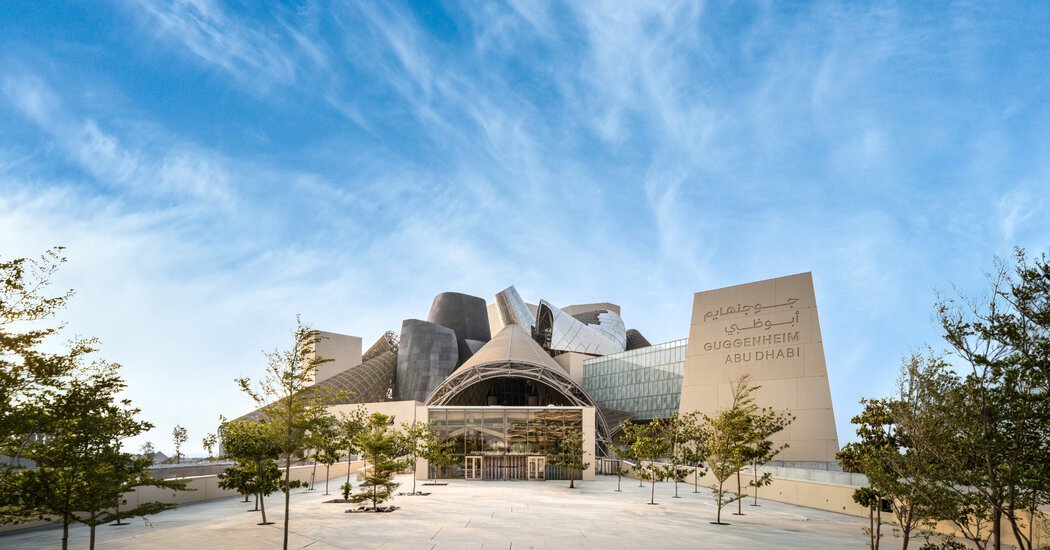
After more than two decades of anticipation, the Guggenheim Abu Dhabi will open the doors of its Frank Gehry-designed art museum on Dec. 11. It will be one of the last major venues in a culture district that the United Arab Emirates has spent billions to create.
“Guggenheim Abu Dhabi is a defining moment in our cultural journey,” Mohamed Khalifa Al Mubarak, chairman for the department of culture and tourism of Abu Dhabi, capital of the United Arab Emirates, said in a statement. “It brings new perspectives to modern and contemporary art, shining a light on art from all around the world.”
Guggenheim Abu Dhabi, focusing on art after the 1960s, is the fourth existing museum in the Guggenheim’s global network, joining institutions in New York, Venice and a celebrated Gehry-designed outpost in Bilbao, Spain. But the partnership between the Abu Dhabi museum and the government is unique. The Guggenheim said all major hiring decisions have been made jointly with Abu Dhabi’s department of culture and tourism; artworks that the museum acquires belong to Abu Dhabi’s government, which has spent more than $1 billion on the construction of its Middle Eastern outpost.
“Our ambition is to show a new art history,” said Mariët Westermann, director and chief executive of the Solomon R. Guggenheim Foundation, adding that the museum would have significant works from the Middle East, Asia and Northern Africa. “This museum was built to invite visitors from the country, the region and the world.”
The new museum will feature 30 galleries connected by a central atrium and 10 sculptural cones that punctuate Gehry’s unconventional design of stainless steel mesh, onyx and glass. The museum offers about 125,000 square feet of interior galleries, with more than double the exhibition space outside.
But the museum is still nearing completion, and some employees have noted cracks in the flooring. The museum also declined to share what artworks would be on view during the opening.
“There is always more to do, but not one specific area other than installing the art,” Westermann said in an interview.
Hotly anticipated and highly scrutinized, the Guggenheim Abu Dhabi was first announced in 2006 by the museum’s director at the time, Thomas Krens, who popularized the expansion strategy of a global museum with multiple outposts. He claimed success after opening the Guggenheim Bilbao, which became a major tourist draw in Spain. Other projects failed to materialize, including museum outposts in Finland, Brazil and Mexico, and partnerships in Berlin and Las Vegas subsequently closed.
Throughout the 2010s, activists accused the museum of putting immigrant laborers in unsafe working conditions at the Abu Dhabi construction site.
Other arts centers have since opened in the Saadiyat Island cultural district, including the Louvre Abu Dhabi, a natural-history museum and an immersive art center by the Japanese company teamLab. A performing arts center, also by Gehry, is under construction.
Westermann, the former vice chancellor of N.Y.U. Abu Dhabi, joined the museum in 2024 with a mandate to open the Guggenheim Abu Dhabi, even reorienting the leadership structure of the foundation so that she could have more flexibility to run the museum’s international profile and raise money.
Many employees have been urged to come into the offices in Abu Dhabi, even as the war between the United States and Iran continues. As recently as May, Iranian ballistic missiles and drone strikes were hitting Abu Dhabi.
At the same time, “the safety of our team and of our visitors is — as it is with any Guggenheim in the world — our top priority,” Westermann said. “I was in Abu Dhabi last week for the first time since February, and it was great to be back.”

