
The country is divided. Half of America wants to address injustice, while the other half has different concerns. A fragile bond is fraying. Rampant disinformation makes it worse.
An exhibition that opened this month at the Atlanta History Center begins with a barrage of conflicting voices, each one amplifying grievances, resentments and fears as the United States was hurtling toward the Civil War.
As visitors listened to abolitionists and clergy members and politicians of that time, they could also detect shades of the present. In 2026, the war is long over, slavery abolished. And yet it can seem as though Americans are still fighting a version of the same battle.
“It’s living on in a different way,” Ann Smith-Williams, an occupational therapist visiting from Maryland, said as she walked through the exhibition, seeing a connection with social justice protests in recent years and the backlash that followed. “This is helping me with putting things back in perspective and back into time frame.”
The History Center, one of Atlanta’s flagship cultural institutions, approached the exhibition, called “More Perfect Union,” with an ambitious mandate.
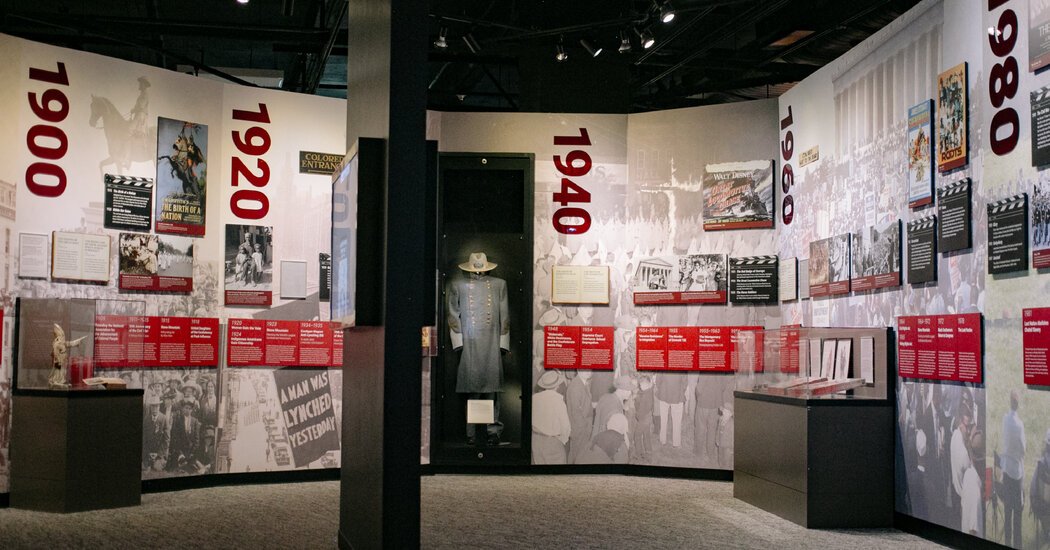
The Civil War was four years of devastation and bloodshed. It was also, in the museum’s telling, a manifestation of a tension as old as the American experiment itself. The exhibition aims to follow the thread from slavery’s role in the country’s founding through the discrimination and racism that have endured long after the last enslaved people were freed.
“What we are trying to do is expose folks to some narratives they think they knew, but maybe misinterpreted or misunderstood,” said La’Neice Littleton, a senior historian at the center.
The exhibition, part of a $16 million investment, stretches over nearly 10,000 square feet and includes an expansive trove of artifacts that curators spent decades collecting. To build it, the center dismantled a Civil War exhibition that had stood for more than three decades — a thorough but tightly focused accounting of alternating military fortunes and growing anguish.
“We acquired all this stuff and additional knowledge,” said Sheffield Hale, the History Center’s chief executive. “And what we decided to do was expand it and have this bigger, longer story.”
There are lots of weapons: rifles, handguns and swords. There is also a Confederate flag that flew over Atlanta when the city surrendered to Union troops.
Smith-Williams was particularly struck by an original copy of Frederick Douglass’s famous 1852 speech, “What to the Slave Is the Fourth of July?” With the country recently celebrating its 250th anniversary, she saw it as a reminder that the Declaration of Independence did not always apply to every American. “Not everyone was free,” she said.
The exhibition also displays letters, journals, personal photographs, uniforms and even a perfectly preserved cracker. (The hardtack given to soldiers was “quite durable and could be eaten even if moldy or infested with weevils,” a placard explains.)
The objects make a complicated history tangible and human, curators and historians said, encouraging visitors to take it in with empathy and nuance and look beyond biases informed by modern politics.
In an earlier era, museum officials said, recounting Civil War history in Atlanta required a certain deference to influential groups that maintained a proud connection to their Confederate lineage. They expected the History Center to present, without scrutiny, justifications for the war that cast the South in a more forgiving light; that it was a fight for states’ rights, for example, rather than about protecting slavery. (Last year, President Trump signed an executive order called “Restoring Truth and Sanity to American History” that questioned how the Smithsonian Institution portrayed history.)
“That’s not a consideration in 2026,” said Pola Changnon, the center’s chief content officer. “It is: What are citizens of every stripe going to take away.”
The exhibition’s overhaul comes during the museum’s centennial and mirrors its overall transformation.
The Atlanta Historical Society, as it was originally known, began in 1926 as a curio cabinet for the city’s white elite that arguably reflected a blinkered interpretation of history, based on their point of view. Over time, the center grew into a 33-acre main campus with a restored locomotive; a farmhouse with livestock and a working loom; vast gardens; the mirrored disco ball from a pioneering gay Atlanta nightclub; and a fully preserved mansion built by one of the city’s wealthiest families.
Its Civil War-related offerings also include the Cyclorama, a 49-foot-high cylindrical panorama created in 1885 that captures the Battle of Atlanta in granular detail. A few miles away is the Margaret Mitchell House, named for the author of “Gone With the Wind,” and the apartment building where she wrote it, which reopened in 2024 after an extensive remodeling undertaken with a similar warts-and-all approach.
One thing that has remained consistent is how the History Center embodies Atlanta’s main character energy. Naturally, the museum positions the city as pivotal to the war’s outcome: In Atlanta, General William T. Sherman’s troops defeated the Confederates after a three-month campaign, a watershed moment signaling the North’s ultimate victory.
“This is where Atlanta started influencing everything,” Hale said, invoking a popular Atlanta slogan printed on T-shirts, caps and tote bags. “This is where the fate of the Union was decided.”
Days before the new Civil War exhibition opened, Gordon Jones, the lead curator, looked over the displays once again. The Battle of Atlanta was consequential, he said.
But the death, destruction and uncertainty about the Union’s survival were the direct result of slavery and a refusal to acknowledge the humanity of the people whose stolen labor underpinned the economy. “The central fact of American history at this point is the existence of slavery,” Jones said.
Curators have relied on technology to help relay that history. An interactive map shows slave ships crossing from Africa to the American coast, beginning as an occasional dot on the Atlantic before becoming a flurry of vessels.
Yet it was the oldest objects — the yellowing pages and fraying fabrics — that made such an expansive history feel painfully intimate and real. Jones pointed out letters and handmade toys one Confederate officer sent home to his family before he was killed. “This is the personal cost,” Jones said.
One of the most treasured items in the collection is a flag from the 127th United States Colored Infantry, stamped with the Union Army regiment’s motto: “We Will Prove Ourselves Men.”
The museum highlights the landmark achievements that immediately followed the war, like the constitutional amendments banning slavery, extending citizenship and equal protection, and guaranteeing the right to vote.
Then it pivots to the ways the conflict dragged on. Crutches, prosthetic limbs and syringes show the devastating injuries and addiction struggles of war veterans (“to be killed outright was often the kinder fate,” one placard says). Propaganda stirred racial animosities, like a booklet with an illustration of a white woman kissing a Black man, proclaiming “miscegenation” as Abraham Lincoln’s postwar aspiration.
“I have to tell the kids we’re on the wrong side of history,” said Claiborne Bouldin, who lives just a few miles away in Atlanta and visited on a recent weekend, noting that he could trace his family lineage back to Confederate soldiers.
Before exiting, visitors pass through a darkened area where quotations meant to be meditated over are projected onto an American flag. Among them is one of William Faulkner’s most remembered lines, taken from “Requiem for a Nun.”
“The past is never dead,” he wrote. “It’s not even past.”

