
Many people may know Alan Turing as the British mathematician who helped crack the supposedly impenetrable Nazi Enigma code during World War II. Others may recognize him as the father of modern computing who foresaw the rise of A.I. And modern audiences may imagine Turing as Benedict Cumberbatch, who portrayed him in the 2014 film “The Imitation Game.”
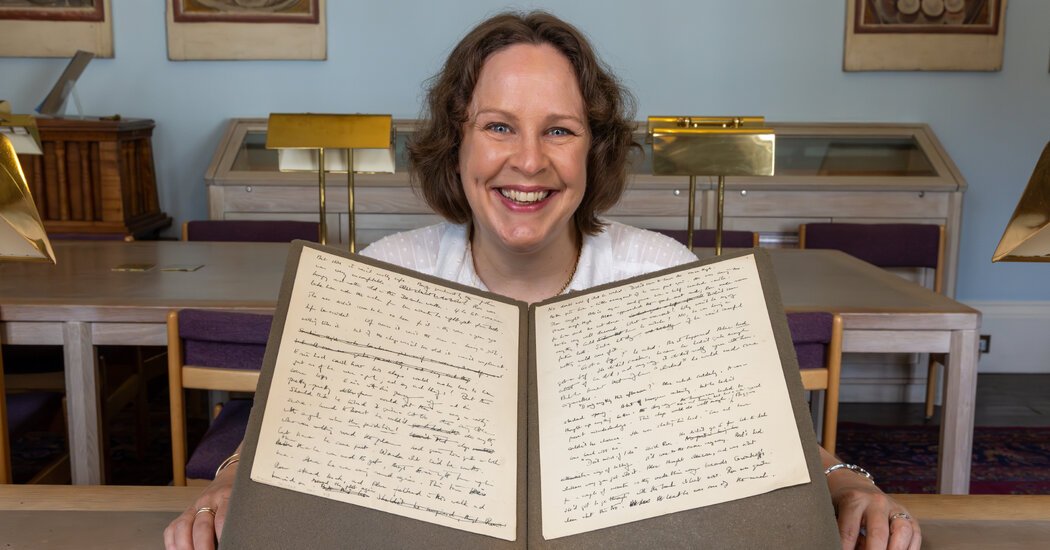
But what many people may not have known is that Turing was also a talented creative writer with a playful side, according to Sarah Dillon, a professor of English literature at Cambridge University who has transcribed a short story that he wrote toward the end of his life.
Until now, Dr. Dillon said, it was “mainly quite geeky academics that knew about” Turing’s literary work. Snippets of his handwritten story had been transcribed for different books and biographies, but the entire work was essentially illegible. With her transcription, the roughly 1,000-word, unfinished piece of fiction can now be read by the wider public.
The story, “Pryce’s Buoy,” is preserved at an archive at Cambridge University. After about 1,000 words and six pages, the work abruptly ends with the words “Ron wouldn’t.”
Any remaining pages have been lost to history, Dr. Dillon said.
She added that Turing’s public image, partly influenced by “The Imitation Game,” was not fully understood. “Working on the story has been part of reclaiming a different narrative about Turing,” she said.
In 1952, the mathematician was convicted of homosexuality, which was illegal in Britain at the time. Instead of serving time in prison, he was sentenced to chemical castration by a series of injections with female hormones. He also lost his security clearance to work on British government cryptography because of the conviction.
Dr. Dillon said that Turing probably wrote “Pryce’s Buoy” after his arrest, either in late 1952 or early 1953. The fictional work tells the story of Ron Miller, a working-class sex worker, and Alec Pryce, a gay scientist famous for an invention he made when he was younger.
“Alec’s character is clearly autofictional,” Dr. Dillon said in a news release. “He represents Turing himself.”
In the story, Alec goes looking for a young man. He wrote:
“Ron caught Alec’s eye and gave him a halfhearted smile. It was enough though.”
Turing died on June 7, 1954, at age 41, of cyanide poisoning. (Britain didn’t take its first steps toward decriminalizing homosexuality until 1967.)
At the time, his work as one of the most influential code breakers of World War II remained classified.
In 2009, the British government apologized, with Prime Minister Gordon Brown calling his treatment “horrifying” and “utterly unfair.”
“We’re sorry — you deserved so much better,” Mr. Brown said at the time.
Then, in 2013, Turing received a pardon from Queen Elizabeth II.
After his death, a coroner ruled that Turing had died of cyanide poisoning and that he had taken his own life “while the balance of his mind was disturbed.” Since then, though, academics have debated whether Turing may have died accidentally instead.
“Pryce’s Buoy” presents an alternative view of the mathematician during his final years, Dr. Dillon said.
“Although he was prosecuted for his homosexuality, he was never ashamed of it,” she said. “He was a proud gay man.”
The story seems to indicate that Turing was someone who was still traveling, having relationships and seeing his friends, even after his conviction, Dr. Dillon added.

