
The confetti got swept off the field not too long ago to celebrate Spain winning the 2026 Men’s World Cup, and now the page turns to the next big international soccer competition: the Women’s World Cup.
Saturday marks one year until the 2027 Women’s World Cup final, and it’s worth asking if the U.S. women’s national team will be there.
What was once all but certain is increasingly unclear, and it has nothing to do with the regression of the USWNT. Sure, the Americans had their worst World Cup showing at the previous tournament in 2023, but after an overhaul of the coaching staff and roster, they won a gold medal at the Olympics in 2024 during their last big tournament.
Rather, the competition has become so much more difficult to navigate. You have likely heard that “The world is catching up” — a phrase that is behind the times. The world has already caught up, and the signs of that were clear over the past decade.
Now, the USWNT is navigating more competitive waters than ever. There are more good teams that have the tactical nuance and the technical ability to win a tournament game, evidenced by Portugal nearly sending the Americans home in the group stage in 2023 (and beating the USWNT in a friendly last year).
Likewise, there are more teams realistically capable of winning the World Cup, which Spain did for the first time in 2023.
The last Women’s World Cup was a low point for the Americans, who exited in the round of 16 in a penalty shootout loss to archnemesis Sweden. The Americans headed into that tournament as the two-time defending World Cup champions and had never finished worse than third in eight previous World Cups.
But these times, they are a-changin’, as Pia Sundhage sang when she took the USWNT job in late 2007. Two decades later, that is abundantly clear to the rest of the world. In 2023, the USWNT looked disjointed and incapable of adapting to the challenges their opponents presented.
Emma Hayes, who took over after that 2023 failure, has not only overhauled the player pool but also the team’s tactical flexibility. It was enough to win gold in the smaller Olympics tournament — but will it be enough for the grander World Cup?
Hayes gave 32 U.S. players their international debuts in her first 32 games in charge, by far a program record. She has improved the depth of the team by getting the federation’s backing to invest in the U-23 national team, effectively looked at as the USWNT of tomorrow. And within all those changes, she has developed a new generation of emerging stars, such as forward Alyssa Thompson and midfielder Claire Hutton.
The reality is that the U.S. women are ranked second in the world and are, once again, one of the clear favorites to win next year’s World Cup.
But the reality is also that the road to a fifth World Cup title will be harder than ever. If anyone needed further proof, just look at the team’s recent trip to Brazil, where the USWNT lost to next year’s World Cup hosts before winning the rematch in one of the roughest games on record.
So, will the USWNT be in the World Cup final on July 25, 2027? Here’s what the USWNT needs to play for that World Cup title once more.
USWNT’s goal scorers and stars must peak for the World Cup
The self-described “Triple Espresso” forward line of Trinity Rodman, Sophia Wilson and Mallory Swanson carried the USWNT to the 2024 Olympic gold medal, combining to score 10 of the team’s 12 goals at the tournament. All three players were at their peak for the tournament, as were defender Naomi Girma and goalkeeper Alyssa Naeher.
As obvious as it might sound, the USWNT will need its best players to meet the moment in 2027 if it has a chance to win the World Cup; the margins are too thin for anything else.
In the USWNT’s 2023 failure, that was not the case. The U.S. didn’t get much production from anybody. The attack struggled, generating 9.30 expected goals, but scoring only four goals — three of which came against Vietnam, one of the lowest-ranked teams in the tournament. It was two defenders, center backs Girma and Julie Ertz, who were the consistent standouts amid struggles throughout the rest of the team. (Swanson, who had been the USWNT’s best attacker in 2023, got injured right before the tournament.)
Now, Rodman and Wilson are locked-in USWNT starters in strong club form, and Thompson has arguably been the team’s best player over the past year after a blockbuster transfer to Chelsea.
Girma has battled injury issues since joining Chelsea over a year ago. She is easily the team’s best defender and one of the best in the world when healthy. Defensively, the USWNT’s prospects look significantly different with and without Girma, even with some of the depth that Hayes has developed.
2:08
How has Alyssa Thompson adapted to the WSL with Chelsea?
A No. 1 American goalkeeper has to step up, but who?
Alyssa Naeher retired from international duty after the Olympics, and after nearly two years, it still isn’t clear who will start for the USWNT in goal at the 2027 World Cup.
Manchester United goalkeeper Phallon Tullis-Joyce appeared to take the inside track in 2025 before the winds shifted back toward Seattle Reign shot-stopper Claudia Dickey. Lately, including for one of the USWNT’s friendlies in June against Brazil, Mandy McGlynn has re-inserted her name into that conversation through stellar shot-stopping and ball distribution for the Utah Royals.
Right now, it is not a problem that there is some uncertainty around the goalkeeper position. After the consistency and veteran presence of Hope Solo in goal, Naeher took over the job with just seven caps heading into the 2019 World Cup. Naeher faced endless questions ahead of the tournament — and her stellar performances eventually led the team to victory.
By the time the calendar flips to 2027, however, it will be time for Hayes to zero in on a No. 1 and develop the relationships between the back line and starting goalkeeper. Those answers may become clearer at World Cup qualifying, which is set to take place at the end of this year. (It should be noted that the U.S. still needs to qualify for the World Cup.)
And when next summer rolls around, it will be a major tournament debut for one of those three Americans. They will follow in the successful footsteps of goalkeepers Briana Scurry, Solo, and Naeher. Can one of them meet the moment and join that legacy?
Hayes must maintain tactical flexibility within a core identity
Some of the chaos and shocking results of the recent Men’s World Cup were another reminder that great teams must play the game that is presented to them.
The USWNT’s 1-0 victory over Brazil on June 9 was ugly: eight red cards, 28 fouls, bad blood all around. Nobody really wants to see that type of game again, but the Americans also proved in that match that they could remain calm and stay focused — even when presented with such an unusually physical setting. This younger, less experienced version of the USWNT had not gone through something like that before, and the U.S. is better for it now.
In October, the USWNT will host world No. 1 Spain in a pair of friendlies that are sure to look nothing like that June night in Fortaleza. Spain will keep the ball and dominate possession, and the Americans must show defensive organization and precision on the counterattack to beat the world’s best team. Hayes has frequently challenged her team to be better in the final third.
A little over a month later, the USWNT will play El Salvador in a win-and-in quarterfinal at World Cup qualifying, where the Americans will undoubtedly have to solve a defensive low block yet again.
Next year’s World Cup is likely to present a similar variety of challenges for the U.S. women. Yes, they will need to stick to their core principles that blend possession and transition. They will also have to adapt, finding a different balance in each game, based on the opponent, if they want to play in the tournament final.
Hayes has constantly thrown different challenges at the team since taking the job to prepare her players for those moments.
With so many options, the USWNT must find right midfield balance
Different players will also be required to defeat a variety of opponents. Just as we wrote in March, the perfect lineup depends on the opponent. Nowhere is that more of a conundrum than in midfield.
At the 2024 Olympics, Hayes played Sam Coffey as the holding midfielder, Rose Lavelle as the attacking midfielder and captain Lindsey Heaps as the box-to-box midfielder. The midfield was frequently bypassed in that tournament to find the team’s dynamic forwards in space or favorable one-on-one opportunities.
Since then, Hutton has developed into a legitimate challenger for the defensive midfield role alongside the spectacular Coffey (a USWNT squad with two starting-quality defensive midfielders?!), and 19-year-old ball maestro Lily Yohannes has emerged as a strong option in possession-heavy games.
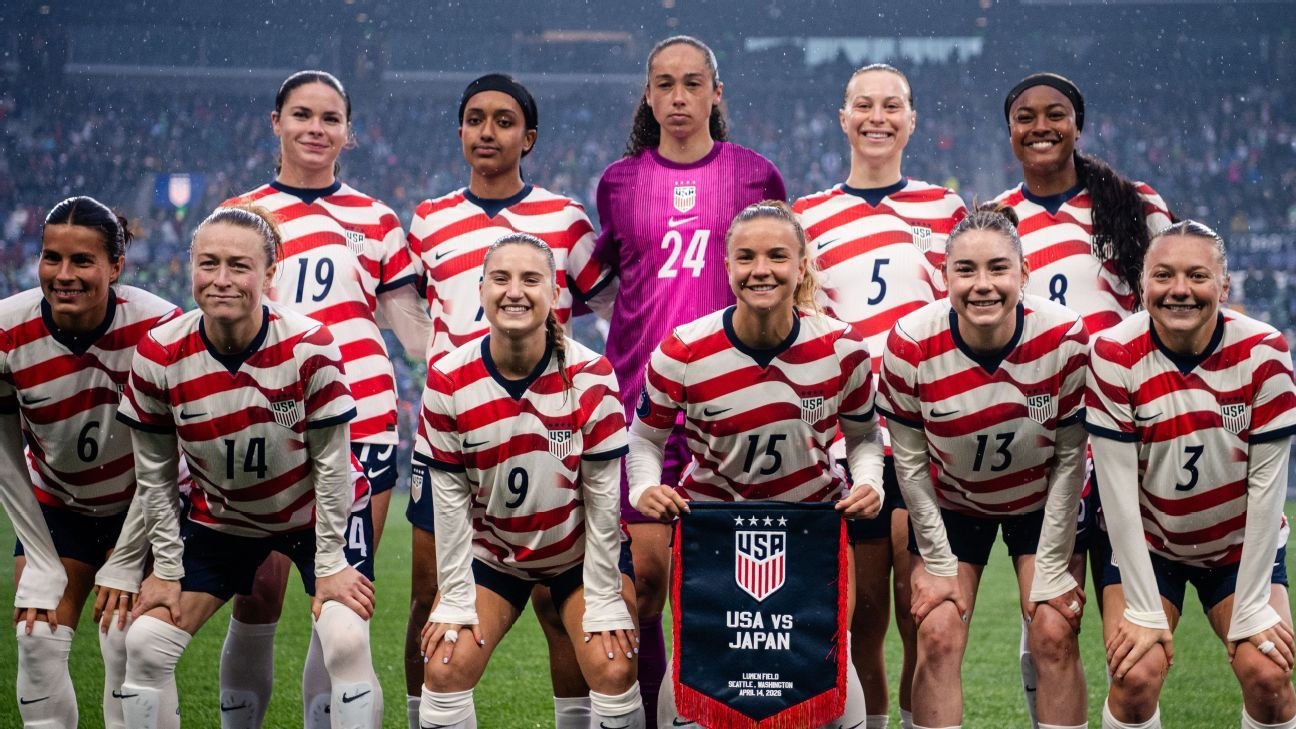
Hayes has tried endless combinations of the midfield trio, including running it back to the Coffey-Lavelle-Heaps trio in a 2-1 win over Japan in April and a 2-1 loss to Portugal last year.
With Coffey unavailable for the June matches because of a knee injury, the Hutton-Yohannes-Heaps combination struggled to meet the physical, man-marking tempo of Brazil in a 2-1 loss. Yohannes, Heaps and Lavelle set the tone as the trio in the 1-0 win that followed three days later.
Hayes has also played Coffey and Hutton as a quasi-double pivot under Lavelle on a couple of occasions, including a convincing 3-0 thrashing of Canada last year. Some physical games will require that level of defensive cover, while others could demand Yohannes to unlock the right final pass.
However Hayes approaches the midfield, she’ll need to find balance on a match-to-match basis. This is the area of the field that will make or break the team’s World Cup chances.
A favorable World Cup draw
Let’s be honest: FIFA is fully capable of making things up at the draw.
In 2015, that meant placing the six seeded teams, which excluded world No. 5 Sweden due to “geographical reasons,” into specific groups. It was unprecedented and manipulated the pathways of the tournament. It was a farce, but the world wasn’t watching as closely back then.
Ahead of the draw for the 2026 Men’s World Cup, FIFA again did the unprecedented by making sure the world’s top four teams would not play each other until the semifinals, as long as they won their groups. Guess which four teams made the semifinals? You bet — the top four teams in the world: Spain, Argentina, France, England.
Whether FIFA does something similar for the Women’s World Cup could drastically change the tournament. As of this writing, FIFA’s regulations do not offer specifics about how December’s draw will go.
Could the USWNT get drawn into a pathway where hosts Brazil or top-ranked Spain could be a quarterfinal opponent, for example? Either would be a significantly more challenging route to the final than most alternatives.
The most recent Men’s World Cup had 48 teams, which added significant uncertainty around the third-place teams that were going to advance. Next year’s Women’s World Cup will have 32 teams for the last time (enjoy it while it lasts), so only the top two teams from each group advance.
Still, the road to a World Cup title requires amalgamation of good form, favorable matchups and some luck. When the draw happens in December, it would be reductive to analyze only the USWNT’s group opponents. How winnable the group is matters, but so does the pathway to the final in the knockout stage.
One thing is certain: It is a more difficult task than ever to win the Women’s World Cup, and it is going to get harder as the rest of the world invests in women’s soccer and as the tournament expands to 48 teams in 2031.
The USWNT is as well-positioned as any team to win the 2027 edition — but everything must align at the right time.

