
When I recently read about Jackson Pollock’s “Number 7A, 1948,” a long scroll of looping lines that brought $181 million at auction, I thought of Betty Parsons and the difficulty she had selling his work. She opened her gallery in 1946 in a single, windowless room on the fifth floor of 15 East 57th Street. From this humble perch, she provided the world with its first glimpse not only of “Number 7A, 1948,” but also of Mark Rothko’s fuzzy blurs of color, Barnett Newman’s room-size red canvases and various other hard-to-sell paintings later hailed as the canonical masterworks of postwar art.
If Parsons helped introduce “the great big shots,” as she called them, she also endured the disappointment of seeing them leave her gallery for dealers who promised to capitalize on the brand-new market for American art. (Market? That is where Parsons bought her tomatoes.) She continued to run her gallery and discover new artists until her death at 82, in 1982.
One artist who failed to merit wall space at the gallery was Parsons, an accomplished painter and sculptor. It would have been “too embarrassing” to give herself a show, she said. The good news is that Amy Sillman, the esteemed abstract painter, and Kelly Taxter, an independent curator, have staged an intervention, organizing “Betty Parsons: An Expanded World,” an enlightening and overdue retrospective at Bard College’s Hessel Museum of Art, in Annandale-on-Hudson, N.Y.
The exhibition is impressively comprehensive, presenting 81 paintings, watercolors, gouaches and sculptures that track her development over four decades. It also includes 24 minutes of looping film footage that chronicles her career as a gallerist on two large screens. Parsons comes across as a forceful personality in a silk scarf and a string of pearls, speaking in a startlingly deep voice about the marvels of art.
She was, in some ways, an unlikely nurturer of the avant-garde. Born Elizabeth Bierne Pierson in 1900, the middle of three daughters, she grew up in New York, in an old-money family that summered in Newport, R.I., wintered in Palm Beach, and expected her to glide through life as a debutante and then a wife. At 19, she married a socialite, Schuyler Livingston Parsons, and took his last name. They divorced three years later, prompting her family to disinherit her. She did not regain their approval by coming out as a lesbian and, instead of remarrying, palling around with her many female friends, including the actress Greta Garbo, her regular tennis partner.
Parsons’s story, the Hessel show suggests, is about a curious and independent woman who took a long time to find her voice. Her early work consists of nice-enough views of mountains and tree trunks that she observed on her travels. After World War II, when she was in her 40s and running her gallery, she veered toward abstraction. Some of her paintings from the ’50s, like the small, potent “Red Eminence” (1955) have a churning energy that that is reminiscent of Pollock. But Parsons had no use for the mural-size proportions of his work and its all-or-nothing emotional range.
Instead, her abstract paintings often depict wide-open spaces and images of islands. They don’t evoke a specific place so much as an emptying out, a brightly lit absence.
Consider “Orange,” from 1962, a large-scale, squarish painting, in which 11 small shards of color float against an orange ground. What first appears to be an elegantly minimal abstraction changes while you’re looking into an aerial view of scattered islands. The orange pigment is so watery it pools into a darkened tide line across the bottom edge of the painting.
Alternately, “Orange” also suggests 11 pieces of torn, ragged-edged paper scraps laid out on a flat surface, as if Parsons were using her canvas to assemble a collage. In her paintings, she often did this, isolating bits and bobs of color in a space evocative of a sky or sea, connoting a vision of voyaging that has no destination.
The second half of the show is devoted to sculpture, Parsons’ most memorable work. While her paintings, with their pancake-flat stretches of color, can put you in mind of artists she exhibited, like Ellsworth Kelly and Jack Youngerman, her sculptures are optimistic American objects instantly recognizable as her own.
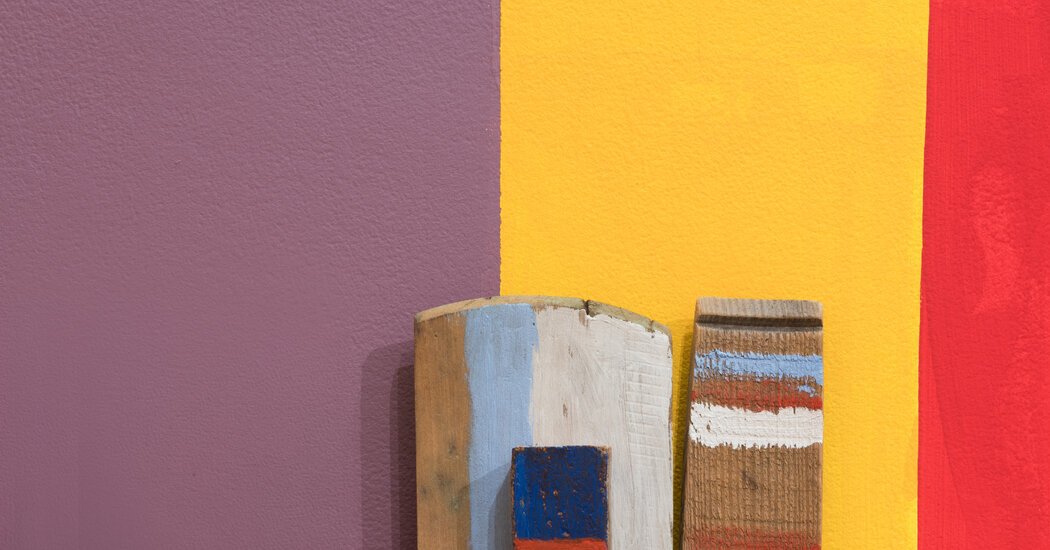
In the ’60s, after moving into a waterfront house in Southold on the North Fork of Long Island, Parsons started making painted wooden assemblages that convey the pleasure of crafting things by hand. She collected discarded lumber scraps on the beach, then cobbled them together into structures that evoke the breezy architecture of fishermen’s shanties, sailboats and lighthouses.
She generally painted her sculptures in patterns of wobbly stripes that leave areas of wood exposed and turn the texture of the grain into a visual bonus. At first the pieces can resemble folk art, but their horizontal and vertical stripes imbue them with a formal rigor that harks back to the modernist grid. Their energy lies somewhere between a Mondrian painting and a seashell in the sand.
At the Hessel, the sculptures, which consist of both wall reliefs and tabletop assemblages, are presented in an oddly carnivalesque setting that can feel overwhelming. They’re grouped together in front of wacky painted backdrops — wide stripes in clangorous hues. The décor, presumably, is intended to acknowledge Parsons’s love of stripes and sunny, headstrong colors.
Yet the design doesn’t serve the sculptures, or encourage us to look at them as autonomous objects. It’s also at odds with Parsons’ much-stated dislike of gallery ornamentation. She is credited with inventing the concept of the contemporary gallery as a chaste, white-painted rectangle purged of the froufrou of the past — like the burgundy wallpaper and velvet drapes that once gave galleries the look of Edwardian living rooms.
I learned from Sillman that she personally painted the walls and pedestals, improvising as she went. Did she think of her creation as exhibition design, or as a high-art extension of her own painting? “Neither,” she said. “I think of this work as a way for me to be a medium between Betty and her show.”
Her comment captures the intense emotional bond that an artist can sometimes feel toward another artist born much earlier. But there are many ways to demonstrate your appreciation. Parsons established a wise precedent when she decided that the highest compliment you can pay to a work of art is to set it against an expanse of white wall and let it take up space, like an island of its own.
Betty Parsons: An Expanded World
Through Oct. 18, the Hessel Museum of Art, at Bard College, Annandale-on-Hudson, (845) 758-7598; bard.edu/ccs. Admission is free.

