
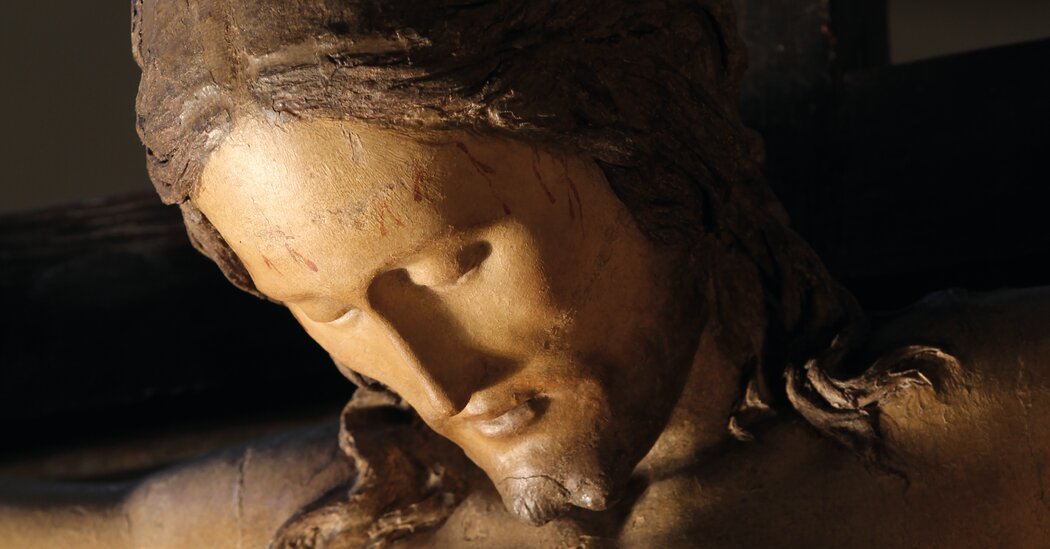
One morning, in September of 1962, the art historian Margrit Lisner arrived at the Piazza Santo Spirito in a sour mood. She was abroad in Florence, doing research on crucifixes scattered throughout Tuscany, and on this particular day, by some divinely ordained stroke of luck, she didn’t want to go to work in the library at the Kunsthistorisches Institut.
Instead, Lisner popped over to the church of Santo Spirito, where she met with Guido Balestri, the Augustinian prior. Lisner mentioned offhandedly that she was researching crucifixes, and Father Balestri said there was a crucifix tucked away in the cloisters.
He brought her down a corridor toward the old rectory and, sure enough, hanging above the door was a wooden sculpture of Christ, his body thin and toned, and completely naked. The bend of the legs, the shape of the skull — Lisner immediately knew what she was looking at. It was the final chapter of her next book: “The Lost Crucifix of Michelangelo.” She had found it.
How a work by the most famous sculptor in the history of Western art was forgotten in a city overflowing with artistic riches is both hard to believe and not. Who today, after going to see the 17-foot David — a naked marble man of eye-throttling scale and beauty — then announces to their parched and crabby relatives: Now let’s walk all the way across the Arno, to a very old church, to see another Michelangelo sculpture but this time one that’s small and made of old wood! Not an easy sell. And yet I would argue it’s one of the best decisions you could make in your art-journeying life.
As you approach from the nave of Santo Spirito, the first thing you will notice about Jesus is that he looks like a freshly peeled shrimp. The glistening firm body, the jarring nudity, the shrunken waist and limbs … the proportions are “disturbingly wrong,” as the art critic Martin Gayford has put it.
I caught a glimpse of this shrimpy wrongness while standing in the church this past summer and was disturbed enough to pay two euros to enter the sacristy, where the crucifix is suspended in the middle of the room, from a long rod that hangs more than 70 feet down from the ceiling. I’ve never seen such a strange and fragile little thing hanging in the air like that, swathed in so much emptiness.
Michelangelo is famous for works of art and architecture that are shocking in their ambition and magnitude: the frescoes of the Sistine Chapel, the Basilica of St. Peter’s, the tomb of Pope Julius II, the unruly block of marble from which the David was freed.
The bodies ripple with muscle and action; their features are meaty and full. With the exception of the “Pietà,” Michelangelo’s work is not known for its sweetness, fragility or visual quiet. Nor is he known for wood sculpture, of which the Santo Spirito Crucifix is possibly the only surviving example (if you exclude the Gallino Crucifix in the Bargello National Museum, which has weak claims to authenticity).
We know that Michelangelo was about 18 when he carved the crucifix in Santo Spirito — that he was young but not unskilled. The year was probably 1493, between the death of Lorenzo de’ Medici in 1492 and before Michelangelo left Florence for Bologna in 1494.
Lorenzo was a consummate Renaissance man: a diplomat, banker, collector, power broker, lavish adulterer and major arts patron. By the end of the 1480s, Florence was running low on top-shelf sculptors. Brunelleschi and Donatello were long dead; Verrocchio was newly dead; and Pollaiuolo was busy in Rome. So Lorenzo plucked from Domenico Ghirlandaio’s workshop a promising young apprentice named Michelangelo Buonarroti and nudged him toward a new craft.
Both Lorenzo and his son Piero had strong ties to Santo Spirito, and it’s likely one of these Medicis set Michelangelo up with the prior of the church, Niccolo di Giovanna. As a favor, Father di Giovanna gave Michelangelo the greatest gift an artist of naked bodies could ask for: unlimited corpses. Michelangelo was provided a room in the convent, near the infirmary, and went about studying the wonders of bone, muscle and skin. (An unauthorized practice at the time but a tolerated one.) As a thank you gift to Father di Giovanna, Michelangelo sculpted a crucifix for the high altar of the church out of lime wood.
The back story is important here because we have to remember that Michelangelo wasn’t only studying dead bodies; he was sculpting one. What makes his Christ so uncanny is the clash between the signs of death — the yellowing ivory skin, the dribble of blood from the wounds, the clumping of hair like brown seaweed — and the childlike proportions, the slim rib cage and the undeveloped musculature of the limbs.
Some of the proportional quirks have been chalked up to the original placement of the crucifix on the high altar, which we know because of Michelangelo’s early biographers Ascanio Condivi and Giorgio Vasari, as well as a drawing from the 1500s in the Uffizi that shows the crucifix above the old choir. But everywhere you stand, and from every angle, it is no less weird or gripping.
Compare the Michelangelo with other polychrome crucifixes done by his contemporaries in Florence, like Benedetto da Maiano and the Sangallo brothers, or earlier examples by Brunelleschi and Donatello. They are all more naturalistic and proportionate.
But they also play fewer notes on the emotional keyboard. Michelangelo’s crucifix makes you feel disturbed, enticed, bereft and moved all at once. What’s hard to fathom is that he had 70 more years of life ahead of him when he sculpted this. (We’re talking about a man who worked under no fewer than eight popes.) And yet somehow Michelangelo already had command of the full amplitude and palette of human emotion.
If you visit Santo Spirito, stand as close to the crucifix as possible. Look at the caverns of the armpits, the sprout of hair on the chest, at the way time has nibbled off bits of the toes and fingers. But, above all, look at the face. The whole drama of the sculpture plays itself out there again in miniature. The proportions are off-kilter, with the elongated forehead pushing all of the features to the middle like vegetables in a bowl of soup, and yet the features themselves are stunning, in particular the thumb-like impressions around the mouth and the great privacy of the eyes. As with marble, Michelangelo somehow makes the wood liquid under his chisel.
For decades, the crucifix was stuck in municipal limbo between Santo Spirito and the Casa Buonarroti, where it was sent to be restored. The church repeatedly requested its return, but it wasn’t until 2000 that it was delivered home and placed in the sacristy.
Originally, there were a few skeptics about its authenticity, but the evidence in its favor — the descriptions of its creation and installation in Condivi and Vasari, and the back-up of the Uffizi drawing — is about as decisive as you could ask for.
I asked the Michelangelo expert Paul Joannides, an emeritus professor in the history of art at the University of Cambridge, if there were any lingering concerns about its authenticity, and he said, “I didn’t think that anyone still had doubts about the Santo Spirito Crucifix. I certainly don’t.”
One explanation for why the sculpture disappeared is because of its failures and disappointments. Some thought it to be unrealistic and clumsy, an early work that’s easy to forget. But I urge anyone to move past that impression. We are not looking at a life-size flesh-and-blood Christ. We’re intercepting a private devotional vision. The piece has all of the contradiction, tenderness and mystery that makes some of the best art worthwhile. In those terms, Michelangelo’s crucifix is perfect.

