
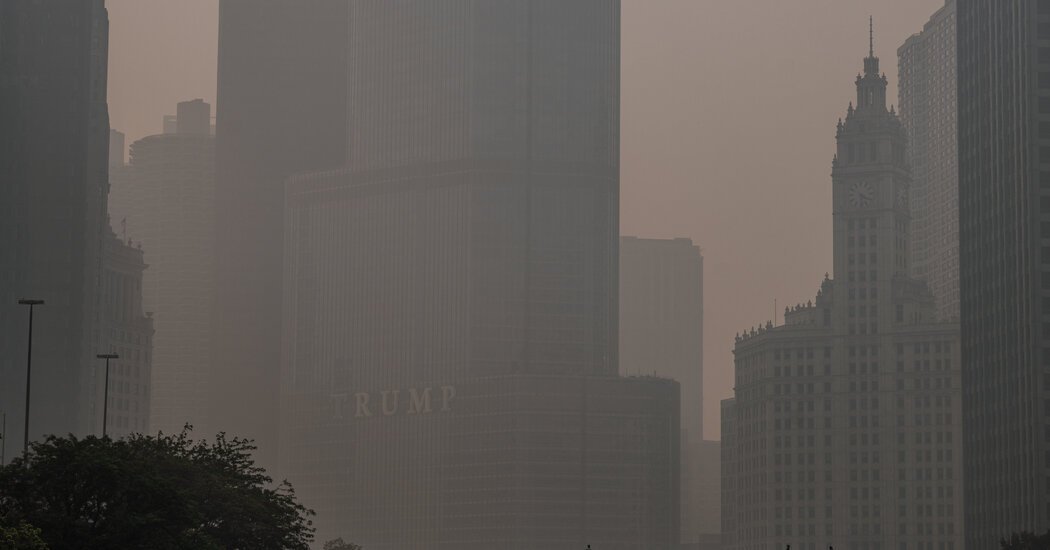
Wildfire smoke is linked to tens of thousands of deaths a year, and human-caused climate change is responsible for a growing share of them, scientists estimate.
Higher temperatures dry out vegetation and help fires burn through larger areas. That can send up huge plumes of the fine particulate matter particles known as PM 2.5. On Thursday and Friday, PM 2.5 concentrations in parts of the states most affected by the smoke from wildfires in Canada, including Illinois, Michigan, Ohio and Pennsylvania, were at levels considered hazardous to all people.
Over the past six decades, the number of deaths worldwide each year associated with inhaling these particles from wildfires grew to 98,700 in the 2010s from roughly 46,400 in the 1960s, according to the researchers’ computer simulations, which were published in 2024 in the journal Nature Climate Change. The share of these deaths attributable to human-caused warming rose to 12.8 percent in the 2010s from 1.2 percent in the 1960s, the researchers found.
Besides hot and dry weather, trends in wildfire activity are also shaped by factors including the ways forests and grasslands are managed, plus how well the causes of wildfire ignitions — downed power lines, sparks from cars and trucks, arson — are controlled.
In another 2024 study, researchers found that changes in these factors had caused the total area burned by wildfires globally to shrink by 19.1 percent between 2003 and 2019. But this progress was partly offset by climate change, which was responsible for an increase in burned area of 15.8 percent during the same period.

