
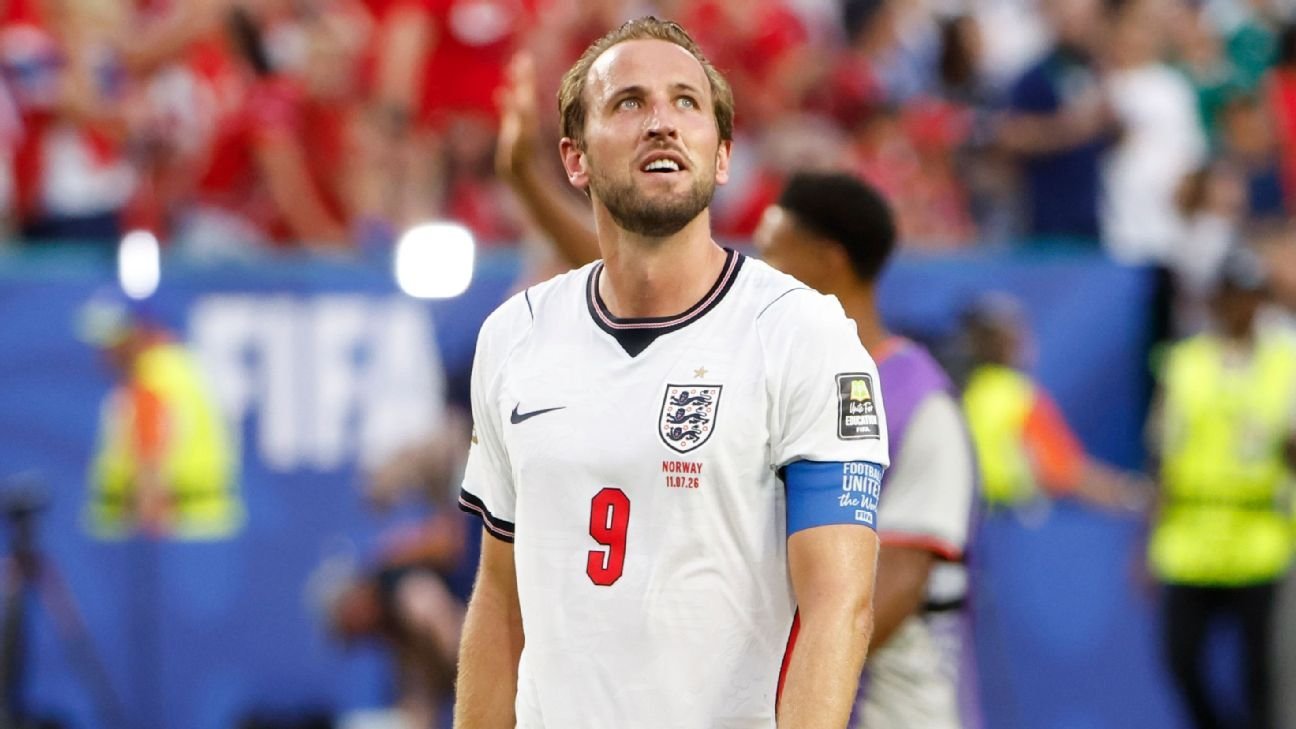
ATLANTA — England manager Thomas Tuchel gets a question about striker Harry Kane every news conference. It’s one of the quirks of a tournament that as you move from match to match, new journalists from various countries around the world share one common curiosity: tell us about Kane.
It was the same before the Norway match. Amid queries over various player’s wellbeing, Norway star Erling Haaland and something else on Argentina, there was the Kane question.
“We speak every match about him as he decides all the matches for us,” Tuchel said. “I’m running out of words and different ways to describe him. He’s our leader. He’s our captain. He leads by example. He’s in the shape of his life and in the highest peak of his career. He has the mindset of a team player. He’s ready to lead by example and to push everybody. He’s ready to take responsibility and to perform, and to help us. It’s a privilege to have him as captain and to be his coach.”
It’s almost taken for granted now that Kane captains England. He’s skippered the country into the last five major tournaments, and on Wednesday night, he will lead England out in a World Cup semifinal for a second time. When Kane was picked as captain for the 2018 World Cup by former coach Gareth Southgate, it was a contentious call. He wasn’t in the typical, historical mould of an England captain. He was a goalscorer, England’s best player, but politely spoken, thoughtful and away from the traditional image of an England captain inhibiting a certain “bulldog” spirit.
The role of the England captain and its symbolism have changed over time. “The English fixation with armbands, clenched fists and rallying cries was a twentieth-century phenomenon,” writes Paul Hayward in “England Football — The Biography.”
“In the nineteenth century, the captaincy was an honour, a ceremonial calling, without the undertone of military leadership one might have expected in the age of empire. There were 125 captains from 1872 to Euro 2020. Most performed unremarkable duties until Billy Wright and Bobby Moore elevated the role to that of statesman.”
Before Kane led England out against Croatia in the World Cup semifinal in 2018, the previous two men’s captains to have such an honour were Moore and Terry Butcher. Moore is immortalised by 1966, the red No. 6 shirt, wiping his hands on his shorts before shaking Queen Elizabeth II’s hand to receive the Jules Rimet Trophy.
“My captain, my leader, my right-hand man,” Sir Alf Ramsey said of Moore. “He was the spirit and the heartbeat of the team. A cool, calculating footballer I could trust with my life. He was the supreme professional, the best I ever worked with.”
By 1990, in England’s second World Cup semifinal, the squad’s skipper was Bryan Robson, a.k.a. “Captain Marvel”, but he was injured in their second match of the tournament against the Netherlands. So it was Butcher who led them out against West Germany in Turin — he of the bloodied headband and scarlet shirt from the 1989 match against Sweden, fully in keeping with the Moore-esque “bulldog” mould.
“He has a low flashpoint, but that is what makes him a special player,” the late Bobby Robson, who managed England from 1982 to 1990, said of Butcher. Butcher described his own playing style as “tin hats and fixed bayonets the moment I pulled on a football shirt”.
So by the time Southgate had to pick a captain for the 2018 World Cup — his first major tournament in charge of England — the main contenders were Kane, Gary Cahill and Jordan Henderson. He had rotated his captains in previous camps. Wayne Rooney had captained England into Euro 2016, but his international career was in its dying light. Cahill’s spot in the team was far from guaranteed. Henderson was the obvious pick. “His experience, selflessness and willingness to call out others made him, for me, the most ‘natural leader’ in the group,” Southgate wrote in his book “Dear England.” But Henderson was struggling for fitness heading into that World Cup, so he went for Kane.
Kane’s credentials were boosted by impressing at a team bonding exercise with the Royal Marines in Devon in June 2017. When Southgate asked them who had emerged as the clear leader of the group, they pointed him towards Kane. “Harry has some outstanding personal qualities,” Southgate said on appointing Kane. “He is a meticulous professional, and one of the most important things for a captain is that they set the standard every day. He has belief and high standards, and it is a great message for the team to have a captain who has shown that it is possible to be one of the best in the world over a consistent period of time, and that has been his drive… he recognises the importance of bringing others with him.”
From there, Southgate, in his book, documents how Kane grew into the role, finding his voice in team meetings, becoming comfortable being the point-person and growing in confidence to the point where he’d stand up to Southgate when he felt the need.
“The way [Kane] carries himself, the way he works, the way he trains, the way you see him in games I think are all the attributes you need to be a good captain,” former England defender Eric Dier said at the time. Kane was a captain who would lead by example and bring others with him through work rate, professionalism and ambition, rather than Churchillian speeches.
“He’s someone who likes to take on responsibility,” his former Bayern Munich teammate Thomas Müller said.
Then there’s his role in welcoming new players to the camp. “All the boys have been so good with me from the first minute I came in,” England winger Bukayo Saka said of his first call-up in October 2020. “Harry Kane put his arm around me. He spoke to me and asked me how I was. For him to do that, it helped me settle in much quicker and made me feel comfortable to be myself around everyone.”
It hasn’t always been straightforward for Kane. He carried a back injury through Euro 2024, and his form suffered badly. He was substituted in the final against Spain on the hour mark. “Physically, it’s been a tough period for him [Kane],” Southgate said after the Spain defeat. “He came in short of games, and he’s not quite up to the level that we’d all have hoped.”
However, since then, Kane has grown both as a player and a captain.
Since Southgate left, Kane has captained England in every match he has started. He missed the defeat to Greece in October 2024 under interim boss Lee Carsley, and he was on the bench for the return match in Athens in November 2024. John Stones and Kyle Walker captained England in his absence.
When Tuchel rested Kane for the friendly with Wales in October 2025, midfielder Declan Rice skippered the team, and for the Uruguay and Japan matches, Tuchel went with Henderson and defender Marc Guéhi, respectively. But by the time the World Cup came around, it was Kane leading them out each time.
Across their six matches at this World Cup, it’s been the Kane and Jude Bellingham show. Kane came into this tournament off the back of a remarkable season with Bayern Munich in which he scored 61 goals in 51 games. He’s on the golden boot chase and is one of a handful of candidates in the running for the Ballon d’Or.
Kane scored two against Croatia to help England through their opener, and grabbed their second against Panama, a goal which saw him become England’s record goalscorer in a men’s World Cup. It was Kane’s double that dragged England through that tricky tie with DR Congo — both classic Kane goals, a bullet header and a smart, lethal finish. In the Estadio Azteca, his second-half penalty proved to be the winner.
He has had to handle all manner of questions as England captain, including his round of golf with U.S. President Donald Trump and then defusing any notion of tension in the camp following Tuchel and Bellingham’s comments post-Norway. The players call him “skip,” although goalkeeper Jordan Pickford stretched it to “skipdog” when Kane gate-crashed a press conference on Monday. They talk about how he’s the second-best golfer in the squad — goalkeeper Jason Steele plays off scratch, Kane off two. But they also hold him in some reverence. “It is an honour to play with him,” Bellingham said after the Panama game. “For me, he is the best England player of all time. He is the one who has shown up more than anyone, more than any other England player.” The plaudits from his own teammates have flowed through this tournament. Winger Anthony Gordon has called him “the best to ever wear an England shirt”, while Rice has said he will tell his kids one day that he was lucky enough to play with Kane. The man himself penned a short piece in November 2024 outlining his own leadership philosophy. But it was typically humble. “I’ve always wanted the environment to feel chilled out, in the sense that the guys can be themselves and feel free to talk to whoever and play how they play, train how they train,” Kane said. He spent most of the article paying tribute to captains he’s learnt from: Rooney, Hugo Lloris, Manuel Neuer, Joshua Kimmich, Müller and David Beckham, to name a few. So while Tuchel will inevitably get asked about Kane again in the run-up to Argentina, and Kane will deflect praise away from himself, it needs one of his teammates to sum up Kane as captain. “He just leads by example. He’s someone who’s always calm, someone who’s always relaxed,” Guehi said. “His quality speaks for itself, to be honest. He’s always keeping everyone else calm as well. When you have someone like Harry, it just makes things easier to be honest.”

