
When Dior debuted its couture show in Paris last week, audiences were eagerly watching for one thing: a clue — any clue — about the wedding dress that the brand’s creative director Jonathan Anderson had designed for the pop singer Taylor Swift, who married the Kansas City Chief’s tight end Travis Kelce in Madison Square Garden just days earlier.
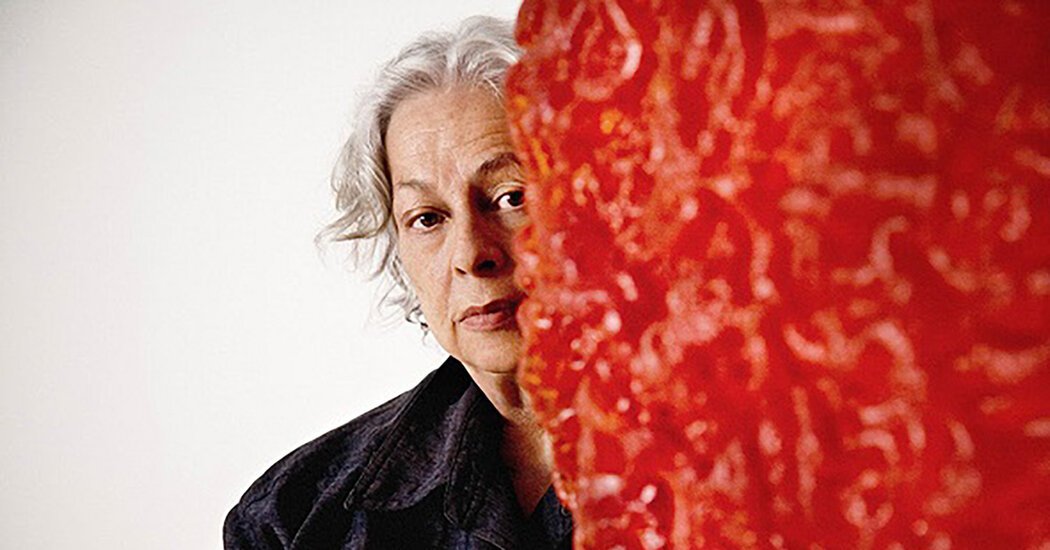
And yes, there was a wedding dress (Anderson declined to comment on whether the romantic off-the-shoulder gown bore any resemblance to Swift’s). But above all, the collection was a love letter to a very different artist: the iconoclastic 84-year-old American sculptor Lynda Benglis.
For more than 50 years, Benglis has been the art world’s mischievous alchemist, creating art that blurs the line between painting and sculpture. She transforms industrial materials — wire mesh, latex, plaster — into puckered knots that cling to the wall and gloopy puddles that congeal on the floor, and, more recently, molding, pulling and stretching a paper “skin” over chicken wire.
Now Dior has transformed her work into wraps, hats, and dresses that quiver and undulate as they move down the runway. “I feel very lucky” that Dior was inspired by my work, said Benglis, who lives in Santa Fe, N.M. Of Anderson, she added, “He’s totally open and a good partner.”
The admiration is mutual. “I think she’s one of the most important living sculptors in America — in the world,” Anderson said of Benglis in a telephone interview. “If I can do a couture show and 20 people know about her who didn’t before,” he considers the effort a success.
Those who were previously unfamiliar with the Louisiana-born artist will have plenty of opportunities to acquaint themselves with her oeuvre in the coming year. On Sep. 11, Pace Gallery will debut an exhibition of sculptures Benglis created between 1972 and 2024. The knotted, tied and folded constructions made out of ceramic, bronze, glass and paper showcase her relentless experimentation.
Next spring, a major Benglis retrospective will open at the Kunstmuseum Basel (Mar. 13 – Aug. 1, 2027) before traveling to Tate Modern in London (Sep. 30 – Mar. 5, 2028) and the Louisiana Museum of Modern Art in Humlebaek, Denmark (May – Sep. 2028). They come on the heels of shows from Manhattan’s Lower East Side to the 10th Biennial of Painting in Belgium to the Barbican in London.
“You can’t say she’s the most overlooked, important sculptor of the ’70s anymore,” said Marc Glimcher, the chief executive of Pace, which signed Benglis in 2019. The gallery was most recently in the news for dramatically downsizing its artist roster and staff, citing a challenging art market. But Glimcher insists that demand for Benglis’s work is stronger than ever; the problem is that her most important series are in museum collections, or closely guarded by the artist, who is reluctant to part with them. Her pleated sculptures, which served as a key influence for Anderson’s collection, cost between $1.5 million and $3 million, Glimcher said.
Benglis emerged in the aftermath of Abstract Expressionism and minimalism. While her male peers were making rigid, heavy constructions out of steel and chrome, she stood out with sculpture that felt fluid, almost liquid. (Although she may not be a household name today, her audacious work earned her a profile in Life magazine at just 28.) She eagerly embraced color and vulgarity. “Sparkle Knot,” a key early wall-mounted work from 1972 covered in rainbow paint and glitter, will be included in the Pace show.
Anderson first encountered Benglis’s work in 2015, on a visit to the Hepworth Wakefield, a museum in West Yorkshire, England. “I could see that he was immediately taken with this artist that he’d never heard of,” said Andrew Bonacina, then the museum’s chief curator. (Bonacina is now an independent curator and creative consultant for Dior, helping facilitate its artist collaborations.)
Anderson went on to acquire at least half a dozen sculptures by Benglis, including one that glows in the dark and hangs in his bathroom.
His creative partnership with her has taken many forms. Anderson included Benglis’s work in “Disobedient Bodies,” an exhibition he organized at the Hepworth Wakefield in 2017. When he was creative director of the Spanish fashion house Loewe, her art lined his runways twice. She also designed a limited-edition collection of jewelry for Loewe in 2024. While some artists might feel uneasy about having their art adapted into luxury clothing or accessories, Benglis finds it “fun.” “I think people should indulge themselves,” she said.
As soon as Anderson took the Dior job last summer, he knew he wanted his first couture collections to be homages to the artists who have inspired him most. “It’s quite petrifying going into a house like Dior,” Anderson said. “I can’t be the only voice in a brand. I find it can get lonely.” His first couture show in January was a tribute to the Kenyan British ceramist Magdalene A.N. Odundo. Anderson translated her supple, anthropomorphic vessels into bulbous skirts.
The following month, the designer and Bonacina began working on this season’s collection with Benglis. They drew up a contract; Bonacina confirmed the artist was paid a fee, but declined to elaborate on the details. According to Anderson, Benglis “signed off on every single piece.”
On several purses, she had notes. The bags resemble sculptures Benglis created between the 1970s and 1990s by manipulating hand-pleated wire mesh armatures into knots, ties, and twists, then spraying them with liquid metal, wrapping them with cotton bunting or covering them in gold leaf. (Several examples from these series will be shown at Pace.) Anderson said Benglis “thought the colors were too polite” in Dior’s interpretations.
The designer couldn’t resist sneaking a particularly “if you know, you know” reference into the collection: a garment emblazoned with a spectral, blurred-out figure in the shape of Benglis’s torso from a controversial ad she took out in Artforum in 1974, when she was 33 and a rising star in New York. In the real ad, she is nude and oiled up, riding a massive sex toy.
Benglis has described the stunt as the “ultimate mockery of the pinup and the macho.” It caused an uproar in the art world and has since threatened to overshadow the rest of her work. Perhaps that’s why Anderson kept the nod subtle. Or, maybe, he is simply well aware of the limits of art and fashion crossovers. Although he said he was “tempted” to include the uncensored version, “I think my bosses might not have got the reference.”

