
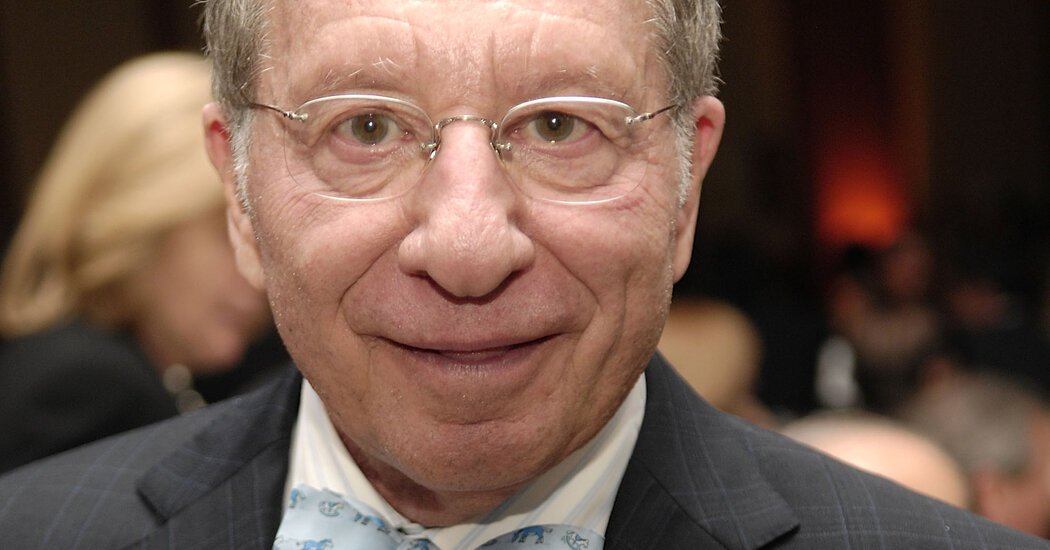
William D. Zabel, the virtuoso divorce lawyer who played a pivotal role in voiding the criminal conviction of an interracial couple married in violation of Virginia law and who clawed back billions of dollars from Bernard L. Madoff’s Ponzi scheme by engineering what was at the time the largest civil forfeiture in American history, died on Tuesday at his home in Bedford, N.Y. He was 89.
His wife, Deborah M. Miller, said the cause was Parkinson’s disease.
The cherubic, bow-tied Mr. Zabel (pronounced ZAY-bull) drafted wills and negotiated prenuptial agreements and marital breakups for the rich and famous — among them George Soros, Rupert Murdoch, Jacqueline Kennedy Onassis, Kerry Kennedy, the golfer Greg Norman, Howard Stern, the heiress Doris Duke, Jack Welch of General Electric, the society figure Claus von Bülow, the Astor heir Anthony D. Marshall and the family of the philanthropist Avery Fisher.
But he also had an enduring commitment to civil rights that began when he was a student at Princeton University in the 1950s. There, he enlisted Albert Einstein at the nearby Institute for Advanced Study to sign a petition demanding that the federal government pursue the accused killers of Emmett Till, a Black teenager lynched in Mississippi in 1955 for whistling at a white woman.
Mr. Zabel went on to become the chairman of Immigrant Justice Corps, a training organization for lawyers, and Human Rights First, a nonprofit group he helped establish.
He often said that he considered his greatest legacy to be his role in Loving v. Virginia, the case in which the U.S. Supreme Court overturned the conviction of Mildred and Richard Loving.
She was Black and of Rappahannock and Cherokee descent; he was white. They married in Washington, D.C., in 1958, and then returned to Virginia, where they were accused of trying to evade the state’s ban on interracial marriage. Their prison sentence was suspended when they promised to leave Virginia.
Melvin Wulf, the legal director of the American Civil Liberties Union, enlisted Mr. Zabel, who had argued against anti-miscegenation laws in a Harvard Law School moot court competition and an article in The Atlantic.
Mr. Zabel became the lead author of the pivotal amicus brief supporting the Lovings, which proved persuasive. He argued that the statute under which the Lovings had been charged was discriminatory because it specifically made race an element of a crime.
In 1967, the Supreme Court unanimously overturned the couple’s convictions, declaring that “under our Constitution, the freedom to marry, or not marry, a person of another race resides with the individual, and cannot be infringed by the State.” The decision enshrined marriage as a fundamental right under the 14th Amendment, which provides for “equal protection of the laws.”
“You could not say this case was not violative of the equal protection clause of the Constitution, because it denied people of different races marriage,” Mr. Zabel told The American Lawyer in 2016.
The Loving decision was later cited as a precedent in federal court decisions declaring that bans on same-sex marriage were unconstitutional.
Mr. Zabel also played an essential role in enabling compensation for victims of the vast fraud scheme that Mr. Madoff ran. In 2020, Mr. Zabel represented the estate of Jeffry M. Picower, a longtime Zabel client who had been a major investor with Mr. Madoff and a defendant in a civil suit filed by the Madoff bankruptcy trustee. (Mr. Picower died in 2009.)
Of the more than $4 billion made available to victims, approximately $2.2 billion was collected as part of the civil-forfeiture recovery from the Picower estate that Mr. Zabel negotiated. (An additional $1.7 billion was collected as part of a deferred prosecution agreement with JPMorgan Chase.) The settlement enabled victims of the Ponzi scheme to be compensated.
In 2016, Mr. Zabel endowed a professorship in human rights at Harvard Law School. (The Harvard Law Bulletin wrote that, in response, Justice Sonia Sotomayor of the U.S. Supreme Court remarked, “You have remained true to the lawyer’s responsibilities to help secure a just world.”)
In 2023, the foundation founded by Barbara Picower, Mr. Picower’s widow, gave Princeton a gift to establish the William D. Zabel ’58 Professorship of Human Rights.
William David Zabel was born on Dec. 14, 1936, in Omaha, where his father, Louis J. Zabel, who was born in Russia, and his mother, Anne (Rothenberg) Zabel, who was born in Romania, settled after arriving in Galveston, Texas. The family later moved to Sioux Falls, S.D., where his father ran a scrap-iron yard and his mother worked in the company’s office.
A high school debate team captain with an interest in journalism, William went on to earn a bachelor’s degree from Princeton in 1958 and won a scholarship to Harvard Law School, graduating in 1961.
The same year, he married Eleanor Breitel, the daughter of Charles D. Breitel, the chief judge of New York State’s highest court. (The marriage ended in divorce; she remarried and, as Eleanor B. Alter, became a prominent matrimonial lawyer.) In 1979, Mr. Zabel married Ms. Miller, a former executive of the American Enka Company who became a venture capital executive.
In addition to her, he is survived by two sons from his first marriage, Richard, a former deputy U.S. attorney in the office of the U.S. attorney for the Southern District of New York, and David, a television writer and producer; a stepson, Gregory Zabel; and seven grandchildren.
Mr. Zabel worked at Cleary Gottlieb Steen & Hamilton in New York until 1969, when he and partners founded what became Schulte Roth & Zabel. (Last year, the firm merged with McDermott Will & Emery to form McDermott Will & Schulte.)
Mr. Zabel’s empathy for the underdog began, in the most literal sense, when his grandfather’s dog was poisoned and a neighbor was held accountable. The neighbor was convicted of “felonious destruction of property” and fined.
“I thought it was a great thing that the law could get justice even for a little dog,” he told the Harvard Law Bulletin in 2020.
His commitment to civil rights was influenced by one of South Dakota’s U.S. senators, George McGovern, a friend of the family.
“He once took me to the Sioux Indian reservation in Pine Ridge,” Mr. Zabel told Princeton Generations, an alumni magazine, in 2023. “I saw how brutally they were treated, and it stuck with me.”
In 1964, he spent the summer as a volunteer civil rights lawyer in Mississippi, where he was shot at by Ku Klux Klan members. In the 1980s, he helped investigate cases of government critics who were “disappeared” or murdered in Chile during Gen. Augusto Pinochet’s “dirty war.”
More recently, Mr. Zabel and his associates pursued a claim for reparations for the last living survivors of the 1921 Tulsa Race Massacre — only one is still alive, at 111 years old — which left hundreds of the city’s Black residents dead.
As a matrimonial lawyer, Mr. Zabel said he preferred mediation in private to sensational divorce cases. But when backstage bargaining failed, he could be dispassionate — “a romantic prenup is an oxymoron,” he once said — and was unafraid to play hardball in public.
In the early 2000s, he represented Jane Beasley Welch in her suit against Jack Welch, the former G.E. chief executive. According to “Perfectly Legal” (2003), by David Cay Johnston, a former New York Times reporter, Mr. Welch offered his estranged wife $35,000 a month — which, Mr. Johnston wrote, was less than Mr. Welch made during a single day of retirement.
To bolster Mrs. Welch’s demand for a larger share of the marital estate, Mr. Zabel filed, for all to see, a list of the perquisites and other assets provided to Mr. Welch by G.E., including an apartment at Trump International Hotel & Tower in Manhattan valued at $80,000 a month (in addition to the couple’s five homes), access to a Boeing 737 corporate jet and membership at a range of country clubs.
In 2003, Mr. Welch agreed to pay his former wife some $180 million, or about $325 million today.
Mr. Zabel’s success in cases like that helped fund his volunteer commitment to civil rights causes.
“I have this whole pro bono civil rights and human rights history,” he told The Financial Times in 2015. “But then I have my private practice,” he added, describing it as basically “protecting the rich and allowing them to keep as much of their money as they can.”
Taking stock of his career years later, Mr. Zabel said he was most gratified by his role in the Supreme Court decision that decriminalized interracial marriage.
“I’m most proud of Loving v. Virginia because that goes in the history books,” he told Princeton Generations.
After he accepted the inaugural Robert F. Kennedy Justice Prize from the Lawyers’ Committee for Civil Rights Under Law, he told The Financial Times, three mixed-race women approached him.
“They said they wanted to thank me because they wouldn’t be alive today if their parents couldn’t have married,” Mr. Zabel recalled. “That was priceless.”
Ash Wu contributed reporting.

