
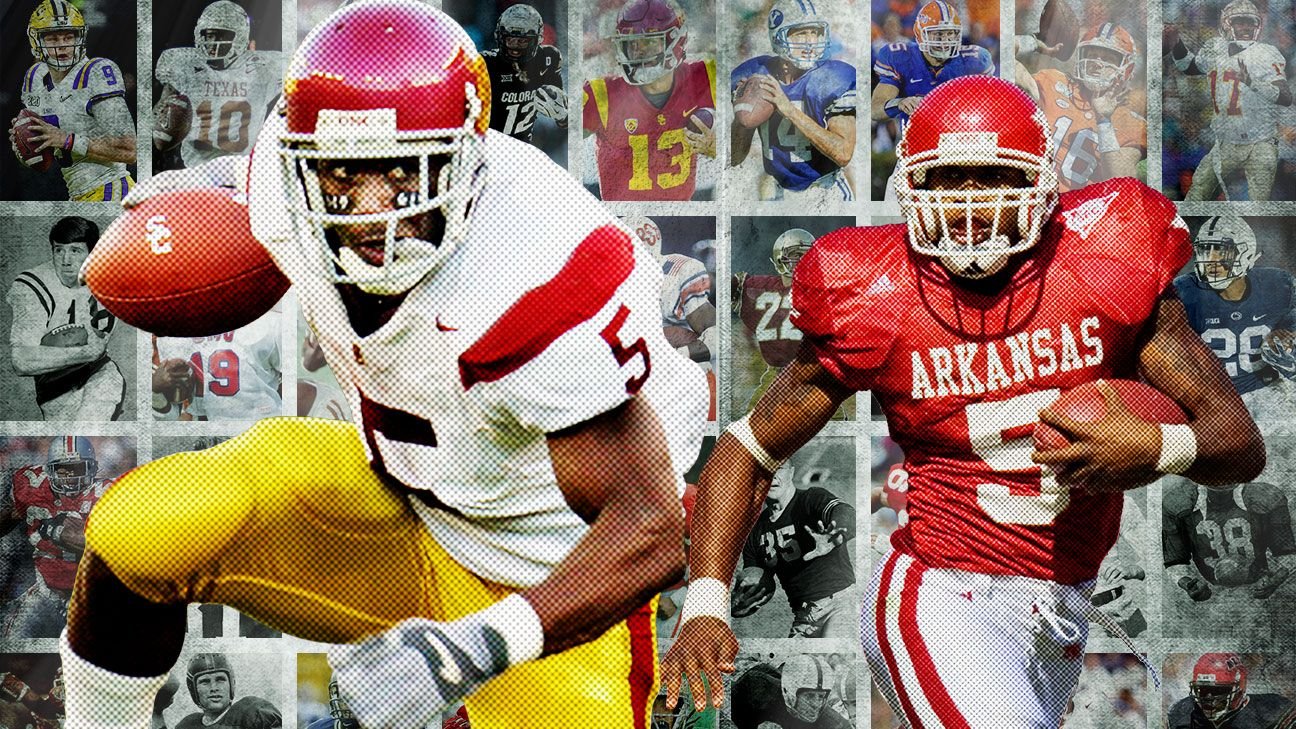
Want to start a good debate at your local bar or office water cooler? Just pose this question: Who’s the best college football player — no NFL stats! — to ever wear the No. 2 jersey?
Easy, you say. It’s clearly Johnny Manziel. The guy won a Heisman. He beat mighty Alabama at the height of Nick Saban’s powers. He was a swashbuckling controversy magnet who was famous even beyond the realm of college football fans. His nickname was Johnny Football, for crying out loud. Of course it’s him!
Well, hang on a second. We’ve got a call from a Mr. Prime on Line 2.
Oh yeah, Deion Sanders. He was pretty good — and pretty famous — as a college player, too.
At least the controversy ends there.
Wait, no. There’s also a guy by the name of Cam Newton who’d like a word. Oh, and Derrick Henry, too. Ah, don’t forget Charles Woodson. They all won Heismans. And that’s not even considering Ashton Jeanty, Justin Jefferson, Willis McGahee or Diego Pavia. We could keep going.
Yeah, you get the idea. It’s no easy task narrowing it down to one clear winner.
But, that’s what our ESPN panel of experts attempted to do — not just for the No. 2 jersey, but for 100 different uniform numbers among every player in college football history. We split our panel into four groups, each taking their share of jersey numbers (0-24, 25-49, 50-74 and 75-99) to dig deep into the archives, sift through the stats, watch some old film and pick a consensus winner.
It didn’t always go as we’d planned. For example, who would you take between these two all-time great running backs?
Player A: 39 career games, 4,470 career scrimmage yards, 43 total touchdowns, two-time All-American, two-time Heisman finalist, 19 career 100-yard games, four career 200-yard games
Player B: 38 career games, 4,955 career scrimmage yards, 51 total touchdowns, two-time All-American, two-time Heisman finalist, 25 career 100-yard games, four career 200-yard games
Both are, quite likely, among the three best running backs of all time in their respective conferences. Both shared a backfield with another accomplished and talented back. Both played in the same era. Both became solid, if not exactly legendary, NFL players (not that we’re counting those stats).
When you add all that up, you’d be splitting hairs to choose one, right?
OK, let’s dig a little deeper, as our ESPN panel did.
What if we told you that both were stellar return men, but Player A was among the best ever, compiling more than 2,000 career return yards? Would that settle the debate?
Ah, but what if we also noted that Player B had four more games against ranked foes? And what if, in those games vs. ranked opponents, he averaged more than 120 scrimmage yards, including going for 190 on the ground against a top-five team as a true freshman? Back to Square 1.
Then what if we told you that Player A was a part of one of the great dynasties in college football, playing alongside more than 30 players who’d eventually be drafted, including seven first-rounders, while Player B arrived during a transition era for his program, had less than half as many future draft picks as teammates, yet still topped 1,000 yards rushing as a freshman for a program that finished just 4-7?
Again, there are ample hairs to split, but a neutral party would probably lean just a tick toward Player B, right? So, it’s good we didn’t attach any names here, because you’d sound silly for skipping Player A, who just so happens to be Reggie Bush.
But, like the Houston Texans did in the 2006 NFL draft, we opted to pass on Bush in favor of an alternative we liked a little better, Arkansas’ Darren McFadden.
Disagree? That’s fair. Bush is a legend with two national championships, a Heisman controversy, pop-culture stardom and a long TV career under his belt. He’s still incredibly famous, and rightfully so. McFadden, on the other hand, was twice a runner-up for the Heisman, and he toiled in far more obscurity at Arkansas. But watch the two play or sift through the numbers and — although they were stylistically different — it’s hard to argue McFadden wasn’t every bit as impactful.
And that’s sort of the point here. Yes, we wanted to identify the best player to wear each jersey number, but we also wanted to take a second look at some arguments most fans considered settled and offer a fresh look to some stars whose popularity has waned even if their impact never did.
So, with that, here’s a look at our selections for every jersey number, 0 through 99, with a few choices we hope will surprise you enough that you’ll dig back into some players’ careers worthy of renewed appreciation.
A special thanks to ESPN Research for providing many of the numbers to know for this project. — David Hale
Jump to:
0-24 | 25-49 | 50-74 | 75-99

0. Xavier Watts, S, Notre Dame | 2020-24
Trophy case: Bronko Nagurski Trophy, unanimous All-American (2003), consensus All-American (2004)
Number to know: 7. Watts’ interceptions in 2023, most in the nation.
Watts arrived at Notre Dame in 2020 as a receiver — the same year the NCAA opened up the use of the number 0 — but injuries on the defensive side in the spring of 2021 opened the door to a move. He played sporadically the next two years but burst onto the national stage as a redshirt junior in 2023, picking off Heisman winner Caleb Williams twice in a 48-20 win over USC. Watts ended the year with an FBS-best seven interceptions. He followed with six more in 2024, making him the only player in the country to post back-to-back seasons of six or more INTs in the past decade.
Three others: RB Ollie Gordon, Oklahoma State; WR Jordyn Tyson, Arizona State; LB Anthony Hill Jr., Texas — Hale

1. Larry Fitzgerald, WR, Pitt | 2002-03
Trophy case: Biletnikoff Award, Walter Camp Player of the Year Award, unanimous All-American, Big East Offensive Player of the Year, College Football Hall of Fame
Number to know: 18. Fitzgerald caught at least one touchdown pass in 18 straight games, an NCAA record.
In just his second college game, Fitzgerald caught 10 passes for 103 yards against Texas A&M, an early statement for one of the best receivers in college football history. Fitzgerald came into his own a few weeks later, catching five passes for 105 yards and three touchdowns in a win over No. 3 Virginia Tech, finishing his freshman season with 69 receptions and 1,005 yards. A year later, he took things to a whole new level, leading the Big East with 92 catches, and leading the country with 1,672 yards and 22 touchdowns. He finished runner-up to Oklahoma QB Jason White for the Heisman, was selected by the Arizona Cardinals with the third pick in the NFL draft and went on to a Hall of Fame pro career.
Three others: QB Kyler Murray, Oklahoma; WR Ja’Marr Chase, LSU; WR Anthony Carter, Ohio State — Hale

2. Deion Sanders, DB, Florida State | 1985-88
Trophy case: Two-time unanimous All-American, Jim Thorpe Award, College Football Hall of Fame
Number to know: 1,429. That’s Sanders’ career punt return yardage, which ranks ninth all time in Division I and, four decades after his college career ended, is still the best in FSU history.
A three-sport star at Florida State, Sanders excelled at baseball and on the track, but football was where he first became a household name. Sanders was a three-time All-American (third team in 1986), racked up 14 career interceptions and set the FSU record for career punt return yardage. His interception to seal a 13-7 win over Auburn in the 1989 Sugar Bowl capped one of the most outstanding college careers of any athlete and ushered in a new era at Florida State. Sanders’ star power did more than just make FSU a national contender. It made the Seminoles cool to a generation of new fans and redefined what playing cornerback could be for the next generation of elite athletes.
Three others: QB Cam Newton, Auburn; CB Charles Woodson, Michigan; RB Derrick Henry, Alabama — Hale

3. Carson Palmer, QB, USC | 1998-2002
Trophy case: Heisman Trophy, consensus All-American, Johnny Unitas Golden Arm Award, College Football Hall of Fame
Number to know: 11,818. That’s Palmer’s career passing yards, which at the time was the highest total in Pac-10 history.
Perhaps no player did more to rekindle USC’s tradition of excellence in the early 2000s than Palmer, who began his career under flagging Paul Hackett, but alongside new head coach Pete Carroll in 2001 and 2002 began the Trojans’ renaissance. In 2002, he set school records for completions (309), passing yards (3,942) and touchdowns (33) en route to an 11-win campaign — USC’s first in 23 years — and the Heisman Trophy. Palmer went on to become the No. 1 pick in the NFL draft, setting the foundation for USC to become QBU in the years that followed.
Three others: QB Joe Montana, Notre Dame; WR Keyshawn Johnson, USC; RB Todd Gurley, Georgia — Hale

4. Deshaun Watson, QB, Clemson | 2014-16
Trophy case: Two-time Heisman finalist, consensus All-American, two-time Manning Award, two-time Davey O’Brien Award
Number to know: 420. That’s Watson’s passing yardage in the 2017 national championship game against Alabama, which boasted the nation’s No. 1 defense entering play. Watson’s last-second touchdown pass to Hunter Renfrow secured the Tigers’ first national title since 1981.
In Watson’s first game, against Georgia, he came off the bench and delivered an awe-inspiring TD pass (in a losing effort) that would set the tone for things to come. In his first start four weeks later, he threw for 435 yards and six touchdowns against North Carolina. Playing on a torn ACL, he led Clemson to its first win over South Carolina in six years in the final game of his freshman season. As a sophomore, he took Clemson to the College Football Playoff and pushed Alabama to the brink. A year later, his touchdown pass to Renfrow became one of the school’s most iconic moments. He finished in the top three in Heisman voting twice and wrapped his Clemson career with a record of 32-3, ushering the Tigers dynasty in the ACC and putting the program on the short list of annual title contenders.
Three others: DB Champ Bailey, Georgia; RB Dalvin Cook, Florida State; RB Jeremiyah Love, Notre Dame — Hale

5. Darren McFadden, RB, Arkansas | 2005-07
Trophy case: Three-time first-team All-SEC, consensus All-American, unanimous All-American, two-time Heisman runner-up, two-time Doak Walker Award, two-time Jim Brown Award, College Football Hall of Fame
Number to know: 4,590. McFadden’s career rushing total ranks third all time in SEC history, trailing only Herschel Walker and Nick Chubb (who played one more year than McFadden).
One of just three players to win consecutive Doak Walker awards, McFadden is arguably the best running back the SEC has seen since Herschel Walker. His 5,881 career all-purpose yards rank second in SEC history. He finished with 22 career 100-yard games — nearly 60% of all the games he played — and twice finished runner-up for the Heisman. The No. 5 jersey offers a who’s who of elite running backs, making any selection here a difficult one, but those who saw McFadden play against brutally tough SEC defenses knows he was a cut above.
Three others: RB LaDainian Tomlinson, TCU; RB Reggie Bush, USC; RB Christian McCaffrey, Stanford — Hale

6. Baker Mayfield, QB, Texas Tech/Oklahoma | 2013-17
Trophy case: Heisman Trophy, three-time Big 12 Offensive Player of the Year, two-time first-team All-American, Walter Camp Award, Davey O’Brien Award, Maxwell Award, Manning Award
Number to know: 153. Mayfield’s career touchdown total — passing, rushing and receiving — ranks fourth all time in NCAA history and first in Big 12 history. Mayfield had at least two passing touchdowns in each of his final 27 college games, an NCAA record.
A walk-on at Texas Tech as a true freshman, Mayfield transferred to Oklahoma and blossomed into a star. In 2015, he led the Big 12 in completion percentage (68.1), touchdown passes (36) and yards per attempt (9.4). In 2016, he was better across the board, completing 71% of his throws for 3,965 yards and 40 touchdowns. Then, after two straight seasons as a Heisman finalist, Mayfield wrapped his college career in 2017 by winning the award after posting a 70.5% completion rate, throwing 43 touchdowns and racking up 4,627 passing yards. Mayfield’s career totals: 14,607 passing yards (third in Big 12 history), 131 passing touchdowns (second) and a 175.4 passer rating (second). He became the No. 1 pick in the 2018 NFL draft.
Three others: QB Robbie Bosco, BYU; RB Jerome Bettis, Notre Dame; WR DeVonta Smith, Alabama — Hale

7. Michael Vick, QB, Virginia Tech | 1999-2000
Trophy case: Big East Offensive Player of the Year, first-team All-American, Archie Griffin Award, Heisman finalist, College Football Hall of Fame
Number to know: 210. That’s Vick’s rushing total against Boston College in 2000, including three rushing touchdowns.
It’s almost impossible to look back at the numbers now and understand just how special Vick was at Virginia Tech. His career totals — 3,074 passing yards, 20 touchdown passes — would hardly warrant a second glance for a single season of production in today’s game. Even his rushing totals — 585 in 1999, 617 in 2000 — aren’t exactly eye-popping. But Vick played with such electric athleticism, made so many genuinely incredible plays and completely changed the concept of what a quarterback could look like in an era before the Air Raid and spread offenses took hold that he seemed more like an alien than a football player. To truly appreciate Vick’s greatness, you had to be there. But to understand his impact requires nothing more than to scan the landscape of today’s game and see how many QBs have followed the path he blazed to help turn the position into something it had never been before.
Three others: QB John Elway, Stanford; QB Byron Leftwich, Marshall; DB Patrick Peterson, LSU — Hale

8. Davey O’Brien, QB, TCU | 1936-38
Trophy case: Heisman Trophy, national champion, unanimous All-American, two-time first-team All-Southwest Conference, College Football Hall of Fame
Number to know: 1,457. He set the NCAA passing record by throwing for that many yards in 1938. The record stood for a decade.
At just 5-foot-7 and 150 pounds, O’Brien would be out of place among most punters today, let alone quarterbacks. Even when he took over for the legendary Sammy Baugh in 1937, he had his share of doubters. But O’Brien’s size never mattered on the field. He instantly became one of the most revered quarterbacks in the game, leading TCU to a national championship in 1938 while throwing 19 touchdown passes and racking up nearly 2,100 total yards. He won the Heisman, was selected fourth in the NFL draft, was named an All-Pro, then hung up his cleats to join the FBI. Today, the Davey O’Brien Award honors the country’s best quarterback.
Three others: WR Julio Jones, Alabama; QB Marcus Mariota, Oregon; QB Lamar Jackson, Louisville — Hale

9. Joe Burrow, QB, Ohio State/LSU | 2015-19
Trophy case: Heisman Trophy, national championship, unanimous All-American, SEC Offensive Player of the Year, Maxwell Award, Walter Camp Award, Davey O’Brien Award, Johnny Unitas Golden Arm Award, Manning Award
Number to know: 6,039. Burrow set the NCAA single-season record for total yardage with 6,039 yards during his Heisman Trophy-winning campaign in 2019. Burrow won the Heisman with 93.8% of the vote, the largest margin in history.
A three-year reserve at Ohio State, then a two-year starter at LSU, Burrow unfurled one of the most decorated individual seasons in college football history in 2019. He was the face of the Tigers’ dominant, 15-0 national title run that fall, when Burrow set NCAA records in total yards (6,039) and touchdowns (65), posted the largest margin of victory in the history of the Heisman Trophy voting and scooped up just about every national award available to a quarterback. Burrow saved his best for last, accounting for 956 yards and 12 touchdowns in playoff wins over Oklahoma and Clemson. The No. 1 pick in the 2020 NFL draft, he remains the only SEC quarterback to throw for at least 5,000 yards and 50 touchdowns in a season.
Three others: WR Peter Warrick, Florida State; QB Steve McNair, Alcorn State; QB Bryce Young, Alabama — Eli Lederman

10. Vince Young, QB, Texas | 2003-05
Trophy case: Consensus All-American, national champion, Maxwell Award, Davey O’Brien Award, Big 12 Offensive Player of the Year, Big 12 Offensive Freshman of the Year, College Football Hall of Fame
Number to know: 30-2. Young went 30-2 in three seasons under center at Texas, posting a 93.8% winning percentage that ranked sixth among quarterbacks in FBS history at the time.
Immortalized by his touchdown run in the final minute of the 2005 national championship game, Young remains one of the greatest quarterbacks of the 21st century. He landed at Texas as the No. 1 overall recruit in the class of 2002, took over as the starting QB just seven games into his freshman season and lost just twice in his three seasons with the Longhorns. The first FBS passer to throw for 3,000 yards and rush for 1,000 yards in the same season, Young was a precursor to a generation of elite dual-threat quarterbacks, and he finished as Heisman Trophy runner-up to Reggie Bush in 2005. Young capped his college career with an iconic performance against USC at the Rose Bowl on Jan. 4, 2006, accounting for 467 yards of total offense and three rushing scores, including his game-winning touchdown scamper on fourth-and-5 with 19 seconds remaining to lift Texas to its most recent national championship in one of the greatest title games of all time.
Three others: QB Robert Griffin III, Baylor; QB Troy Smith, Ohio State; RB Steve Slaton, West Virginia — Lederman

11. LaVar Arrington, LB, Penn State | 1997-99
Trophy case: Butkus Award, Bednarik Award, Lambert Trophy, two-time first-team All-American, Big Ten Co-Defensive Player of the Year, College Football Hall of Fame
Number to know: 9. Arrington ranked ninth in Heisman Trophy voting in 1999, the second-best finish for a Penn State defender behind defensive tackle Mike Reid (1969).
Before Oklahoma’s Roy Williams in 2003 or Virginia Tech’s Ahmad Brooks in 2004, Arrington gave us “The Lavar Leap” in October 1998. The iconic play, which saw Arrington perfectly time his jump over the Illinois offensive line and smother Illini rusher Elmer Hickman for a loss, burnished Arrington’s status among the sport’s most-feared linebackers. He earned the first of his two first-team All-American honors and became the first sophomore named Big Ten Defensive Player of the Year that fall. A year later, in 1999, Arrington exploded for 173 tackles, 19 sacks and three interceptions, earning a unanimous All-America selection, the Butkus, Bednarik and Lambert awards and a ninth-place finish in Heisman Trophy voting.
Three others: QB Matt Leinart, USC; QB Steve Spurrier, Florida; QB Kellen Moore, Boise State — Lederman

12. Travis Hunter, WR/DB, Jackson State/Colorado | 2022-24
Trophy case: Heisman Trophy, two-time first-team All-American, Walter Camp Award, Biletnikoff Award, Bednarik Award, two-time Hornung Award, Big 12 Defensive Player of the Year
Number to know: 1,356. Hunter logged 1,356 snaps between offense and defense during his Heisman Trophy campaign in 2024, 434 more than any other FBS player that fall. He was on the field for 84% of Colorado’s snaps that season. No other FBS player was on the field for more than 56% of their team’s snaps.
Few players possess the ability to play both ways. Even fewer, if any, have done it at the ultra-elite level Hunter reached during his college career. ESPN’s No. 2 overall recruit in the 2022 class, Hunter followed Deion Sanders first to Jackson State, then to Colorado, where he emerged as one of the sport’s most electric playmakers on both sides of the ball. He made that work look easy in 2024, hauling in 96 passes for 1,258 yards and 15 touchdowns while allowing only 16 receptions for 177 yards and a touchdown on defense with 37 tackles and four interceptions. That performance not only landed Hunter the Heisman Trophy and Walter Camp Award, it made him the first player in college football history to win both the Biletnikoff (most outstanding receiver) and Bednarik (outstanding defensive player) awards at the end of one of the most decorated FBS seasons of all time.
Three others: QB Colt McCoy, Texas; QB Andrew Luck, Stanford; QB Roger Staubach, Navy — Lederman

13. Caleb Williams, QB, Oklahoma/USC | 2021-23
Trophy case: Heisman Trophy, unanimous All-American, Walter Camp Award, Maxwell Award
Numbers to know: 52 and 5. In his Heisman season of 2022, Williams accounted for 52 total touchdowns and threw just five picks. He’s one of just five players in FBS history with more than 50 touchdowns and five or fewer interceptions in a season.
Williams was a top recruit coming out of high school, but he seemed likely to wait his turn behind Spencer Rattler at Oklahoma until coming on in relief against rival Texas and turning in a brilliant performance that made him an overnight sensation. He finished that season with 21 touchdown passes and just four picks, then followed coach Lincoln Riley to USC and won the Heisman. His 2022 season was an all-time great campaign, in which Williams racked up 4,537 passing yards, 382 rushing yards and an FBS-high 42 passing touchdowns. He returned in 2023 for a struggling USC team but still posted the best QB rating of his career while accounting for 41 touchdowns before being drafted first by the Chicago Bears.
Three others: QB Dan Marino, Pitt; QB Gino Torretta, Miami; QB Tua Tagovailoa, Alabama — Hale

14. Ty Detmer, QB, BYU | 1988-91
Trophy case: Heisman Trophy, two-time consensus All-American, two-time WAC Offensive Player of the Year, Davey O’Brien Award, Maxwell Award, College Football Hall of Fame
Number to know: 5,188. Detmer’s passing yards in 1990 set a record at the time, narrowly edging David Klingler, who threw for 5,140 the same year as they became the first two 5,000-yard passers in college football.
BYU’s tradition of elite QBs was well established before Detmer arrived, but he took things to a new level. In the 1989 Holiday Bowl against Penn State, he set a bowl record with 594 yards, setting the stage for what would come the following year. In 1990, Detmer won the Heisman Trophy by obliterating the record for passing yards in a season, averaging 432 yards per game and upending top-ranked Miami by throwing for 406 yards and three touchdowns. He finished second nationally in passing touchdowns for three straight years (1989-1991) and led the nation in passing yards in 1990 and 1991. When his career at BYU ended, Detmer held the NCAA records for pass attempts, completions, passing yards, touchdowns and passer rating.
Three others: QB Vinny Testaverde, Miami; DB Eric Berry, Tennessee; QB Sam Bradford, Oklahoma — Hale

15. Tim Tebow, QB, Florida | 2006-09
Trophy case: Heisman Trophy, two-time Maxwell Award, Davey O’Brien Award, Manning Award, three-time All-American, two-time SEC Male Athlete of the Year, two-time national champion, BCS championship game MVP, College Football Hall of Fame
Number to know: 145. Tebow’s career touchdown tally, the most by any player in SEC history.
There’s a case to be made for Tebow as the single greatest college football player ever. There are the numbers: 145 career touchdowns, more than 13,000 career yards, an SEC-record 57 rushing touchdowns. There are the awards: He was a Heisman finalist three times and was the first sophomore ever to win it in 2007. There are the wins: Tebow was a critical part of Florida’s 2006 title as Chris Leak’s backup, then he won one of his own in 2008. But what truly sets Tebow apart is the mythology. From his “promise” speech after the 2008 loss to Ole Miss, which is now immortalized on a statue, to the legendary jump pass against LSU to the raw determination with which he led — he might not be the best to ever strap on a helmet, but there’s definitely no one else like him.
Three others: QB Drew Brees, Purdue; QB Tommie Frazier, Nebraska; QB Fernando Mendoza, Cal and Indiana — Hale

16. Trevor Lawrence, QB, Clemson | 2018-20
Trophy case: Heisman runner-up, All-American, two-time All-ACC, Archie Griffin Award, national champion
Number to know: .944. Lawrence’s win-loss record of 34-2 as a starter at Clemson gives him the third-best winning percentage by a QB since the Division I split in 1978, trailing only Miami’s Ken Dorsey (.950) and USC’s Matt Leinart (.949) (minimum 30 starts).
The No. 16 jersey has belonged to two all-timers who — controversially — never won a Heisman: Lawrence and Peyton Manning. Both were highly touted recruits. Both became No. 1 NFL draft picks. Both had spectacular careers. Here are the key differences: Lawrence won a national championship, while Manning left the year before Tennessee won it all. Lawrence had more touchdown passes and passing yards despite playing in fewer games. Lawrence was elite from the jump, while Manning needed a year to really find his footing. Is all of that splitting hairs? Sure. But Lawrence’s final tally — 67% completions, 90 touchdown passes, 17 interceptions, 10,098 passing yards and a 34-2 record as a starting QB — more than warrants his place here.
Three others: QB Gary Beban, UCLA; QB Peyton Manning, Tennessee; QB Chris Weinke, Florida State — Hale

17. Charlie Ward, QB, Florida State | 1991-93
Trophy case: Heisman Trophy, Maxwell Award, Johnny Unitas Golden Arm Award, Walter Camp Award, Davey O’Brien Award, unanimous All-American, College Football Hall of Fame
Number to know: 19. Ward set 19 school records over his two seasons as the Seminoles’ starting quarterback.
Ward became one of the greatest two-sport stars in the history of college athletics during his decorated career in Tallahassee. He led the Seminoles to their first national championship in 1993 as a Heisman winner and consensus All-American, went 22-2 as their starter and was also a four-year starter at point guard who helped take the Florida State men’s basketball team to the Elite Eight in 1993. Ward earned back-to-back ACC Male Athlete of the Year honors and went on to become a first-round NBA draft pick for the New York Knicks.
Three others: QB Don Meredith, SMU; QB Bobby Dodd, Tennessee; QB Philip Rivers, NC State — Max Olson

18. Archie Manning, QB, Ole Miss | 1968-70
Trophy case: SEC Player of the Year, two-time All-American, two-time All-SEC, College Football Hall of Fame
Number to know: 56. Manning held the Ole Miss career touchdowns record with 56 for more than three decades until his son Eli broke it as a senior in 2003.
The iconic matriarch of football’s royal family became an SEC legend in his three seasons as Ole Miss’ record-setting starting quarterback. Manning finished fourth in Heisman Trophy voting in 1969 and led the Rebels to four wins over top-10 opponents, including an upset of No. 3 Arkansas in the Sugar Bowl, for a No. 8 finish in the AP poll. He came back from a broken left arm that should have ended his senior season, playing with a cast for his final two games with the Rebels and earning a third-place finish in Heisman voting before the New Orleans Saints made him the No. 2 pick in 1971.
Three others: QB Jason White, Oklahoma; WR Marvin Harrison Jr., Ohio State; QB Roman Gabriel, NC State — Olson

19. Eric Dickerson, RB, SMU | 1979-82
Trophy case: Two-time SWC Offensive Player of the Year, two-time All-American, College Football Hall of Fame
Number to know: 28. Dickerson surpassed 100 rushing yards in 28 career games at SMU, one of his 12 school records that still stand.
Dickerson was a dominant force during his run at SMU, breaking Earl Campbell’s Southwest Conference rushing record with 4,450 career yards and 47 rushing touchdowns. He teamed with Craig James to form the Pony Express and help the Mustangs win back-to-back Southwest Conference titles in 1981 and 1982 as the conference’s leading rusher each season. Dickerson finished third in Heisman voting at the end of an 11-0-1 senior season and SMU’s No. 2 finish in the polls, then went No. 2 to the Los Angeles Rams in the 1983 NFL draft.
Three others: RB Rashaan Salaam, Colorado; TE Brock Bowers, Georgia; QB Keenan Reynolds, Navy — Olson

20. Earl Campbell, RB, Texas | 1974-77
Trophy case: Heisman Trophy, Davey O’Brien Award, two-time All-American, College Football Hall of Fame
Number to know: 11. Campbell surpassed 100 rushing yards in 11 consecutive games to close out his Heisman-winning senior season with the Longhorns.
Coaches liked to say Campbell was the only player they had seen who could have skipped college and gone right from high school to the NFL. The incomparable “Tyler Rose” rushed for 4,443 career yards and 40 touchdowns and became the Longhorns’ first Heisman Trophy winner. Back to full strength after an injury-plagued junior season, Campbell was unstoppable in 1977, leading the nation with a Southwest Conference-record 1,744 rushing yards, including 222 yards against rival Texas A&M to close out Texas’ undefeated regular season. He went No. 1 to the Houston Oilers in 1978 and led the NFL in rushing each of his first three seasons.
Three others: RB Johnny Rodgers, Nebraska; RB Billy Sims, Oklahoma; S Ed Reed, Miami — Olson

21. Barry Sanders, RB, Oklahoma State | 1986-88
Trophy case: Heisman Trophy, Maxwell Award, Walter Camp Award, two-time All-American, College Football Hall of Fame
Number to know: 34. Sanders set 34 NCAA records during his unprecedented 1988 season and owns or shares nearly 30 entries in the FBS record book to this day.
The greatest season by a running back — and arguably any player — in college football history still belongs to Sanders. After two years as a backup to Thurman Thomas, the 5-foot-8 back took over as a junior and lit up Big 8 defenses in legendary fashion with 2,850 rushing yards and 44 total touchdowns over 12 games. That epic run to the Heisman Trophy included four 300-yard performances on the season and a whopping 1,472 rushing yards over his final five regular-season games.
Three others: WR Desmond Howard, Michigan; RB Frank Sinkwich, Georgia; WR Calvin Johnson, Georgia Tech — Olson

22. Doug Flutie, QB, Boston College | 1981-84
Trophy case: Heisman Trophy, Maxwell Award, Davey O’Brien Award, unanimous All-American, College Football Hall of Fame
Number to know: 10,579. Flutie became the first 10,000-yard passer in FBS history with 10,579 yards over his four seasons at Boston College.
The charismatic 5-foot-9 passer made an unforgettable impact at Boston College. Flutie took over as a starter during his freshman season, never missed a game and led a major turnaround for the Eagles from 5-6 to 10-2 with a AP top-five finish in 1984 and the program’s first bowl victory in more than four decades. Flutie finished third in Heisman voting in 1983 and took home the trophy as a senior, one week after his iconic Hail Mary pass to Gerard Phelan to stun Miami.
Three others: RB Emmitt Smith, Florida; RB John Cappelletti, Penn State; RB Mark Ingram, Alabama — Olson

23. Jonathan Taylor, RB, Wisconsin | 2017-19
Trophy case: Two-time Doak Walker Award winner, two-time first-team All-American
Number to know: 1,977. Taylor broke the FBS record for most rushing yards by a true freshman in 2017 with 1,977 yards and 13 touchdowns.
Taylor arrived at Wisconsin as a three-star recruit from New Jersey and became the Big Ten’s most dominant running back as soon as he took the field. He hit 1,000 rushing yards within his first seven career games and surpassed 2,000 yards from scrimmage in each of his three seasons with the Badgers. Taylor’s 12 career games of 200-plus rushing yards set an FBS record, as did his career 6.7 yards per carry average. He finished No. 4 in FBS history with 6,174 career rushing yards and punched in 55 touchdowns for the Badgers before becoming an All-Pro in the NFL.
Three others: RB/DB Leroy Keyes, Purdue; RB Jim Swink, TCU; RB Lance Alworth, Arkansas — Olson

24. Nile Kinnick, HB, Iowa | 1937-39
Trophy case: Heisman Trophy (1939), Maxwell Award (1939), Walter Camp Award (1939), AP Male Athlete of the Year (1939), two-time All-American (third team in 1937, first team in 1939), College Football Hall of Fame (1951)
Number to know: 18. Kinnick still shares the Iowa interceptions record after picking off 18 passes during his career.
The namesake of Iowa’s football stadium was a do-it-all star as a passer, rusher, defender, kicker and kick returner who rarely left the field. Kinnick produced 1,012 total yards on offense, eight interceptions on defense and was involved in 107 of Iowa’s 130 points during his run to a 6-1-1 season and the Heisman Trophy in 1939. His eloquent acceptance speech, delivered months after World War II began, remains arguably the finest in the award’s history. Kinnick turned down pro football for law school, enlisted in the Navy Air Corps Reserve and died during a training flight at the age of 24.
Three others: RB Pete Dawkins, Army; RB Joe Washington, Oklahoma; RB Knowshon Moreno, Georgia — Olson

25. Tommy McDonald, HB, Oklahoma | 1954-56
Trophy case: Maxwell Award, two-time first-team All-American, two-time national champion, College Football Hall of Fame
Number to know: 11. McDonald became the first Oklahoma player to score a TD in every game of a season in 1955, when the Sooners won the first of consecutive national titles.
McDonald was one of the defining players of Oklahoma’s 47-game winning streak. The next year, he finished third in the Heisman voting. McDonald might have won it had he and teammate Jerry Tubbs, who placed fourth, not split the Oklahoma vote; McDonald actually earned more first-place votes than winner Paul Hornung. In 1985, McDonald was inducted into the College Football Hall of Fame — 13 years before he was enshrined into the Pro Football Hall of Fame.
Three others: WR Fred Biletnikoff, Florida State; RB Melvin Gordon, Wisconsin; WR Rocket Ismail, Notre Dame — Jake Trotter

26. Saquon Barkley, RB, Penn State | 2015-17
Trophy case: Paul Hornung Award, consensus All-American, two-time Big Ten Offensive Player of the Year
Number to know: 3K/1K. First player in Penn State history and fourth in Big Ten history to gain 3,000-plus rush yards and 1,000-plus receiving yards in a career.
Barkley was electrifying from the moment he arrived in State College in 2015, as his penchant for breaking long runs and his versatility as an all-purpose player set the stage for what was to come. By the time his three-year career with the Nittany Lions ended, Barkley set nine school records — including career rushing touchdowns (43), career total touchdowns (53) and career all-purpose yards (5,538) and became the only player in Penn State history to gain 3,000 rushing and 1,000 receiving yards in a career. His 3,843 career rushing yards rank No. 2 all time at Penn State.
Three others: DB Rod Woodson, Purdue; S Sean Taylor, Miami; Landon Collins, Alabama — Andrea Adelson

27. Eddie George, RB, Ohio State | 1992-95
Trophy case: Heisman Trophy, Walter Camp Award, Doak Walker Award, College Football Hall of Fame
Number to know: 12. Number of consecutive games with 100-plus rushing yards in 1995, an Ohio State record. His 148.2 rushing yards per game that season also remains an Ohio State record.
George rushed for 3,578 yards and 43 touchdowns in his career, culminating with his senior season when he set an Ohio State record with 1,927 rushing yards and led the country with 24 rushing touchdowns. George also caught 44 passes that season. He won the Heisman, earned the Doak Walker Award and the Walter Camp Award and was named the Big Ten’s MVP. George was inducted into the College Football Hall of Fame in 2011. He’s now the head coach at Bowling Green.
Three others: HB Joe Bellino, Navy; S Bennie Blades, Miami; CB Terrell Buckley, Florida State — Trotter

28. Marshall Faulk, RB, San Diego State | 1991-93
Trophy case: WAC Offensive Player of the Year, three-time All-American, College Football Hall of Fame
Number to know: 1. As in becoming the first freshman to lead the nation in scoring (140 points) and rushing (158.8 yards per game) in 1991.
Talk about making a big first impression: In his first start as a true freshman against Pacific in Week 2, Faulk rushed for 386 yards, an NCAA record at the time. He did not slow down from there, becoming the first freshman in history to lead the nation in scoring (140 points) and rushing (158.8 yards per game) in the same season in 1991. He led the nation in rushing in 1991 and 1992, the fifth player in NCAA history to do that in consecutive seasons. A three-time Heisman finalist, Faulk finished his career with 5,562 all-purpose yards and 62 total touchdowns.
Three others: RB Adrian Peterson, Oklahoma; RB Montee Ball, Wisconsin; RB Warrick Dunn, Florida State — Adelson

29. Rickey Dixon, S, Oklahoma | 1984-87
Trophy case: Jim Thorpe Award, first-team All-American, College Football Hall of Fame
Number to know: 9. Oklahoma single-season interception record holder (9). He also ranks second at the school with 17 career interceptions (behind Darrell Royal, 18).
Dixon, who was inducted into the College Football Hall of Fame in 2020, still holds the OU season record with nine interceptions in 1987. That year, he picked off Mike Gundy to seal a win over Oklahoma State in Bedlam. Two weeks later, he intercepted two passes as the second-ranked Sooners knocked off top-ranked Nebraska 17-7 in Lincoln to advance to the Orange Bowl. Dixon also went 3-0-1 in his career against Texas, with two more interceptions in a 44-9 rout of the Longhorns in 1987. Over his four seasons, the Sooners went 42-5-1 with four Orange Bowl appearances and a national title.
Three others: S Minkah Fitzpatrick, Alabama; LB Jarvis Jones, Georgia; HB Hugh Gallarneau, Stanford — Trotter

30. Mike Rozier, RB, Nebraska | 1981-83
Trophy case: Heisman Trophy; Maxwell Award; Walter Camp Award, College Football Hall of Fame
Number to know: 29. Each of Rozier’s 29 TDs in 1983 came on the ground, an NCAA record.
Rozier put together one of the best single-season rushing performances of all time in 1983 en route to the Heisman Trophy, when he set the Nebraska record with 2,148 yards on the ground and 29 rushing touchdowns. In addition, he set school records for attempts in a season (273) and career (668) and also set the single-season school record for points (174) and all-purpose yards (2,486). Rozier still holds the school record for career rushing yards with 4,780, and his 52 career touchdowns are best among running backs. Only quarterback Eric Crouch has more.
Three others: RB Greg Pruitt, Oklahoma; Napoleon McCallum, Navy; Alex Wojciechowicz, Fordham — Adelson

31. Vic Janowicz, HB, Ohio State | 1949-51
Trophy case: Heisman Trophy, unanimous All-American, College Football Hall of Fame
Number to know: 4. Positions Janowicz played (HB, S, P, K). Was also one of two Heisman winners to play Major League Baseball.
A two-way star for the Buckeyes, Janowicz could do it all. In an 83-21 win over Iowa in 1950, Janowicz completed five passes for four touchdowns, ran for another two scores, including a 61-yard punt return, and broke a Big Ten record with 10 extra points. After winning the Heisman in 1950, he ended his college career by playing for new coach Woody Hayes. His No. 31 was the second jersey retired by Ohio State.
Three others: LB Paul Posluszny, Penn State; DE Will Anderson Jr., Alabama; CB Dre Bly, North Carolina — Trotter

32. Johnny Lujack, QB/HB/DB, Notre Dame | 1943, 1946-47
Trophy case: Heisman Trophy, AP Athlete of the Year, two-time unanimous All-American, College Football Hall of Fame
Number to know: 4. The number of sports Lujack lettered in at Notre Dame (football, basketball, track and baseball).
Simply put, Lujack did it all at Notre Dame, playing quarterback, halfback and defensive halfback. After spending three years in the Navy in the middle of his career, Lujack led the Irish to back-to-back national titles when he returned in 1946 and 1947. His touchdown-saving tackle on Doc Blanchard against No. 1 Army preserved a 0-0 tie and helped the Irish claim the title in 1946. Over those two seasons, he never lost a game, going 17-0-1. The first four-sport letterman at Notre Dame since 1912.
Three others: RB O.J. Simpson, USC; RB Franco Harris, Penn State; S Jack Tatum, Ohio State — Adelson

33. Tony Dorsett, RB, Pittsburgh | 1973-76
Trophy case: Heisman Trophy, Maxwell Award, Walter Camp Player of the Year, three-time first-team All-American, College Football Hall of Fame
Number to know: 18. Set or tied 18 collegiate rushing records, more than any other player in the history of college football.
Dorsett dazzled from the start, rushing for 1,586 yards in 1973 — at the time, the most by a true freshman. Dorsett kept going, all the way to an NCAA record 6,082 career yards rushing, a mark that stood for 22 years (until Texas’ Ricky Williams broke it). Along the way, he set or tied 18 NCAA records, more than any other college player in history at that time. His final season was remarkable. In his final seven games, he averaged a whopping 215 yards rushing to not only become the first Heisman winner in Pitt history but also help the Panthers win the 1976 national title.
Three others: RB Ron Dayne, Wisconsin; RB Marcus Allen, USC; James Laurinaitis, Ohio State — Adelson

34. Herschel Walker, RB, Georgia | 1980-82
Trophy case: Heisman Trophy, Maxwell Award, Walter Camp Award; three-time SEC Player of the Year, two-time All-American, College Football Hall of Fame
Numbers to know: 3. One of three players with three top three Heisman finishes.
When Walker left Georgia after one of the greatest careers in college football history, he had set 11 NCAA records, 16 SEC records and 41 school records in just three years. In 1980, Walker broke the single-season rushing record by a freshman with 1,616 yards while also setting NCAA marks for most all-purpose yards (1,805) and rushing touchdowns by a freshman (15) as the Bulldogs won the national title. By the time his career had ended, he had rushed for 5,529 yards and 49 touchdowns — his blend of speed, size, power and physicality making him nearly impossible to stop.
Three others: RB Bo Jackson, Auburn; RB Walter Payton, Jackson State; RB Ricky Williams, Texas — Adelson

35. Doc Blanchard, FB, Army | 1944-46
Trophy case: Heisman Trophy, Maxwell Award, unanimous All-American, College Football Hall of Fame
Number to know: 38. That’s the number of touchdowns he scored in just 28 games.
Known as “Mr. Inside,” Blanchard teamed up with Glenn “Mr. Outside” Davis to form one of the greatest one-two backfield punches in college football history. Blanchard won the Heisman in 1945, placed third in the voting in 1944 and fourth in 1946. He averaged 5.9 rushing yards per carry through his career and scored 35 touchdowns. During Blanchard’s three seasons starring for the Black Knights, Army went 27-0-1 and won three national championships. He was inducted into the College Football Hall of Fame in 1959.
Three others: HB Billy Vessels, Oklahoma; RB Alan Ameche, Wisconsin; LB Zach Thomas, Texas Tech — Trotter

36. Chris Spielman, LB, Ohio State| 1984-87
Trophy case: Lombardi Award, three-time All-Big Ten first team, three-time All-American, College Football Hall of Fame
Number to know: One of the hardest hitting linebackers in the game, Spielman was a tackling machine throughout his career at Ohio State. When he left the Buckeyes, he had the school record for career solo tackles with 283. For his career, Spielman finished with 546 total tackles, eight sacks and 11 interceptions, cementing his place as one of the greatest players in school history. Spielman was inducted into the College Football Hall of Fame in 2009.
Three others: RB Jerome Bettis, Notre Dame; DB Bennie Blades, Miami; RB Steve Owens, Oklahoma — Adelson

37. Doak Walker, HB/DB/K, SMU | 1945, 1947-49
Trophy case: Heisman Trophy, Maxwell Award, Three-time All-American, College Football Hall of Fame
Number to know: 1946. That’s the year Walker missed due to his service in the Army.
Walker had a career for the ages with the Mustangs, drawing such large crowds to watch him play at the Cotton Bowl that the stadium eventually came to be known as “The House That Doak Built.” Over his career, he played offense, defense and special teams — catching and throwing passes, piling up rush yards, making interceptions, punting, kicking and returning kicks, too. In 35 games, he gained over 3,500 yards rushing and passing, scored 40 touchdowns, made 60 extra points and averaged 39.3 yards per punt. To honor his legacy, the Doak Walker Award was established in 1990 and is awarded to the best running back in college football every year.
Three others: RB Shaun Alexander, Alabama; John Pingel, Michigan State; Tommy Casanova, LSU — Adelson

38. George Rogers, RB, South Carolina | 1977-80
Trophy case: Heisman Trophy, two-time All-American, College Football Hall of Fame
Number to know: 22. The number of consecutive games in which he rushed for 100 yards.
Over his four-year career, Rogers had 27 100-yard rushing games and left South Carolina with school records for single-season rushing yards (1,894), career rushing yards (5,204) and rushing average per game (112.7). In 1980, he became the first player from South Carolina to win the Heisman, as he rushed for more than 100 yards in every game that season, winning the award over Pitt defensive end Hugh Green and Georgia running back Herschel Walker.
Three others: S Roy Williams, Oklahoma; FB Sam Francis, Nebraska; OL John Michels, Tennessee — Adelson

39. Sam Cunningham, FB, USC | 1970-72
Trophy case: All-American, national champion, Rose Bowl Hall of Fame, College Football Hall of Fame
Number to know: 135. Number of rushing yards in his first college game (against Alabama, no less). The performance inspired coach Paul “Bear” Bryant to integrate the Crimson Tide.
He ran for 1,579 yards and 23 touchdowns in his USC career, including 13 TDs in 1972. The Trojans had a record of 24-8-2 during his three years when Cunningham earned the nickname “Bam” for his bruising goal-line dives. In his final game, Cunningham scored four touchdowns in the Rose Bowl, capping USC’s national championship season. He was the 11th overall pick of the New England Patriots in the 1973 NFL draft.
Three others: FB John Kimbrough, Texas A&M; FB Larry Csonka, Syracuse; RB Curtis Enis, Penn State — Trotter

40. Howard ‘Hopalong’ Cassady, Ohio State | 1952-55
Trophy case: Heisman Trophy, Maxwell Award, Big Ten MVP, College Football Hall of Fame
Number to know: 37. The number of touchdowns he scored in 36 games.
Cassady departed Ohio State as the school’s career leader in rushing yardage, all-purpose yardage and scoring. He won a national championship under coach Woody Hayes in 1954, then won the Heisman in a landslide vote in 1955. Cassady was named an All-American in both 1954 and 1955. After football, he worked for more than 30 years for the New York Yankees. Ohio State retired Cassady’s No. 40 jersey in 2000.
Three others: LB Luke Kuechly, Boston College; LB Dana Howard, Illinois; LB Von Miller, Texas A&M — Trotter

41. Glenn Davis, Army | 1944-46
Trophy case: Heisman Trophy, unanimous All-American, Maxwell Award, College Football Hall of Fame
Number to know: The other half of Army’s famed backfield, Davis won the Heisman in 1946. “Mr. Outside” also finished runner-up in the Heisman voting in 1944 and in 1945, when teammate Doc “Mr. Inside” Blanchard won it. Davis averaged 11.5 yards per carry in 1944 and 10.9 in 1945. He scored 36 career rushing touchdowns and caught 12 more. Davis and Blanchard became the only members of the same backfield to both win the Heisman and become three-time consensus All-Americans.
Three others: FB Keith Byars, Ohio State; RB Rob Lytle, Michigan; FB Charlie Flowers, Ole Miss — Trotter

42. Ronnie Lott, S, USC | 1977-80
Trophy case: All-American, Pac-12 All-Century Team, College Football Hall of Fame
Number to know: 8. Interceptions during his senior season. It is safe to say offensive players did everything in their power to stay away from Lott, one of the fiercest defensive players in football history — in both pro and college. A sure-handed tackler and one of the smartest players on the field, Lott helped the Trojans win the 1978 national title and two Rose Bowls. In his senior year, he led the country in interceptions. He had 14 picks during his college career. He went on to have a Hall of Fame pro career with the San Francisco 49ers.
Three others: RB Dick Kazmaier, Princeton; LB Pat Tillman, Arizona State; RB Ricky Bell, USC — Adelson

43. Troy Polamalu, S, USC | 1999-2002
Trophy case: Two-time All-American, Pac-12 All-Century Team, two-time All-Pac-12 selection, College Football Hall of Fame
Number to know: 118. The number of tackles he had for the Trojans in 2001 en route to All-America honors.
Polamalu played far bigger than his 5-foot-10 size because of his ability to find the ball and make plays superceded everything else. Known for his long black hair that spilled out from his helmet, Polamalu made trademark plays with ferocious tackling. Over four years, Polamalu had 281 tackles and six interceptions and went on to a Pro Football Hall of Fame career with the Steelers.
Three others: LB Rod Shoate, Oklahoma; RB Darren Sproles, Kansas State; Terry Kinard, Clemson — Adelson

44. Jim Brown, RB, Syracuse | 1954-56
Trophy case: Walter Camp All-Time All-American, All-American, College Football Hall of Fame
Number to know: 6.2. Set the Syracuse record for yards per rush. One of the greatest players never to win the Heisman, Brown placed just fifth in the voting in 1956 despite leading the nation with 13 rushing touchdowns. Brown earned letters in four sports at Syracuse, including basketball, track and lacrosse, in which he was an All-American. In a game against Colgate in 1956, Brown rushed for six touchdowns and kicked seven extra points for 43 individual points, breaking an NCAA record. Brown was inducted into the College Football Hall of Fame in 1995.
Three others: RB Ernie Davis, Syracuse; RB Floyd Little, Syracuse; LB Brian Bosworth, Oklahoma — Trotter

45. Archie Griffin, RB, Ohio State | 1972-75
Trophy case: Two-time Heisman Trophy winner, Maxwell Award, College Football Hall of Fame
Number to know: 31. The number of consecutive games with at least 100 yards rushing (1973-75), which is still an FBS record.
Griffin remains the only player to win the Heisman twice. He started four years for the Buckeyes, propelling Ohio State to four Big Ten titles, four Rose Bowl appearances and a record of 40-5-1. Griffin finished with 5,589 career rushing yards, a school record that still stands today. Griffin also totaled 26 touchdowns while averaging better than 6 yards per carry. He was inducted into the College Football Hall of Fame in 1986, and Ohio State retired his No. 45 jersey in 1999.
Three others: QB Sammy Baugh, TCU; HB Johnny Majors, Tennessee; LB Andy Katzenmoyer, Ohio State — Trotter

46. Khalil Mack, Buffalo | 2010-13
Trophy case: MAC Defensive Player of the Year, first-team All-American, three-time first-team All-MAC
Number to know: 16. The number of fumbles he forced, an NCAA record.
Mack was just a two-star recruit coming out of high school. After redshirting his freshman year at Buffalo, Mack became one of the most feared linebackers in recent college football history. He broke the NCAA career record with 74.5 tackles for loss. He posted 100 tackles in his final season in 2013, as Buffalo advanced to a bowl for only the second time in school history. That season in the opener against second-ranked Ohio State, Mack had 2.5 sacks and returned a pick 45 yards for a touchdown.
Three others: FB Bob Ferguson, Ohio State; LB James Laurinaitis, Ohio State; QB Harry Newman, Michigan — Jake Trotter

47. Michael Irvin, WR, Miami | 1984-87
Trophy case: Freshman All-American, University of Miami Sports Hall of Fame
Number to know: 26. His career touchdown receptions, which is still a Miami record.
Irvin never made it a secret he believed he was the best player on the field at all times. He backed up that swagger and bravado with one highlight reel catch after another, helping establish the Hurricanes as a national power in the 1980s. Famously wearing a towel hanging from his waist, Irvin emerged as a starter as a redshirt freshman in 1985 and never looked back. When he left Miami following the 1987 season, he held school career records for receiving yards (2,423) and touchdown receptions (26) and was second in receptions (143) and fourth in touchdowns (26).
Three others: DB Mel Blount, Southern; LB AJ Hawk, Ohio State; Bennie Oosterbaan, Michigan — Adelson

48. Gale Sayers, RB, Kansas | 1962-64
Trophy case: Consensus All-American, three-time All-Big 8, College Football Hall of Fame
Number to know: 99. First player in NCAA Division IA history to record 99-yard run (against Nebraska, 1963).
In his first season starring for the Jayhawks, Sayers led the country by averaging 7.1 yards per carry in 1962. Sayers finished his career with 2,674 rushing yards and 18 touchdowns, leading the Big 8 in rushing in both 1962 and 1963. In 1964, Sayers returned the opening kickoff for a touchdown, and Kansas knocked off Oklahoma for the first time in school history. In 1977, the “Kansas Comet” was inducted into the College Football Hall of Fame.
Three others: DE Terrell Suggs, Arizona State; QB Angelo Bertelli, Notre Dame; QB Otto Graham, Northwestern — Jake Trotter

49. Julius Peppers, DE, North Carolina | 1999-2001
Trophy case: Bednarik Award, Lombardi Award, two-time All-American, College Football Hall of Fame
Number to know: 1.87. His career tackles for loss per game (43.0 total) remains second-most in FBS history.
A two-sport athlete for the Tar Heels, Peppers dominated on the football field his final two seasons. In 2000, he led the nation with 15 sacks and set a school record with 24 tackles for loss. The following year, he won the Lombardi Award as the best lineman in the country, and the Bednarik Award as the best defensive player in college football. In his career, Peppers had 30.5 sacks, 53 tackles for loss, 177 total tackles, five interceptions (two interceptions returned for touchdowns) and five forced fumbles. He also played basketball for the Tar Heels.
Three others: LB Patrick Willis, Ole Miss; Bob Chappuis, Michigan; Bob Mathias, Stanford — Adelson

50. Dick Butkus, C/LB, Illinois | 1962-64
Trophy case: Three-time consensus All-American, Big Ten MVP, AFCA Player of the Year, three-time All-Big Ten, College Football Hall of Fame
Number to know: 374. His career tackles, including 145 in 1963, and 23 against Ohio State that season. Redefined the middle linebacker position as a fearsome, scowling, intimidating force. He helped lead Illinois to a 8-1-1 record in 1963, a Big Ten title and a Rose Bowl win over Washington, where Butkus made a key interception. He’s the namesake of the Butkus Award for the nation’s best linebacker, was inducted into the CFB Hall of Fame in 1983, had his number retired by Illinois in 1986 and got a statue in 2019.
Three others: C Dave Rimington, Nebraska; DT Chris Zorich, Notre Dame; WR Art Weiner, North Carolina — Dave Wilson

51. Pat Fitzgerald, LB, Northwestern | 1993-96
Trophy case: Only player to win Bednarik Award and Nagurski Trophy twice each, two-time Big Ten Defensive Player of the Year, two-time consensus All-American, Big Ten Medal of Honor, College Football Hall of Fame
Number to know: 299. His career tackles, 20 of which were for loss. A walk-on who became a legend at Northwestern, including anchoring a 1995 squad that led the nation in scoring defense and reached the Rose Bowl for the first time in 47 years. He was inducted into the College Football Hall of Fame in 2008, became the youngest coach in Big Ten history at 31 at Northwestern following the death of Randy Walker, and became the program’s winningest head coach.
Three others: C/LB Kurt Burris, Oklahoma; C Jim Ritcher, NC State; C/LB Ken Houston, Prairie View A&M — Wilson

52. Ray Lewis, LB, Miami | 1993-95
Trophy case: Two-time All-Big East; All-American; Butkus Award runner-up
Number to know: 160. His school-record for tackles in 1995. He also is No. 2 in team history with 152 tackles in 1994. He had 388 career tackles in three years.
Lewis got Miami’s last scholarship in 1993 and immediately entrenched himself in the middle of the Hurricanes’ defense, one of the nation’s best. His leadership, intensity and combination of speed and strength made opponents account for him on every play. He became a first-round pick of the Baltimore Ravens after his junior year and an NFL legend. Miami put him in its Ring of Honor in 2017.
Three others: QB Harry Gilmer, Alabama; LB Ron Pritchard, Arizona State; LB Dave Chaney, San Jose State — Wilson

53. Randy Gradishar, LB, Ohio State | 1971-73
Trophy case: Two-time All-American, three-time first-team All-Big Ten
Number to know: 320. His career tackles were an OSU record at the time.
A three-year starter under Woody Hayes, who called Gradishar the best linebacker he’d ever coached. He was the center of a defense that posted four shutouts and allowed just 64 points in 1973, and was part of OSU teams that won three Big Ten titles and made two Rose Bowls. Elected to the College Football Hall of Fame in 1998 and Pro Football HOF in 2024.
Three others: LB Jerry Tubbs, Oklahoma; DL Ray Childress, Texas A&M; LB D.D. Lewis, Mississippi State — Wilson

54. Bruce Smith, RB, Minnesota | 1939-41
Trophy case: Heisman Trophy, All-American, All-Big Ten
Number to know: 116. That’s how many yards Smith had, of Minnesota’s 205 total yards, in the Golden Gophers’ 1940 win over Michigan.
“Boo” Smith led Minnesota and coach Bernie Bierman to back-to-back national championships and is the only Heisman winner in school history. He scored game-winning touchdowns against Ohio State, Nebraska and Michigan in 1940, then accepted his Heisman on Dec. 9, 1941, two days after Pearl Harbor. He enlisted in the Navy and served as a pilot, played himself in a 1942 movie about his life, and after being stricken with cancer in 1967, was nominated for sainthood by a Catholic priest who was unaware of his athletic career after Smith spent his final three months visiting sick children in hospitals. He was inducted into the CFB HOF in 1972 and he became the first player in Minnesota history to have his number retired, in 1977.
Three others: LB Lee Roy Jordan, Alabama; DE Dwight Freeney, Syracuse; LB Gregg Carr, Auburn — Wilson

55. Derrick Thomas, LB, Alabama | 1985-88
Trophy case: Butkus Award, unanimous All-American, SEC Defensive Player of the Year
Number to know: 27. The NCAA didn’t recognize sacks until 2000, but Alabama credits Thomas with 27 in 1988. Arizona State’s Terrell Suggs holds the official NCAA record with 24 in 2002.
Thomas’ 1988 season may never be duplicated, with 38 tackles for loss in addition to those 27 sacks, including five in one game against Texas A&M. He is Alabama’s career leader with 52 sacks and 68 tackles for loss, and was the fourth overall pick of the 1989 NFL draft. He died after a car accident in 2000, and was inducted into the College Football Hall in 2014.
Three others: LB Junior Seau, USC; LB Marvin Jones, Florida State; C E.J. Holub, Texas Tech — Wilson

56. Corey Moore, DE, Virginia Tech | 1996-99
Trophy case: Two-time All-American, two-time Big East Defensive Player of the Year, Nagurski Trophy, Lombardi Award
Number to know: 17.5. His Big East record for sacks in 1999.
While Michael Vick was shredding defenses, Moore at just 6-0, 225, was destroying offenses with 166 tackles, 35 career sacks and 58 tackles for loss, becoming the first player to win both the Lombardi and Nagurski awards in the same season. He was just the second unanimous All-American in school history. His number was retired by the Hokies in 2010 and he was enshrined in the CFB Hall in 2023.
Three others: LB Micheal Barrow, Miami; LB LaMarr Woodley, Michigan; LB Frank Sheptock, Bloomsburg — Wilson

57. Steve Kiner, LB, Tennessee | 1967-169
Trophy case: Two-time All-American, two-time All-SEC, SEC Defensive Player of the Year, College Football Hall of Fame
Number to know: 14. The number of tackles (five for loss) he had during a 10-9 victory over Alabama in 1969. He added an interception and a forced fumble.
Despite playing most of the season with a broken wrist, Dickey led a 1968 Vols defense that set a Tennessee record by allowing 93 rushing yards per game. After his stellar game against Alabama, Bear Bryant called him the SEC’s best linebacker since Lee Roy Jordan. He led the team in tackles his junior and senior years and added nine career interceptions as the Vols won SEC titles in 1967 and 1969. He was inducted into the CFB Hall of Fame in 1999.
Three others: C Dwight Stephenson, Alabama; DE Kevin Carter, Florida; G/DT Larry Pugh, Westminster — Wilson

58. Peter Boulware, LB/DE, Florida State | 1993-96
Trophy case: All-American, ACC Defensive Player of the Year, Football News National Defensive Player of the Year, College Football Hall of Fame
Number to know: 19. His Florida State single-season sack record.
Boulware was one of the most dominant pass rushers of the 1990s. Despite starting just two games as a sophomore in 1995, he had 10 sacks. The next year, he had 19, with 20 tackles for loss and 68 tackles. He was more than just a speed rusher, posting 151 career tackles along with his 34 career sacks despite playing just three years and turning pro after his junior year, where he was selected fourth overall by the Baltimore Ravens.
Three others: OT/DT Bob Reifsnyder, Navy; DE Elvis Dumervil, Louisville; LB Steve Tovar, Ohio State — Wilson

59. Alex Agase, G/LB, Illinois/Purdue | 1941-46
Trophy case: Three-time All-American, Big Ten MVP, Walter Camp Foundation All-Century Team, College Football Hall of Fame
Number to know: 2. As a guard, once scored two touchdowns in one game, including stealing the ball from the running back and running 38 yards for a score.
A Big Ten legend, Agase was dominant on both sides of the ball, and at two different schools. After an All-American season at Illinois in 1942, he was sent to Purdue as part of the Marines’ V-12 officer training program and played football, becoming an All-American for the Boilermakers in 1943. He shipped off to the Pacific, got a Purple Heart and a Bronze Star at Iwo Jima and Okinawa, then returned to Illinois in 1946, where he was named Big Ten MVP and led the Illini to a conference title and a Rose Bowl victory over UCLA. After winning two titles with the Cleveland Browns, he was hired by Ara Parseghian as an assistant at Northwestern, then replaced him as head coach when Parseghian left for Notre Dame. He later served as head coach at Purdue as well.
Three others: C Sylvester Croom, Alabama; LB Gary Spani, Kansas State; LB Joe Federspiel, Kentucky — Wilson

60. Tommy Nobis, G/LB, Texas | 1963-65
Trophy case: Outland Trophy Maxwell Award, Walter Camp Award, Knute Rockne Memorial Trophy, Two-time All-American, Three-time All-Southwest Conference, Texas Sports Hall of Fame, College Football Hall of Fame
Number to know: 20. Estimated unofficial number of tackles Nobis averaged per game over three years as a starter.
A dominant three-year starter, Nobis was the picture of toughness. He led Texas to an undefeated season in 1963 and a national title, and then famously stopped Joe Namath on fourth-down at the goal line in the 1965 Orange Bowl to preserve a 21-17 win over No. 1 Alabama. After the season he won nearly every major award and finished seventh in the Heisman Trophy voting. Called “the finest two-way player I have ever seen” by coach Darrell Royal, Nobis’ No. 60 was retired by Texas and is one of the most revered numbers in the program, and he became Texas’ first-ever No. 1 overall NFL draft pick as well as the Atlanta Falcons’ first-ever draft pick.
Three others: Chuck Bednarik, Penn; Mark Messner, Michigan; Tom Novak, Nebraska — Wilson

61. Greg Eslinger, C, Minnesota | 2002-05
Trophy case: Outland Trophy, Rimington Trophy, Big Ten Offensive Lineman of the Year, two-time All-American, three-time All-Big Ten, Big Ten Medal of Honor, College Football Hall of Fame
Number to know: 50. Started in all 50 games of his college career, becoming one of two Minnesota players to ever be named first team All-Big Ten in three consecutive seasons.
A four-year starter, Eslinger became the first player to win both the Outland Trophy and the Rimington Trophy in the same year. The Gophers had four consecutive 1,000-yard Gopher rushers while he was anchoring the offensive line, and they twice led the Big Ten in rushing, including reaching 273.1 yards per game in 2005, when Laurence Marone ran for 1,464 yards. Eslinger and Maroney were co-MVPs of the team.
Three others: Jim Lynch, Notre Dame; Joe Steffy, Army; Bob Novogratz, Army — Wilson

62. Charley Trippi, QB/RB, Georgia | 1942-43, 1945-46
Trophy case: Maxwell Award, Walter Camp Memorial Trophy, two-time All-American, SEC Player of the Year, Heisman runner-up, Rose Bowl MVP, Rose Bowl Hall of Fame, Georgia Sports Hall of Fame, one of four players to have his number retired by Georgia, College Football Hall of Fame
Number to know: 115. The number of yards he had in his college debut at the 1943 Rose Bowl — more than the entire UCLA team.
Bear Bryant called Trippi the greatest college football player ever and Jim Thorpe echoed him, without the college designation. He was a running back who also threw the ball, punted and returned kicks. As a sophomore, he was MVP of the 1943 Rose Bowl, then joined the Air Force until 1945. He returned for the final six games of 1945 and set an SEC single-game record for rushing with 239 yards against Florida, and the SEC single-game record for passing with 323 yards passing against Georgia Tech. In 1946, he led Georgia to its first undefeated season, winning the SEC title and the Sugar Bowl, won the Maxwell as the most valuable player and was runner-up for the Heisman.
Three others: Jim Parker, Ohio State, Randall McDaniel, Arizona State, Calvin Jones, Iowa — Wilson

63. Mike Singletary, LB, Baylor | 1977-80
Trophy case: Two-time All-American, three-time All-SWC, two-time Davey O’Brien Award as SWC’s outstanding player, Texas Sports Hall of Fame, College Football Hall of Fame
Number to know: 15. Singletary’s average tackles per game over his career.
As the cornerstone of Baylor’s defense, Singletary cemented himself in the program’s history as one of the most dominant players in decades. The linebacker and defensive captain led Baylor to its first SWC championship in 16 years (1980), and its first 10-win season in school history. He had a school-record 662 career tackles, highlighted by a standout sophomore season in1978. That year, he racked up a school-record 232 tackles, including a jaw-dropping 35 against Arkansas. He was eventually named Southwest Conference Player of the Decade for the 1980s.
Three others: G Justin Blalock, Texas; G Gene Upshaw, Texas A&I; G Bill Yoest, NC State — Heather Dinich

64. Bob Brown, OT, Nebraska | 1961-63
Trophy case: Unanimous All-American, two-time All-Big 8 , College Football Hall of Fame
Number to know: 2. Brown played two ways, both offensive line and linebacker, where he grabbed two fumble recoveries.
At 6-foot-5, 260 pounds, Brown was considered a massive offensive lineman at the time, earning the nickname “Boomer” as his relentlessness helped the Huskers become one of the nation’s top programs. Brown led Nebraska to a 10-1 record and its first-ever Big 8 championship, the Huskers’ first conference title since 1940. As a linebacker, he also recorded 49 tackles and an interception. Brown was the first African-American to earn All-America honors at Nebraska, and the first All-American to play for Bob Devaney and the Huskers. Brown’s No. 64 jersey joins Tom Novak’s No. 60 as the only two numbers permanently retired at Nebraska.
Three others: G Jim Lachey, Ohio State; G J.D. Roberts, Oklahoma; LB John Bramlett, Memphis — Dinich

65. Willie Lanier, LB, Morgan State | 1963-66
Trophy case: Two-time small college All-American, National Football Foundation Hall of Fame, College Football Hall of Fame
Number to know: 26. Lanier still holds the school record for tackles in a game with 26.
Lanier was a burly middle linebacker who further carved his legacy in the sport by also playing offensive guard in 1966, when he used his brute strength to help pave the way for 2,220 rushing yards in eight games. A year earlier, in 1965, the middle linebacker anchored a defense that held opponents to 129 yards rushing all season and 732 yards in total offense. Under his leadership as a team captain, Morgan State won three conference championships and at one point had a 32-game winning streak. He helped Morgan State win bowl games in 1965 and 1966, holding opponents to zero total yards in the 1965 bowl game.
Three others: DL Steve DeLong, Tennessee; LB Joe Schmidt, Pitt; G Greg Roberts, Oklahoma — Dinich

66. William ‘Refrigerator’ Perry, DT, Clemson | 1981-84
Trophy case: Three-time All-American, ACC Player of the Year, Lombardi Award finalist, Outland Trophy finalist
Number to know: 200. How many pounds the Fridge weighed in sixth grade, according to Clemson’s athletic website. “Even when I was little,” he said, “I was big.”
Perry’s ability to move quickly in spite of his size was what devastated opposing offenses. As a senior, he was ranked first among Division I players with 2.45 TFLs per game. He was the school’s all-time leader in sacks (25) until his younger brother Michael Dean Perry broke the record three years later. He was also the ACC’s all-time leader in career TFLs (60) until his brother broke it by one in 1987. During his freshman season, Clemson won the national title. As a rookie with the Chicago Bears in 1985, he scored a touchdown as a fullback from one yard out to help them win the Super Bowl. His Super Bowl ring was the largest ever made — a size 23.
Three others: Alan Faneca, RG, LSU; Banks McFadden, HB, Clemson; Granville Liggins, DL, Oklahoma — Dinich

67. Russell Maryland, DT, Miami | 1987-90
Trophy case: Outland Trophy, All-American, UPI Lineman of the Year, two-time national champion, College Football Hall of Fame
Number to know: 20.5. His number of career sacks.
Maryland wasn’t a highly touted recruit, but he became one of the most dominating defensive linemen of his era, helping the Hurricanes to two national titles, four bowl wins, a perfect home record and a 44-4 overall record in his four seasons. He finished his career with 279 tackles and 25 TFLs. He captured nearly every award during his standout senior season in 1990. He was also a strong academic student and the first player chosen in the 1991 NFL draft by the Dallas Cowboys.
Three others: OL Aaron Taylor, Nebraska; LB Les Richter, Cal; G/LB Joe Romig, Colorado — Dinich

68. Tedy Bruschi, LB, Arizona | 1992-95
Trophy case: Two-time All-American, three-time All-Pac-10, Pac-10 Defensive Player of the Year, two-time Lombardi Award finalist, Fiesta Bowl MVP, Morris Trophy, College Football Hall of Fame
Number to know: 19. Bruschi earned Arizona’s single-sack record in 1993.
A fearsome defensive end on Arizona’s storied “Desert Swarm” defense, Bruschi helped the Wildcats lead the nation in scoring defense in 1992 and rushing defense in 1993. That year, Arizona earned its first 10-win season and beat Miami in the Fiesta Bowl, where Bruschi earned MVP honors. He ended his collegiate career tied for the NCAA FBS record in career sacks with 52. He graduated with 74 TFLs, which ranked sixth in FBS history, and helped lead Arizona to three bowl berths under coach Dick Tomey.
Three others: DT Mike Reid, Penn State; G/LB Jim Stillwagon, Ohio State; DL Mike Ruth, Boston College — Dinich

69. Tom Brown, G, Minnesota | 1958-60
Trophy case: Outland Trophy, unanimous All-America, Big Ten MVP, All-Big Ten, national champion, College Football Hall of Fame
Number to know: 2. Brown finished second in the Heisman Trophy voting in 1960, the highest placement for an interior lineman.
In 1960, Brown’s Golden Gophers team went from last place in the Big Ten the previous season to winning the national title and earning a trip to the Rose Bowl — one of most remarkable turnarounds in the sport’s history. On defense, Brown was so immovable that season he earned the nickname “Rock of Gibraltar,” and the defense only allowed 88 points. On offense, coach Murray Warmath compared him to a “rolling boulder” for his ability to create running lanes. Nicknamed “Brownie,” he was also on the track team in shot put and discus and was drafted by the NFL’s Baltimore Colts.
Three others: DL Gabe Rivera, Texas Tech; C Clyde “Bulldog” Turner, Hardin-Simmons; OL Jordan Gross, Utah — Dinich

70. Lloyd Phillips, DT, Arkansas | 1964-66
Trophy case: Outland Trophy, two-time consensus All-American, two-time All-SWC, national champion, Arkansas All-Century team, Arkansas Sports Hall of Fame, Southwest Conference Hall of Fame, Cotton Bowl Hall of Fame, Texas Sports Hall of Fame, College Football Hall of Fame
Number to know: 100. The number of tackles Phillips had in 1965.
Recruited by Hall of Fame Coach Frank Broyles out of Longview High School (TX), Phillips headed to Fayetteville at 230 pounds as a defensive tackle. During his sophomore season in 1964, he helped the Razorbacks finish with a 11-0 record and a national title, which was selected by the Football Writers Association of America. Phillips led a stingy defense that shut out the final five opponents of the 1964 regular season. Phillips racked up 304 career tackles (100 in 1965, 97 in 1966) for Razorback teams that went 29-3 record, including three victories over Texas.
Three others: DL Bob Gain, Kentucky; DT Fred Dean, Louisiana Tech; DT/OL Ed White, Cal — Dinich

71. Merlin Olsen, DT, Utah State | 1959-61
Trophy case: Outland Trophy, two-time All-American, two-time all-conference, Hula Bowl MVP, Utah Sports Hall of Fame, USU All-Century Football Team, College Football Hall of Fame
Number to know: 3.67. Olsen’s GPA when he graduated summa cum laude in 1962. He was president of the Honor Society and given the Army’s award as the top military science student in college. He was the first National Football Foundation scholar-athlete to be inducted into the College Football Hall of Fame.
Utah State named its football field in Olsen’s honor, as he was the first Utah State player to be drafted in the first round of the NFL draft and left his legacy on the program. At 6-foot-5, 265 pounds, Olsen was a bruising, hard-hitting defensive tackle. During his senior season, Olsen led an Aggies defense that allowed a national-best 50.8 rushing yards per game. That year, the Aggies finished No. 10 in the AP and UPI postseason polls for the only time in school history.
Three others: OL Tony Boselli, USC; G Dean Steinkuhler, Nebraska; G Brad Budde, USC — Dinich

72. Bronko Nagurski, DT/FB, Minnesota | 1927-29
Trophy case: All-American at fullback and defensive tackle, Big Ten champion, FWAA All-American, College Football Hall of Fame charter inductee
Number to know: Six. That’s how many defenders were on him in 1928 when he scored a go-ahead touchdown against Wisconsin as a fullback. He did it while wearing a steel corset to protect a vertebra he cracked four weeks earlier.
The Nagurski name is one of the most recognizable in the sport, as his namesake trophy has been awarded annually since 1993 to college football’s top defensive player. In 1928 and 1929, though, he also played fullback, and against Iowa in 1929, Nagurski lined up at five positions: end, tackle, guard, halfback and fullback. Nagurski was the only player in history to receive first-team All-American recognition at two different positions in the same season. In 1929, he led the nation with 737 rushing yards. Minnesota went 18-4-2 during his three seasons.
Three others: DT Glenn Dorsey, LSU; DL Bob Lilly, TCU; OT Joe Thomas, Wisconsin — Dinich

73. John Hannah, G, Alabama | 1970-72
Trophy case: Two-time All-American, All-SEC, Jacobs Blocking Trophy, Lombardi Award finalist, College Football Hall of Fame
Number to know: 3. How many sports Hannah lettered in at Alabama (SEC champion wrestler, SEC record-holder in the shot put and discus, and two-time All-American football player).
Coach Paul “Bear” Bryant said Hannah was “the finest offensive lineman I’ve ever been around,” according to the Alabama Sports Hall of Fame. During Hannah’s three seasons, the Tide was 27-8-1 and won two conference championships. The 6-foot-2, 265-pound offensive guard was named to Alabama’s all-century team and the SEC’s all-50-year team (1933-1982). He was also named the 1972 Lineman of the Year by the Birmingham Quarterback Club, Atlanta Touchdown Club and Miami Touchdown Club.
Three others: OT Mark May, Pittsburgh; OT Jim Dombrowski, Virginia; OL/DL Leo Nomellini, Minnesota — Dinich

74. John Hicks, OT, Ohio State | 1970, 1972-73
Trophy case: Three-time Big Ten champion, Outland Trophy, Lombardi Award, two-time All-American, Heisman Trophy runner-up, Rose Bowl Hall of Fame, College Football Hall of Fame
Number to know: 3. The number of Rose Bowls he started in, the first player to do so.
The 6-foot-2, 258-pound offensive tackle was a three-year starter for Hall of Fame coach Woody Hayes on teams that won Big Ten titles in 1970, 1972 and 1973. Because freshmen were ineligible in 1969, Hicks’ first season was 1970, when he helped the Buckeyes to a 9-1 record, including 7-0 in the Big Ten with a 20-9 win against Michigan. The National Football Foundation named the 1970 Ohio State team the national champion. In 1971, when Hicks was sidelined for the last six games with a knee injury, the Buckeyes struggled and finished 6-4. The following season, he was a first-team All-American and Ohio State finished 9-2 overall with a 14-11 win against Michigan. He finished his career with a 10-0-1 record (including a tie with Michigan) and a resounding 42-21 win against USC in the 1974 Rose Bowl game.
Three others: DT Tracy Rocker, Auburn; DE Jack Youngblood, Florida; OT Michael Oher, Ole Miss — Dinich

75. Orlando Pace, OT, Ohio State | 1994-96
Trophy case: Two-time Lombardi Award winnwe, Outland Trophy, Jim Parker Trophy, two-time unanimous All-American, Big Ten Offensive Player of the Year, two-time Big Ten Offensive Lineman of the Year, fourth in Heisman voting, College Football Hall of Fame
Number to know: 2. Pace is the only player to win the Lombardi Award twice. While we’re at it, he’s also the only player to have a Heisman campaign based around pancakes.
If Pace isn’t the most celebrated offensive lineman in the history of the sport, he’s close. His dominance broke into the mainstream in a way that just doesn’t happen for the big guys up front: He finished fourth in the Heisman voting in 1996, and yes, his pancake blocks became so legendary that Ohio State worked breakfast into its promotional campaign. He didn’t allow a sack in his final two seasons in Columbus, and he was included in virtually every All-Century team. He was drafted No. 1, by the way. Of course he was.
Three others: OT Jimbo Covert, Pitt; DT Joe Greene, North Texas; G Will Shields, Nebraska — Bill Connelly

76. Warren Sapp, DT, Miami | 1991-94
Trophy case: Lombardi Award, Bronko Nagursky Trophy, unanimous All-American, two-time first-team All-Big East
Number to know: 84. That’s how many tackles Sapp made in his star turn in 1994. As a 280-pound defensive tackle!
Before he became a four-time first-team All-Pro, the NFL’s Defensive Player of the Year, a Super Bowl champion and a Pro Football hall-of-famer, the fiery Sapp enjoyed an absolute supernova season at Miami in 1994. His athleticism had long been obvious — he played everything from tight end to place-kicker in high school — but he harnessed it all in his fourth season in Coral Gables, recording 10.5 sacks and scooping up basically every award a defensive lineman can win. Miami’s star was beginning to fall a bit after the peak years of The U, but despite a fading offense, the ’94 Hurricanes won 10 games because of the best defense in the country. Sapp was the standout.
Three others: DE Carl Eller, Minnesota; G Steve Hutchinson, Michigan; OT Walter Jones, Florida State — Connelly

77. Red Grange, HB, Illinois | 1923-25
Trophy case: Unanimous All-American, two-time consensus All-American, Big Ten MVP, three-time first-team All-Big Ten, national champion, College Football Hall of Fame
Number to know: 5. The number of touchdowns he scored against Michigan — four runs, one kick return — in 1924 in what still might be the greatest individual performance in the sport’s history. He picked off two passes, too!
He inspired a Grantland Rice poem, he appeared on the cover of Time magazine, he was given one of the all-time great nicknames (Galloping Ghost), and his star power was so high when he left college that he actually made professional football cool for the first time. And he did it all while wearing the coolest number imaginable. Writer Damon Runyon called him “Jack Dempsey, Babe Ruth, Al Jolson, Paavo Nurmi and Man o’ War,” all in one. Grange was the All-American’s All-American, and his legend is as big now as it was 100 years ago.
Three others: DT Alex Karras, Iowa; OT Jake Long, Michigan; OT Anthony Munoz, USC — Connelly

78. Bryant McKinnie, OT, Miami | 2000-01
Trophy case: Outland Trophy, Jim Parker Award, unanimous All-American, first-team All-American, two-time first-team All-Big East, national champion, College Football Hall of Fame
Number to know: 8.9. Miami’s scoring offense improved by 8.9 points, from 33.7 points per game to 42.6, when McKinnie entered the starting lineup in 2000. Was he the only reason for that? Probably not. But maybe.
Undersized coming out of high school, McKinnie blossomed into just about the most physically intimidating offensive tackle imaginable. After two years in junior college, he played two nearly perfect seasons at Miami, scooping up awards and even coming in eighth in the Heisman voting in 2001. Think about that! Think about how much you have to stand out to steal Heisman votes from everyone else on that 2001 Miami team!
Three others: DE Bobby Bell, Minnesota; OT Robert Gallery, Iowa; DE Bruce Smith, Virginia Tech — Connelly

79. Rich Glover, DT, Nebraska | 1970-72
Trophy case: Outland Trophy, Lombardi Award, unanimous All-American, first-team All-American, Big 8 Defensive Player of the Year, two-time first-team All-Big 8,two-time national champion, College Football Hall of Fame
Number to know: 100. As middle guard (basically nose tackle) on a brilliant Nebraska defense, Glover made 100 tackles in 1972, including 52 solo tackles, by far the most on the team.
Glover was a unicorn. He weighed in under 240 pounds in college, roamed sideline to sideline like a linebacker, rushed the passer like a defensive end and made centers miserable like a great defensive tackle. He became the second Cornhusker to win the Outland Trophy, the first to win the Lombardi and the first of four Nebraska players to win both in the same year. He even finished third in the Heisman voting. As defining as Dave Rimington and Johnny Rodgers were to Nebraska’s early-1970s rise, Glover might have been the linchpin for all of it.
Three others: DT Buck Buchanan, Grambling; G Bill Fralic, Pitt; OT Tony Mandarich, Michigan State — Connelly

80. Ed ‘Too Tall’ Jones, DE, Tennessee State | 1972-73
Trophy case: All-American, Little All-American, two-time Black college national champion, Black College Football Hall of Fame
Number to know: 3. Jones was a three-sport athlete: Football, basketball … and boxing. He came to Tennessee State to play hoops before switching over, and he once paused his NFL career to win six professional boxing matches.
A 6-foot-9, 270-pound defensive end would stand out now. What’s the 2026 equivalent of a guy with that stature in the early-1970s? 7-foot-0, 310? Despite being told by legendary head coach John Merritt that he was indeed “too tall,” Jones recorded 38 career sacks at TSU, and he was the driver of a perfect TSU season in 1973, in which the Tigers allowed just 8.7 points per game and rolled to the Black college national title. He then moved on to a 100-sack career in the NFL.
Three others: TE Ron Beagle, Navy; DE Rick Bryan, Oklahoma; WR Antonio Bryant, Pitt — Connelly

81. Howard Twilley, WR, Tulsa | 1963-65
Trophy case: Unanimous All-American, College Football Hall of Fame
Number to know: 2. Twilley finished second in the Heisman voting in 1965 despite Tulsa despite playing for a small school in an era without television saturation.
The greatest receiving season in the history of college football might have happened in 1965. The second-greatest may have happened the year before. In those two seasons — in the mid-1960s, smack in the middle of the “three things can happen when you pass and two are bad” era — Twilley caught 229 combined passes for 2,957 yards and 29 touchdowns. He would have been an All-American today with those stats. Doing it over 60 years ago might be the most unfathomable achievement the sport has seen.
Three others: WR Justin Blackmon, Oklahoma State; WR Tim Brown, Notre Dame; DT George Connor, Notre Dame — Connelly

82. Leon Hart, E, Notre Dame | 1946-49
Trophy case: Heisman Trophy, Maxwell Award, unanimous All-American, consensus All-American, first-team All-American, AP Male Athlete of the Year, three-time national champion
Number to know: 0. In his four years at Notre Dame, Hart was a part of zero losses. The Fighting Irish went 36-0-2.
He stood 6-foot-5 and 250 pounds, and he was almost immediately a standout for some of the deepest and most loaded teams of all time — the late-1940s Notre Dame teams. Following another Irish legend, Angelo Bertelli, he became the second person to win a national title, the Heisman (as a lineman!) and then go No. 1 in the NFL draft. As a tight end, he became a key part of three NFL championship teams, too, with the Detroit Lions.
Three others: Wendell Davis, WR, LSU; Al Harris, DE, Arizona State; Ted Kwalick, TE, Penn State — Connelly

83. Richard Wood, LB, USC | 1972-74
Trophy case: Two-time unanimous All-American, three-time AP All-American, two-time national champion, College Football Hall of Fame
Number to know: 3. Wood was the first three-time AP All-American on the West Coast.
After crossing the country from New Jersey to play in Los Angeles, the linebacker helped the Trojans to a pair of national championships and three Rose Bowl appearances prior to a 10-year NFL career. He was inducted into the College Football Hall of Fame in 2007.
Three others: WR Steve Largent, Tulsa; TE Kellen Winslow, Missouri; WR Jeff Samardzija, Notre Dame — Kyle Bonagura

84. Jerry Robinson, LB, UCLA | 1975-78
Trophy case: Three-time All-American, two-time unanimous All-American, two-time Downtown Athletic Club LB of the Year, College Football Hall of Fame
Number to know: 28. Robinson still holds the UCLA record for tackles in a game, which he accomplished against Air Force in 1976.
After being recruited to UCLA as a receiver, Robinson converted to linebacker after his freshman year and he promptly became one of the best players in the country. His 468 tackles over three seasons set a new school record and he was named an All-American three times — including twice unanimously. New York’s Downtown Athletic Club named him the national linebacker of the year in 1977 and 1978.
Three others: DL Shaun Cody, USC; WR Corey Davis, Western Michigan; WR Buddy Dial, Rice — Bonagura

85. Jim Seymour, WR, Notre Dame | 1966-68
Trophy case: Two-time All-American, national champion
Number to know: 276. Still holds Notre Dame’s single-game receiving yards record, which he attained with 276 yards against Purdue in 1966.
From 1966-68, Seymour established a Notre Dame record with 138 catches for 2,113 yards and 16 touchdowns — remarkable numbers for that era. Along with quarterback Terry Hanratty, he formed the partnership known as “Mr. Fling and Mr. Cling,” appearing together on the cover of TIME magazine as sophomores.
Three others: WR Ryan Broyles, Oklahoma; DL Chris Slade, Virginia; DL Andre Wadsworth, Florida State — Bonagura

86. Courtney Brown, DE, Penn State | 1996-99
Trophy case: First-team All-American, Big Ten Defensive Player of the Year
Number to know: 33. Brown is Penn State’s all-time leader in career sacks.
During his four-year career in Happy Valley (1996-1999), Brown developed into the best pass rusher in college football, finishing his career with 33 sacks and 70 tackles for loss. He was a second-team All-Big Ten selection in 1997 before being named first-team the next two seasons, eventually finishing as a finalist for the Bronko Nagurski Trophy, Chuck Bednarik Award and Lombardi Award as a senior. He was the No. 1 overall pick in the 2000 NFL draft.
Three others: TE Dave Casper, Notre Dame; TE Zach Ertz, Stanford; DL Dan Hampton, Arkansas — Bonagura

87. Chad Hennings, DT, Air Force | 1984-87
Trophy case: Outland Trophy, Unanimous All-American, WAC Defensive Player of the Year, College Football Hall of Fame
Number to know: 24. Led the nation in sacks during the 1987 season.
After beginning his career at tight end, he was moved to defensive tackle ahead of the 1985 season where he helped Air Force (12-1) to its best season in school history. As a senior, Hennings led the nation with 24 sacks and was a unanimous All-American. He became a pilot in the U.S. Air Force and won three Super Bowls with the Dallas Cowboys before being inducted into the College Football Hall of Fame in 2006.
Three others: Bill Carpenter, End, Army; Ron Kramer, TE-E, Michigan; Greg Ellis, DE, North Carolina — Bonagura

88. Randy Moss, WR, Marshall | 1996-97
Trophy case: Fred Biletnikoff Award, Heisman finalist, College Football Hall of Fame
Number to know: 55. The number of touchdowns he scored in 28 college games.
After helping Marshall to the 1996 NCAA Division I-AA national championship with 78 catches for 1,709 yards as a freshman in 1996, he helped usher the Thundering Herd to what is now the FBS level the following season. As a sophomore, he caught a record 26 touchdown passes and was a Heisman Trophy finalist. Moss scored at least one touchdown in all 28 games of his college career.
Three others: WR Jerry Rice, Mississippi Valley State; TE Keith Jackson, Oklahoma; DT Rien Long, Washington State — Bonagura

89. Ross Browner, DE, Notre Dame | 1973, 1975-78
Trophy case: Outland Trophy, Lombardi Trophy, Maxwell Award, UPI Lineman of the Year, two-time national champion, College Football Hall of Fame
Number to know: 2. He’s the only two-time UPI Lineman of the Year.
A four-year starter for the Irish, Browner was inducted into the College Football Hall of Fame in 1999. He is one of just three defensive players to win the Maxwell Award — given to the best player in college football — over the past 50 years. As a senior, Browner finished fifth in the Heisman Trophy voting and finished his career with a school-record 340 tackles. He was part of two national championship teams (1973 and 1977).
Three others: LB Ted Hendricks, Miami; TE Mike Ditka, Pitt; LB Ricky Hunley, Arizona — Bonagura

90. Steve Emtman, DL, Washington | 1989-91
Trophy case: Outland Trophy; Lombardi Award, two-time Pac-12 Defensive Player of the Year, unanimous All-American, Rose Bowl MVP, national champion, College Football Hall of Fame
Number to know: 20.5. Of his 62 tackles in 1991, 20.5 were for loss.
A 2006 inductee into the College Football Hall of Fame, Emtman turned in one of the best seasons by a defensive player in college football history in 1991, when he helped guide the Huskies to a national title. A dominant defensive lineman, Emtman finished that season with 62 tackles and 20.5 tackles for loss, earning the Outland Trophy and Lombardi Award. He was fourth in the Heisman Trophy voting and a unanimous All-American. He was twice named the Pac-12 Defensive Player of the Year.
Three others: LB George Webster, Michigan State; DT Nick Fairley, Auburn; LB Darryl Talley, West Virginia — Bonagura

91. Doug Atkins, DE, Tennessee | 1950-52
Trophy case: SEC Player of Quarter Century, University of Tennessee Hall of Fame, first-team All-America, national champion, College Football Hall of Fame
Number to know: 1 of 3. Atkins is one of three Volunteers in the Pro Football Hall of Fame (Reggie White and Peyton Manning).
Tennessee recruited Atkins for basketball but wisely moved the 6-foot-8 giant to football, where he dominated along the defensive line for coach Robert Neyland. Opponents couldn’t throw over or around Atkins or run away from him, as he led a Vols defense that recorded 14 shutouts from 1950 to 1952. Atkins intercepted passes in each season, returning one for a touchdown in 1952, and also blocked a punt and returned it to the end zone in 1951, when Tennessee won the national title. He was the SEC’s Player of the Quarter-Century spanning 1950 to 1975 and made eight Pro Bowls in the NFL.
Three others: DE Chris Long, Virginia; DE Tamba Hali, Penn State; DE Dewey Selmon, Oklahoma — Adam Rittenberg

92. Reggie White, DE, Tennessee | 1980-83
Trophy case: SEC Player of the Year, University of Tennessee Hall of Fame, Lombardi Award finalist, unanimous All-American, College Football Hall of Fame
Number to know: 15. Set the Tennessee single-season sack record in 1983.
The eventual NFL all-time sacks leader began flattening quarterbacks at Tennessee. White finished with 100 tackles that fall and earned SEC Player of the Year honors, recording three sacks against LSU, two against Alabama and four against The Citadel, which remained as a team record until 2013. He was a Lombardi Award finalist that year, after recording seven sacks in 1982 and a team-high eight in 1981, when he also racked up 95 total tackles. White also excelled on special teams early in his Vols career with a blocked punt and three blocked extra points.
Three others: NG Tony Casillas, Oklahoma; DT Rob Waldrop, Arizona; DT Quinnen Williams, Alabama — Rittenberg

93. Ndamukong Suh, DT, Nebraska | 2005-09
Trophy case: AP Player of the Year, Rotary Lombardi Award, Bronko Nagurski Trophy, Outland Trophy, Chuck Bednarik Award, Heisman Trophy finalist, Big 12 Defensive Player and Defensive Lineman of the Year, two-time first-team All-Big 12, unanimous All-American
Number to know: 1 of 2. Suh is one of two defensive players — along with Colorado’s Travis Hunter — to win AP Player of the Year.
Suh did everything but win the Heisman in 2009, when he put together one of the most dominant seasons by a defensive tackle. He swept the awards for top defender and top lineman, while becoming the first tackle invited to the Heisman ceremony since Warren Sapp in 1994. Suh recorded 12 sacks, 24 tackles for loss, 26 quarterback hurries and three blocked kicks, while leading Nebraska in tackles for the second straight year. His Big 12 championship game performance against Texas — 4.5 sacks, seven tackles for loss, 12 tackles — marked one of the best ever for a college defender. He finished his Nebraska career fourth in sacks (24) and second in tackles for loss (57).
Three others: DE Lee Roy Selmon, Oklahoma; DT Gerald McCoy, Oklahoma; DE Jonathan Allen, Alabama — Rittenberg

94. Randy White, DT, Maryland | 1972-74
Trophy case: Outland Trophy, Lombardi Award, UPI Lineman of the Year, ACC Player of the Year, two-time first-team All-America, College Football Hall of Fame
Number to know: 122. The number of yards opponents lost on his 24 tackles for loss in 1974.
Maryland recruited White to play fullback but shifted him to defensive line, where he became an undersized defensive tackle who dominated the ACC in 1973 and 1974. He earned All-America honors both seasons and in 1974 recorded 24 tackles behind the line of scrimmage. White set a team record with 12 sacks that fall and finished with 147 tackles, winning the Outland Trophy, Lombardi Award and other honors. He was selected No. 2 overall in the 1975 NFL draft and was an eight-time first-team All-Pro for the Dallas Cowboys.
Three others: LB Alfred Williams, Colorado; DE Jared DeVries, Iowa; DE Ryan Kerrigan, Purdue — Rittenberg

95. Bubba Smith, DE, Michigan State | 1964-66
Trophy case: UPI Lineman of the year, two-time first-team All-America selection, two-time first-team All-Big Ten, two-time national champion, College Football Hall of Fame
Numbers to know: 19-1-1. Michigan State’s record in 1965 and 1966 with Smith dominating opponents.
Smith grew up in Texas wanting to be a Longhorn, but with the team not yet integrated, he traveled North and became a Michigan State legend as a merciless lineman for a dominant defense. The 6-foot-7 Smith helped MSU to a 19-1-1 record, and anchored defenses that led the nation in scoring in 1965 and ranking third in rushing the following year. Smith had 10 tackles for loss as a senior in 1966, inspiring the “Kill, Bubba, Kill” chant as he swarmed ball-carriers. He was the clear choice for the No. 1 overall pick in the 1967 NFL draft and made two Pro Bowl appearances.
Three others: TE Gordon Hudson, BYU; DT Sam Adams, Texas A&M; DE Björn Werner, Florida State — Rittenberg

96. Haloti Ngata, DT, Oregon | 2002-05
Trophy case: Morris Trophy (Pac-10 top interior lineman), first-team All-America, Pac-10 All-Century Team, College Football Hall of Fame
Number to know: 7. The number of blocked kicks for Ngata.
We debated No. 96 extensively before going with Ngata, a Hall of Fame defensive tackle who had 151 tackles as a Duck, including 24.5 tackles for loss. After earning second-team All-Pac-10 honors in 2004, Ngata became the first defensive lineman in 18 seasons to be named Pac-10 Defensive Player of the Year. He finished his career with 10 sacks and three forced fumbles, and was ferocious on special teams with seven blocked kicks. The 6-foot-5, 338-pound Ngata led Pac-10 interior defensive linemen with 61 tackles in 2005, and was a finalist for both the Outland and Nagurski trophies. Named to the Pac-10’s All-Century Team, he entered Oregon’s athletics Hall of Fame in 2016.
Three others: DT Cortez Kennedy, Miami; DE Justin Smith, Missouri; DE Danny Stubbs, Miami — Rittenberg

97. Aaron Donald, DT, Pitt | 2010-13
Trophy case: Nagurski Trophy, Bednarik Award, Lombardi Trophy, Outland Trophy, First-Team All-America, ACC Defensive Player of the Year, two-time first-team all-league, College Football Hall of Fame
Number to know: 28.5. Donald led the nation in tackles for loss in 2013.
Before becoming the NFL’s best defender, Donald held that role in college for Pitt, when he swept the national defensive awards in 2013 with one of the most productive seasons ever for a defensive tackle. Donald had 11 sacks, while forcing four fumbles and blocking a kick. He finished his Pitt career with a team-record 66 tackles for loss, the most by an interior lineman since the stat began being tracked in 2000. He had 29.5 career sacks and six forced fumbles, and set team records for single-season TFLs and single-game TFLs (six against Georgia Tech in 2013). The No. 13 overall pick in the NFL draft became a three-time Defensive Player of the Year and eight-time first-team All-Pro.
Three others: DT Tommie Harris, Oklahoma; LB Cornelius Bennett, Alabama; DE Joey Bosa, Ohio State — Rittenberg

98. Tom Harmon, QB/HB, Michigan | 1938-40
Trophy case: Heisman Trophy, Maxwell Award, AP Athlete of the Year, Silver Football (Big Ten MVP), two-time All-America, College Football Hall of Fame
Number to know: 2. Number of years he led the nation in scoring.
Michigan’s first Heisman winner did it all for the Wolverines, often playing every minute of games, but he shined most as a halfback and quarterback. Harmon scored 33 touchdowns, kicking PATs after all of them, while converting two field goals and passing for 16 touchdowns, leading the nation in scoring in 1939 and 1940. A runner-up to Iowa’s Nile Kinnick for the 1939 Heisman, Harmon left no doubt the following year, cementing his superstar status with three rushing touchdowns, two passing touchdowns, three interceptions and other contributions in Michigan’s 40-0 win at archrival Ohio State, whose fans gave Harmon a standing ovation. He finished with 3,438 career yards at Michigan.
Three others: LB Lawrence Taylor, North Carolina; DT John Henderson, Tennessee; DE Grant Wistrom, Nebraska — Rittenberg

99. Hugh Green, DE, Pitt | 1977-80
Trophy case: Maxwell Award, Walter Camp Award, Rotary Lombardi Award, Sporting News and UPI Player of the Year, UPI Lineman of the Year, three-time All-American, College Football Hall of Fame
Number to know: 13. Number of sacks he had as a freshman.
Green is among the most decorated and dominant defensive players in college football history, as evidenced by just about the only award he didn’t win. He finished second in Heisman Trophy voting in 1980, the highest finish by a strictly defensive player (winners Charles Woodson and Travis Hunter played offense and/or special teams). Green was the first defensive player to claim the Walter Camp Award, and his 49 sacks still stands as a Pitt record. He finished with 441 career tackles. Pitt went 39-8-1 during Green’s career with three top-10 finishes. An NFL first-round draft pick, Green made two Pro Bowls.
Three others: RB/LB Jay Berwanger, Chicago; DE J.J. Watt, Wisconsin; LB Andre Tippett, Iowa — Rittenberg

