
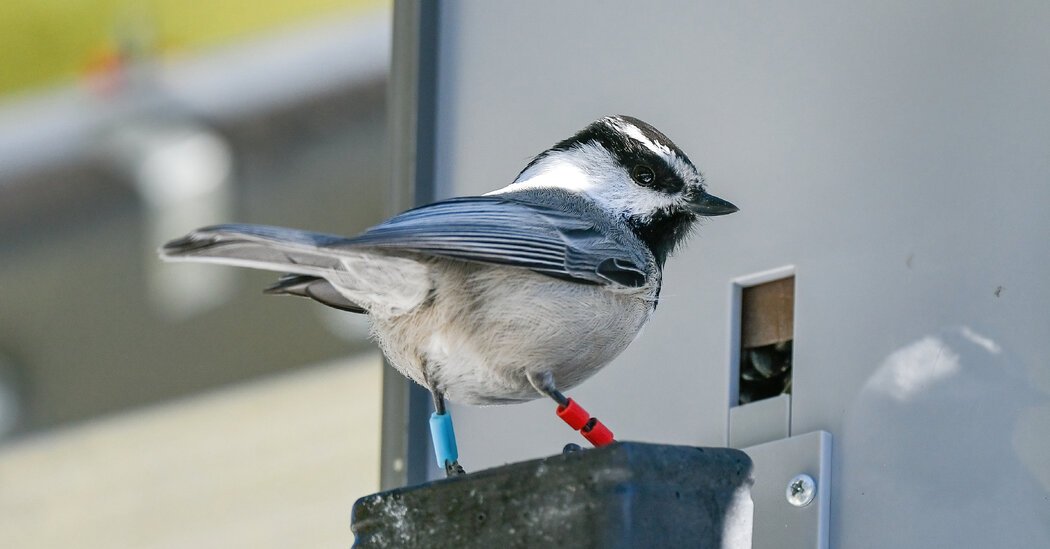
Is intelligence sexy? Female mountain chickadees think so. They find brains so attractive that they will cheat on their mates if a smarter male comes along.
That’s the conclusion from a new study, published in the journal eLife, that found female mountain chickadees proactively sought out males that had better cognitive skills than the one back in their nest. The researchers behind this study say acts of chickadee cheating improve the likelihood of successful reproduction, as chicks sired by “smarter” fathers are more likely to survive.
Mountain chickadees, small songbirds found in Western North America, were long thought to be monogamous, but recent genetic studies have brought that belief into question. “Birds were always held up as the epitome of monogamy, and then genetics was like ‘just kidding,’” said Carrie Branch, an assistant professor at Western University in Ontario and lead author of the study.
While it’s true that mountain chickadees breed and raise their young with the same mate year after year, scientists have found that nests are often full of half-siblings, suggesting that both males and females may be stepping outside of their pairs.
When Dr. Branch was in graduate school, she saw evidence that female mountain chickadees that lived at both high and low elevations preferred high-elevation males, which are known to be better at remembering where their food caches are.
Mountain chickadees spend the summer and fall storing food in caches across their territory. When winter comes around, these reserves become their primary source of food; thus, the ability to remember where those spots are becomes critical to their survival.
The fact that females were traveling to high elevations to rendezvous with the resident males made Dr. Branch wonder whether female mountain chickadees were attracted to intelligence.
Across the animal kingdom, there are many traits that females find attractive, like strength, size and the ability to sing on key, but rarely is smarts a turn-on. So in 2018, Dr. Branch set out to learn if a desire for strong cognitive abilities was driving these chickadees to cheat.
Dr. Branch and her colleagues installed a series of “smart” feeders throughout California’s Sierra Nevadas and attached colored bands to the legs of the local mountain chickadees. Each feeder was programmed to dispense food only to birds wearing a specific colored leg band. This way, each bird would have to remember which feeder on the array could be counted on for food.
For three years, the researchers measured the ability of the birds to remember which feeders offered food. They also used DNA testing to identify which ones were breeding, both within and outside of their matings.
After crunching the numbers, the researchers found that around a third of the chicks born during those three years were the product of infidelity, with 70 percent of nests having at least one chick whose father was different from that of its siblings.
And while both smart and less smart males contributed to these mixed paternity families, it was the males the researchers deemed smart that sired more young. The males who performed best in the researcher’s cognition tests sired between six and seven chicks outside of the matings each year, while those who scored low sired only between one and two.
When Dr. Branch realized what these chickadees were up to, she was surprised. “It matched our predictions, but I was still like, Is this actually happening?” Dr. Branch said. “It is really convincing evidence that these females are seeking good genes for their offspring.”
In some cases, the behavior could exist to make up for a female’s own lack of such genes. The researchers also discovered that females who had trouble remembering their designated feeder were more likely to have mixed paternity families.
How these females know which males have the best brains remains a mystery, but the researchers have a few hunches, one of which is that females don’t cheat with strangers, but rather with birds they know well.
During the winter, mountain chickadees spend most of their time in flocks of six to 12 birds, allowing them ample opportunity to assess the spatial cognition of the birds around them. “We know they can identify individuals based on vocalizations,” Dr. Branch said. “These animals spend a lot of time together. They know each other.”
Adelaide Abraham, a doctoral student at the University of Oxford who studies the love lives of songbirds but was not involved with the study, said that given how much these birds were expected to remember, it stood to reason they might note which males fared well during the previous winter.
Whether females identify intelligent males through direct observation or by picking up on other signals such as their plumage or vocal prowess, the fact that they have learned to choose the smartest mates is remarkable, Ms. Abraham said.
“The females in this mating system are showing agency, they’re making active choices about the kind of males they want to mate with, and that’s really cool to see.”

