
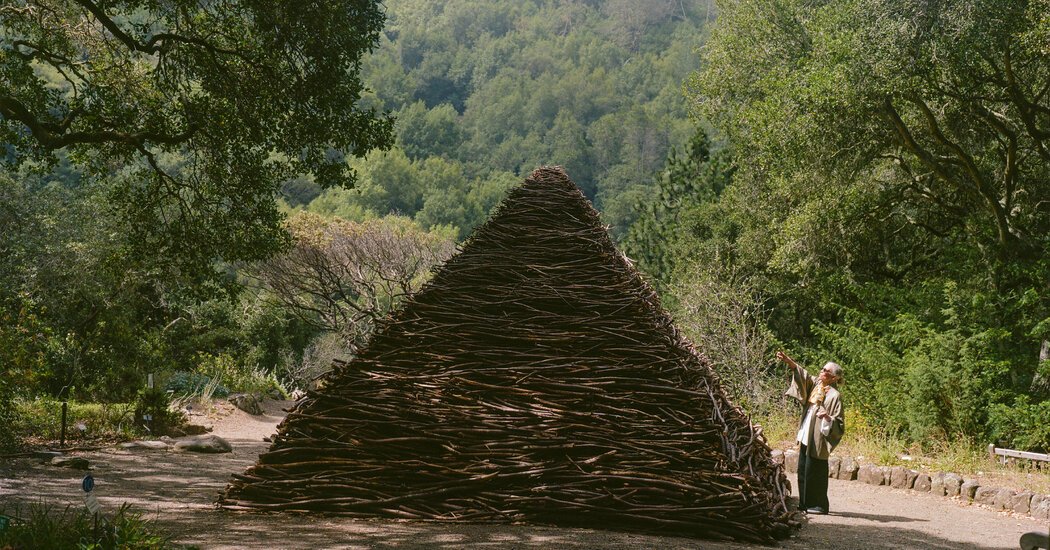
The artist Maren Hassinger looked like she was ready to fly.
Sitting on a wooden bench at the University of California Botanical Garden here, she was taking a moment to appreciate or maybe meditate on her newest sculpture: a 10-foot-tall pyramid made of interwoven redwood branches, set within a grove of mature oak trees. She was looking up at the blunt tip of the pyramid and the fog blanketing the Golden Gate Bridge in the distance. Birds chirped above and traffic hummed below. “We’re so far away from the stress of the city,” said the artist, 78, who was visiting from her home in Harlem for the installation. “This is really a wonderful place to sit and float.”
Then she stood up and made a surprisingly slow and regal flapping gesture.
Busting a move is not uncommon for Hassinger, a dancer-turned-sculptor who has been performing in art galleries and of bringing a sense of motion to her abstract artworks for more than 50 years. “I see the suggestion of movement in everything I make,” she said.
That is the theme of her new retrospective, “Maren Hassinger: Living Moving Growing,” organized by the Berkeley Art Museum and Pacific Film Archive, just downhill from the gardens. It is her biggest exhibition to date, spanning her career.
It features a mix of sculpture (including the off-site pyramid), performance videos and photographs and large-scale installations recreated for the occasion.
“I kept seeing her work piece by piece” in different museum collections, said Margot Norton, the museum’s chief curator. “I felt there was a larger story to tell, about how her performance informs her sculpture practice, which informs her performance.”
The Museums Special Section
Norton and her co-curator Anthony Graham are also attempting to distinguish the artist from her collaborators in Studio Z, a loosely-knit group of experimental Black artists who energized the Los Angeles art scene of the 1970s with unconventional performances, often in unexpected or urban places such as freeway underpasses. The group included Senga Nengudi, David Hammons, and Ulysses Jenkins.
Hassinger is often lauded as Nengudi’s longtime collaborator, but the curators are trying to bump her up from a supporting to leading actor category. Some recent recognition—such as the Getty’s acquisition of her archives in 2023—helps. Raised in Los Angeles, Hassinger planned to study dance when she enrolled at Bennington College in Vermont in 1965. But teachers told her she didn’t have what it takes, steering her away from the major. “I was taking classes every week, but apparently the other students were taking classes every day since they were 5,” she recalled.
Encouraged by a sculpture professor, she ended up studying art in college and earning an M.F.A. at U.C.L.A. There, officially part of a fiber arts program, she discovered industrial wire rope as a material stiff enough to stand up but supple enough to shape. “She can take something hard and make it feel soft or growing or alive,” Norton pointed out.
The show begins with some of her earliest wall sculptures from the 1970s, including one that positions an actual tree branch above two lengths of undulating wire rope. “The river is flowing under the tree,” she said, stopping in front of the work, which has the economy of a haiku.
More expansive installations follow, such as a field of wood dowels tilting at the same angle, like “reeds in the wind,” she said. A collection of knee-high bundles of wire rope, which she unraveled at the top and bottom into spiky clusters, vaguely resembles tumbleweed. A wall covered with inflated pink plastic bags adds a shock of color and sense of levity— “not every artist would use pink because it’s so girly-girly,” Hassinger said.
Videos from the ’70s document her collaborative dance performances, while those made in the aughts, when she ran the sculpture school at the Maryland Institute College of Art (MICA), explicitly confront racism and other social issues.
“You tend to make things inspired by what’s around you,” she said. “There was a lot of racism in Baltimore. “The video “Legacy,” from 2006, is particularly bold, listing in white type on the black screen a litany of African American inheritances, from “peanut butter” and “yams” to “hopelessness” and “police violence.”
The final gallery includes a new version of her 2008 installation, “Wrenching News.” Conceived in the wake of Hurricane Katrina, it consists of ropes made out of twisted and knotted newspaper strips that cascade down the wall, and it will grow during the course of the show. Hassinger led a workshop with volunteers, her take on a sewing circle, to make the first set of newsprint ropes in early June. A local artist will lead a community workshop every month the show is open to make more for the gallery.
About her use of twisting forms, associated with both the natural world and post-minimal sculpture, Hassinger offered, “Maybe it has to do with umbilical cords. Something we were all connected to.”
But she rejected a suggestion that her ropes look like hair, and she doesn’t like to linger in the interpretive or metaphoric realm for long. “Really,” she added, “the twisting is a way to make material stronger. It turns everyday materials into something you can build with.”
The offsite pyramid was made from eight truckloads of redwood branches that a team of volunteers wove together, the first layer tucked into a hidden steel armature covered with chicken wire. No trees were harmed in the process; coastal redwood trees naturally shed their lowest limbs as they grow.
Hassinger made the first version in 2022 out of invasive buckthorn for a public space in downtown Milwaukee. The Berkeley incarnation has a smoother veneer and rustier color. Shaded by the towering oak trees, the new sculpture also has a deeper relationship to its setting.
“Look at how the tree branches above it are all curling and interlocking,” the artist said on site. “What I like so much is that it feels like the trees are protecting it, like they gave birth to it. I had nothing to do with it.”
Maren Hassinger: Living Moving Growing
Through Nov. 29, Berkeley Art Museum and Pacific Film Archive, 2155 Center Street, Berkeley, Calif.; (510) 642-0808; bampfa.org.

