
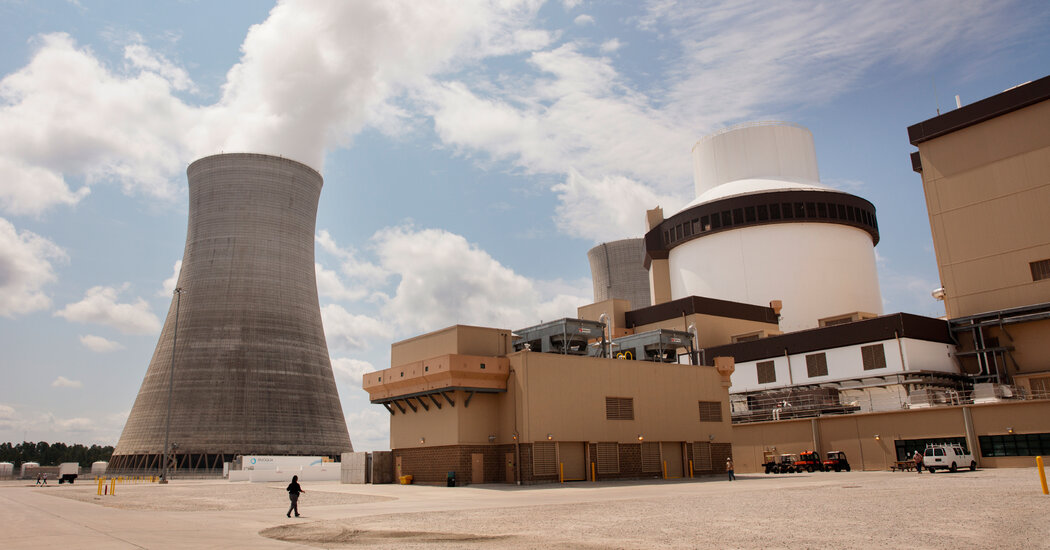
The Trump administration on Tuesday announced a plan for billions of dollars in federal loans aimed at spurring the country’s largest build-out of nuclear power plants in more than three decades.
The complex and unusual strategy, which would be overseen by the Energy Department, would provide up to $17.5 billion in low-cost loans to help electric utilities buy expensive components that could be used in up to 10 new AP1000 nuclear reactors, a large type of reactor designed by Westinghouse.
Electric utilities would need to put up hundreds of millions of dollars of their own money to unlock the federal financing, and none have publicly announced their participation yet. While a number of utilities have expressed interest in building large new nuclear power plants to meet rising electricity demand, many have so far been deterred by the difficulty and financial risk of doing so.
The Trump administration is hoping to persuade power companies to take the plunge by coordinating a sizable order of equipment for new reactors ahead of time, such as steam generators and coolant pumps. Those components can typically make up one-quarter of the cost of a new reactor.
“This deal plays an important role in reviving the supply chain needed for America to once again build large-scale commercial reactors,” said Energy Secretary Chris Wright.
Nuclear power has seen a resurgence of bipartisan interest in the United States in recent years, especially as demand for electricity rises. Nuclear reactors don’t emit planet-warming greenhouse gases, unlike coal and gas plants, and they can produce electricity around the clock, unlike wind turbines and solar panels. While some Democrats remain opposed because of concerns over safety and the disposal of nuclear waste, others have come to see it as a crucial technology for fighting climate change.
One of the biggest obstacles to nuclear power, however, has been the time and enormous expense involved in building large new plants. Only two AP1000 reactors have ever been completed in the United States, at the Vogtle nuclear power plant in Georgia. Those colossal reactors came online in 2023 and 2024, and today, they generate enough electricity to power roughly 1 million homes and businesses. But they took 15 years to build and cost $35 billion, double the initial estimates, after facing numerous delays and construction snags.
Utilities in South Carolina also tried to build two AP1000s but abandoned the effort in 2017 after costs soared past $9 billion.
Many utilities and tech companies have been scared off by the staggering price tag of large plants and have since explored investing in a new generation of smaller reactors that, they hope, will be easier to finance. Some early small reactor projects are already underway in Wyoming and Tennessee.
Yet the Trump administration has also been trying to convince companies to build large reactors like the AP1000 — in part because the technology is more proven and can generate vast amounts of power — and has set a goal of getting at least 10 under construction by 2030.
The federal loan guarantee, the first of its kind, aims to encourage utilities to take the first step toward building AP1000 reactors by banding together to buy components like reactor vessels that can take three or four years to manufacture. The idea is that bulk orders would make it faster and cheaper to build the reactors. Some of the parts would have to come from places like Japan or South Korea, since the United States no longer has the capacity to make many of them.
The plan envisions financing up to five pairs of reactors around the country. For each reactor pair, Westinghouse would provide $500 million and a utility partner would provide $500 million, while the federal government would backstop roughly $4 billion in debt. Taxpayers could be on the hook for losses from the loans, though utilities could resell any components they ordered to other companies or countries trying to build AP1000 reactors.
Even after ordering the parts, utilities would still need to make a final decision on whether to build the reactors, which requires approval from the Nuclear Regulatory Commission that oversees the safety of the nation’s nuclear plants. The Energy Department has separately said that it can backstop roughly $100 billion worth of construction loans, while Congress has approved lucrative tax credits that could offset up to 50 percent of the cost of new reactors.
Still, there are huge hurdles ahead — and no guarantees that any companies will ultimately move forward with building large reactors, despite the hefty incentives.
The Energy Department said that seven utilities had signed formal letters of intent to participate in the program, but it did not name any of them. In a recent note, analysts at the investment bank Jefferies warned that any publicly traded utility that announced its participation would probably see its stock price drop initially, as many investors remained extremely wary of the risks that the multibillion-dollar plants could face delays or cost overruns.
At least some state regulators and utilities have said they would need even more extensive federal protections — including some sort of insurance against the risk of overruns — before building large reactors like the AP1000 again.
“If you build 10 reactors, the first three will be expensive, and you don’t know how much, that’s the problem,” said Armond Cohen, executive director of the Clean Air Task Force, an environmental group that supports nuclear power. “Developers and utilities are all saying the problem is we can’t take unlimited balance sheet risks.”
The Energy Department has been more optimistic. Under the Biden administration, the agency released an analysis suggesting that some of the problems that plagued the Vogtle project in Georgia — such as construction beginning before the AP1000’s design was complete — have since been solved and that subsequent reactors would be cheaper. China has been building its own modified version of the AP1000 in recent years, and after some early hurdles, is now on track to have more than a dozen up and running by 2030.

