
Contains spoilers for Season 1 of “Sugar.”
The first season of “Sugar” had a twist that, even if you saw it coming, changed everything about the show. Released on Apple TV in 2024, the series was a love poem to film noir with a mystery about the missing granddaughter of a Hollywood mogul that recalled “Chinatown” and “The Big Sleep.” In the background was a second mystery: Who, or what, was John Sugar, the dapper, sad-eyed private eye, played by Colin Farrell, who worked for a mysterious organization and appeared to have unusual capabilities?
Eventually the show gave up its secret: Sugar was an alien, part of a group sent to Earth to observe humanity with unspecified but apparently benevolent aims. We had been watching a science-fiction story all along, but because the hero had modeled his terrestrial style and values on the old, black-and-white crime movies he watched every night, we had also been watching a noir.
In the second eight-episode season of “Sugar,” which premiered on Friday, Sugar is more isolated than ever. His alien companions returned home at the end of the first season, and to his and the audience’s great misfortune, the human love interest played by the wonderful Amy Ryan is gone as well.
His associates are now standard crime-story types: the young woman he hires to drive for him and, when she proves herself able, to help him investigate (Sasha Calle); the honest, oddball cop who provides him inside information (Shea Whigham). They step up at key moments as he looks for a missing petty criminal (Raymond Lee) who has run afoul of a bent sheriff’s deputy (Tony Dalton). This “Sugar” is less noir fantasy, more gritty Los Angeles crime procedural.
It is still genuinely romantic at heart, though, in a way that sets it apart from other series in its various genres. Under a new showrunner, Sam Catlin (“Breaking Bad,” “Preacher”) — who takes over from Simon Kinberg and the show’s creator, Mark Protosevich — it strives for a touch of poetry and achieves it often enough to keep its self respect.
The show retains its most conspicuous device, the insertion of snippets from classic Hollywood films that echo Sugar’s feelings about events in the real world of the story: “Gilda” when he encounters a new femme fatale (Laura Donnelly of “Outlander”), “Vertigo” when he needs to fake a death. The soundtrack, with numbers like “One for My Baby (and One More for the Road),” “C’est si bon” and “Twilight Time,” contributes to the nostalgia signaling.
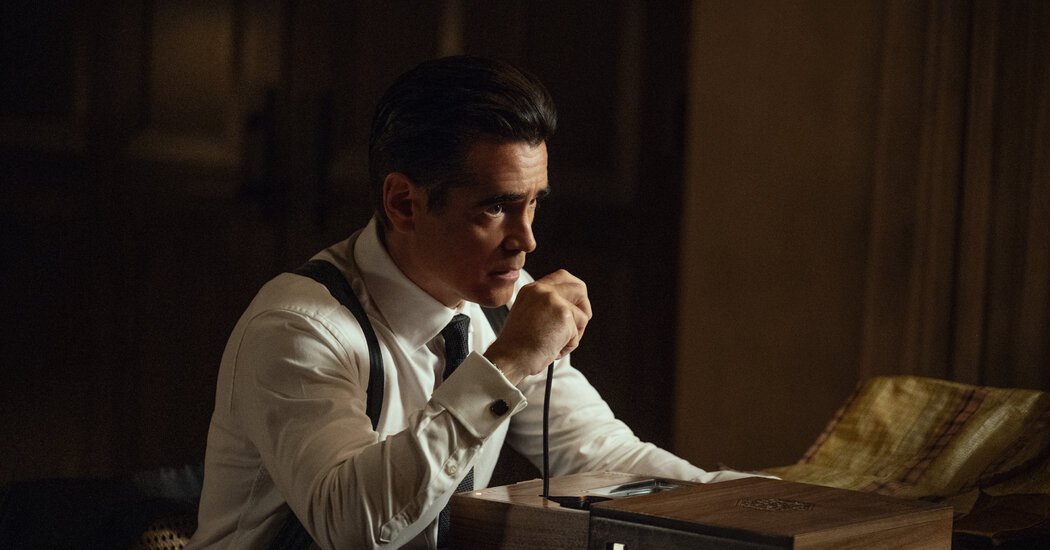
These embellishments are enjoyable in their own right, though they start to feel forced, like a tour guide who won’t stop talking. And they are kind of redundant because the show already has the only thing it needs to signal retro California cool and wounded nobility: Colin Farrell, in a crisp white shirt, slim dark suit and sunglasses, cruising around Los Angeles in his Corvette Sting Ray.
“Sugar” is in a long line of stories about an alien who dreams of being human while, of course, being more human — in the good sense — than the craven meat sacks he lives among. Farrell perfectly captures Sugar’s mix of estrangement and wonder; it is easy to believe that they are both operating on a slightly higher plane than the rest of us.
The series is not overtly political, but respect for the outsider is one of its primary themes. Working in the melting pot of Los Angeles, with associates, clients and enemies of color, Sugar self-identifies as a lonely immigrant, cut off from home and wary of assimilation, which his planet’s rules forbid.
And the Golden State is the promise that “Sugar” holds out, the gleaming, sordid, all-too-human reward for the traveler, no matter how far he has to go to get there. As it has been for generations of noir gumshoes, it’s the dash of utopia in the cocktail of fatalism. “I can never go back home,” Sugar says. “But — there’s always California.”

