
Ancient Egyptians knew the Temple of Dendur as the residence of the goddess Isis, who would interact with worshipers there through her cult statue. Today we know the temple as an event space, in the most generous sense. It has hosted performances of music and poetry, a protest that contributed to the renaming of the wing that houses it, and numerous fund-raisers — most famously the Met Gala — that have transformed it into a giant sandstone stage set, its bas-reliefs of deities and pharaohs lit up by theatrical gels.
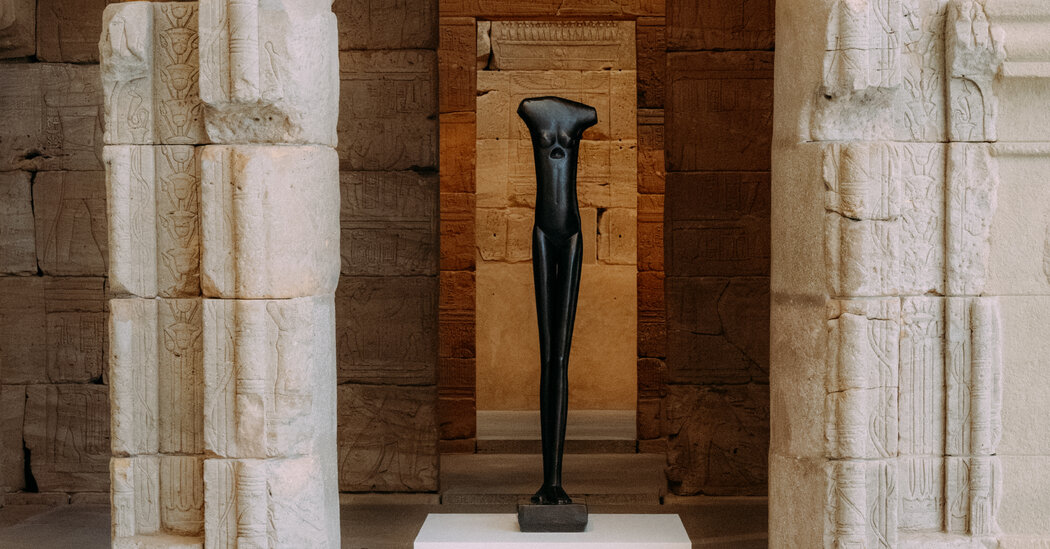
With “Giacometti in the Temple of Dendur,” a new installation siting hauntingly elongated female figures by the Swiss modernist Alberto Giacometti in and around the temple, the Met aims to restore some gravitas to its most famous set piece (given to the United States by Egypt in the 1960s, when the construction of the Aswan High Dam flooded the site). This striking and otherworldly show uses secular modern sculpture to help us visit the Temple of Dendur once again as a sacred space.
The Met has certainly chosen the perfect artist for the job, in that Giacometti’s works seem to turn their surroundings into quasi-spiritual environments. As his critic and champion Jean Genet observed, “One must have a strong stomach to have one of your statues in one’s house …. One of your statues in a room, and the room is a temple.”
A collaboration between the Met and the Fondation Giacometti in Paris, “Giacometti in the Temple of Dendur” includes 17 sculptures — most of them from the foundation’s collection, making a rare journey abroad before the new Giacometti museum opens there in 2028. It assembles a critical mass of Giacometti’s “Women of Venice” figures from 1956, attenuated apparitions in plaster and bronze that were originally created for the French Pavilion at that year’s Venice Biennale.
Although weighted toward these postwar works, the show gives prime placement to the 1932 goddess-figure “Walking Woman (I)” — a headless, stylized female with a cavity in her chest, shown with one leg slightly in front of the other in a pose familiar from ancient Egyptian and Greek figures (like the smaller statue of the priestess Tagerem that sat inside the temple before this exhibition). Giacometti’s bronze rests just inside the entrance, as if it is about to step out — a nod to the ritual of carrying sculptures out from the sanctuary to the terrace, so that the deities could greet worshipers.
On the Met’s version of that terrace, above a reflecting pool, the “Women of Venice” convene in small groups. They may be humans, or deities, or deified humans (like the brothers Pedesi and Pihor, who were buried in a crypt behind the temple in its original home).
Genet, among other critics, saw Egypt in these sculptures, comparing them in his 1957 essay “The Studio of Alberto Giacometti” to a statue of Osiris at the Louvre. He also observed their spatial and temporal ambiguities: “ They are familiar, they walk in the street. And yet they are in the depths of time, at the origin of everything, they keep coming near and moving back, in a sovereign immobility.”
Installed at the Met, the sculptures have the profound effects Genet described. When you enter the gallery and catch sight of them from across the reflecting pool, they are intimidating but spectral — wiry-limbed enough to feel more like drawings than sculptures. But they also exude power, with large feet firmly anchored to their bases and a postural tension that continues all the way up through the Pharaonic crowns of their heads. This, more than anything, links them to the ancient sculptures Giacometti sketched on regular visits to the Louvre and in the margins of his books on Egyptian art.
He never actually visited Egypt, content to explore it through Western collections of ancient art and contemporaneous Egyptology texts such as Hedwig Fechheimer’s “Egyptian Sculpture” (popular with artists and poets in Giacometti’s Parisian circles, and notable for its emphasis on the spiritual presence of Egyptian statues). He was also a frequent visitor to the Sphinx, a brothel with Egyptian-themed décor, where the women “attract and amaze me,” he wrote.
Visitors will have to glean those facts from other sources, because the curators have chosen not to offer much background on Giacometti or his Egyptian inspirations. One place to start is the Fondation Giacometti’s 2021 exhibition “Giacometti and Ancient Egypt,” which included Giacometti’s drawings of Egyptian statues and some of the objects that inspired them. (A plaster version of “Walking Woman (I),” for instance, was paired with the Louvre’s statue of the Goddess Nephthys in mid-stride.) Catalog essays from that show quoting Giacometti on Egyptian sculpture are especially illuminating, suggesting that he was drawn to these works on both technical and humanistic levels.
“Egyptian sculptures have a greatness, a rhythm of lines and forms, a perfect technique that was never used again after,” he wrote to his parents from Rome after encountering examples in the Vatican museum there. “All is made and measured to the smallest details, there is not a single shadow a little too strong or too weak, not a single line or form that is out of place, no hollow in which to slide a finger. And the heads seem alive, it looks like they are staring at you and talking.”
More of this material would have been welcome in this show, where wall text is scant (as is the fashion these days) and unaccompanied by any catalog or audio guide. That’s unfortunate, because the museum is positioning “Giacometti in the Temple of Dendur” as a preview of curatorial thinking for its forthcoming Tang Wing of Modern and Contemporary Art. You hope that the ancient and modern will coalesce, in that new wing, in displays that are as substantial as they are stylish. We will be looking for visual connections across centuries and millenniums, but also recognizing where context and scholarship are needed.
There are some auspicious signs, in two recent exhibitions at the Met looking at ancient Egypt through the eyes of modern and contemporary artists: Lauren Halsey’s triumphant reimagining of the Temple of Dendur by way of South Central Los Angeles, up on the museum’s roof garden in 2023, and “Flight Into Egypt, 1876-Now,” an ambitious 2024 group show featuring multiple generations of Black artists.
“Giacometti in the Temple of Dendur” was organized by Stephanie D’Alessandro, a curator of Modern art at the Met and its senior research coordinator of Modern and Contemporary art, with Aude Semat, the museum’s associate curator of Egyptian art and Emilie Bouvard, the Fondation Giacometti curator.
The presence of Giacometti’s sculptures in the temple points to the monument’s Roman-Egyptian origins, although the show doesn’t highlight this connection. The Temple of Dendur was commissioned by the emperor Augustus, who appears throughout the reliefs dressed as a pharaoh and making offerings to Egyptian deities (so as to reassure his subjects that their religious traditions would continue under his reign). In its layered identity, it’s an appropriate setting for an artist who came to know Egypt primarily via the antiquity collections of Italy and France.
Decades of cocktails and canapés around the temple have made it harder to see the complexities of its history, or to feel its ceremonial importance. Its interiors, once open up through the entrance hall, have been roped off for several years now (a response to the post-Covid uptick in Met visitors). Think of this spare but stunning presentation of Giacometti as an invitation to come as close as you can get.
Giacometti in the Temple of Dendur
Through Sept. 8, Metropolitan Museum of Art, 1000 Fifth Avenue, Manhattan; 212-535-7710, metmuseum.org.

