
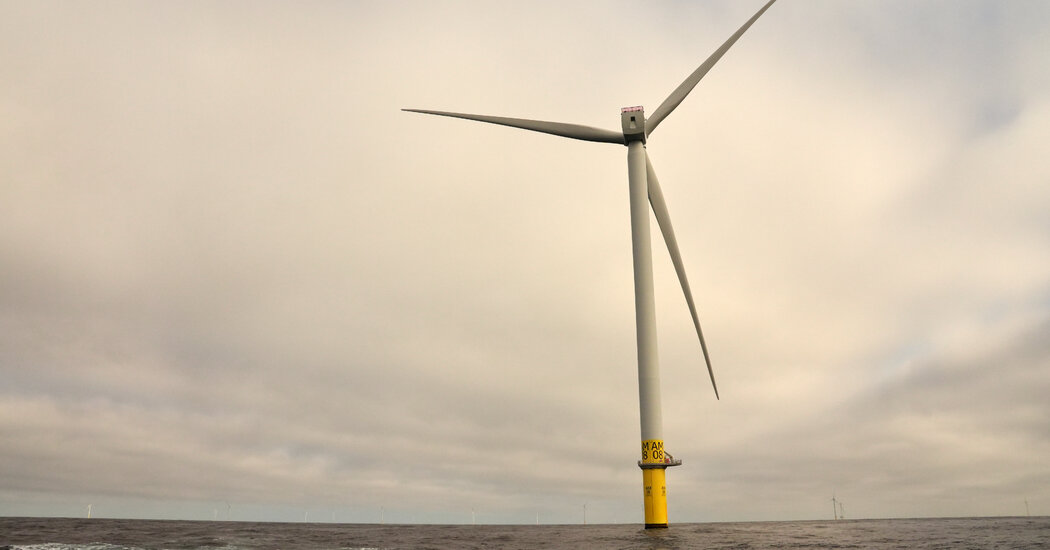
The Interior Department said on Wednesday that it would pay the energy developer Invenergy hundreds of millions of dollars to abandon plans to build wind farms in the Atlantic and Pacific, in the third such deal struck by the Trump administration to cancel offshore wind leases.
Under the agreement Invenergy will voluntarily surrender four leases in federal waters for wind farms that would have been located in the New York Bight, off the Central Coast of California and in the Gulf of Maine. All of those projects were in the early stages of development and had little chance of moving forward under the Trump administration, which has halted all federal permitting for offshore wind.
The government will then reimburse Invenergy $765 million, or somewhat less than what the company had paid for the leases under the Biden administration.
In exchange, Invenergy said it would put that money toward the development of at least five new natural gas-fired power plants in the Midwest, as well as in geothermal projects in the Western United States.
The agreement is similar to deals that the Trump administration has struck since March with other companies, including French energy giant TotalEnergies, to abandon wind farms off California, New Jersey, New York and North Carolina in exchange for investing in fossil fuel projects.
The announcement means the government has so far spent roughly $2.5 billion to get companies to terminate their offshore wind leases.
Wind power generates far fewer planet-warming emissions than using fossil fuels. But President Trump has criticized the technology as ugly and inefficient and has sought to block new wind turbines. Last year, the Interior Department ordered work to stop on five wind farms already under construction off the East Coast, but federal judges struck down all of those moves. The Pentagon has also sought to halt approvals of wind farms on land.
The agreements with companies to forfeit their offshore leases are a new strategy and represent a highly unusual use of taxpayer dollars. Seven Democratic-controlled states, including New York, have already sued the Trump administration over the Interior Department’s deal with TotalEnergies.
Invenergy is the nation’s largest privately held developer of energy projects, with a broad array of solar, wind, battery and natural gas plants.
The company had originally paid roughly $800 million for its four offshore leases during the Biden administration and had spent additional funds on development. The largest lease, in the New York Bight between New Jersey and Long Island, covered nearly 84,000 acres and was purchased in a 2022 auction.
Daniel Runyan, Invenergy’s senior vice president for development, said in a statement that the company would refocus its efforts on “projects that can be delivered on a commercially reasonable timeline” in order to meet the nation’s growing demand for electricity.
The company said it planned to use the funds to develop additional natural gas plants in Indiana, Wisconsin, Iowa, Kansas, and Missouri.
While previous deals had committed companies to investing only in fossil fuels like natural gas, Invenergy said it was also planning to invest in geothermal energy projects. Geothermal plants, which can run at all hours and emit few greenhouse gas emissions, are one of the few renewable energy sources that have found favor with the Trump administration.
Trump administration officials indicated that more such agreements could be in the works.
“The Department of Justice looks forward to continued cooperation from companies that are re-evaluating their energy investments,” Stanley Woodward, an associate attorney general, said in a statement.
Interior Secretary Doug Burgum said in a statement that offshore wind projects made more financial sense under the Biden administration, which offered lucrative tax credits for wind turbines, solar panels, electric cars and other green technologies. The Republican-controlled Congress eliminated those incentives last summer.
“The offshore wind leases were sold under the assumptions that taxpayers would indefinitely subsidize costly, unreliable projects,” Mr. Burgum said.
Mr. Burgum also repeated his claim that offshore wind projects pose national security risks. Last year, the Interior Department cited national security concerns in ordering a halt to construction of the five offshore wind projects on the East Coast. But the agency has not detailed those concerns in public, and, earlier this year, several federal judges said they were unconvinced by the administration’s arguments.
Proponents of offshore wind projects criticized the deals, pointing out that regions like the Northeast were counting on the wind farms to meet rising electricity demand and could now face future shortages.
“Replacing coastal offshore wind with geothermal or natural gas infrastructure in another region does nothing to address rising ratepayer affordability concerns, reliability challenges or potential gaps in power supply in the Northeast and mid-Atlantic,” said Hillary Bright, the executive director of Turn Forward, an offshore wind advocacy group.

