
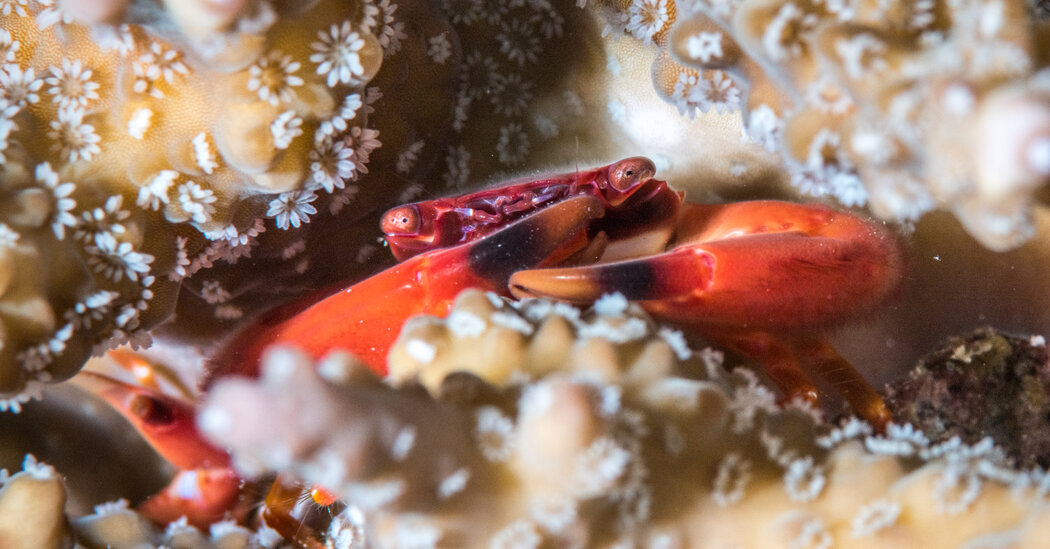
As spiking ocean temperatures are devastating reefs around the world, a handful of scientists have found a reason for cautious optimism. They’ve used artificial intelligence to detect sheltered pockets where cool currents, reduced exposure to sunlight and locations outside cyclone paths mean corals are more likely to survive.
The study, presented at the Our Ocean Conference in Mombasa, Kenya, on Tuesday, is currently undergoing peer review for publication in the journal Environmental Research Letters.
Five scientists identified 42 factors that create the conditions for the coral havens, called refugia, and then ran those through a program with nearly 38,000 human observations of coral cover and composition gathered over 65 years. The program identified more than 5,800 square miles of climate-resilient ocean in 72 countries.
The work found three times as many refugia as a landmark 2018 assessment known as the 50 Reefs Study, the first paper to systematically identify areas around the globe where coral might still be saved. Scientists and environmentalists said the new assessment offered a more nuanced picture of the state of the world’s reefs and could help fine tune conservation priorities.
“This study sharpens decades of work on reef resilience to climate change,” said David Obura, a former chairman of IPBES, the global intergovernmental scientific panel on biodiversity, who was not involved in the new research. “It focuses attention on the critical question: Will climate refuges comprise 10 percent, 1 percent, or even less of the former extent of coral reefs?”
Coral reefs are crucial ecosystems. They nurture an estimated quarter of ocean species at some point during their life cycles, supporting fish that provide protein for millions of people and protecting coastlines from storms.
They are also vulnerable to bleaching, which occurs when heat causes corals to lose the algae they need to survive. Bleached corals can recover, but if the water they live in stays too hot for too long, they die.
“Every tenth of a degree warming drives reefs to the limit,” Dr. Obura said.
According to Australian researchers who study ocean heat, the demise of the Great Barrier Reef could occur within a generation unless humanity acts with far more urgency to rein in climate change. A study published in 2025 found that virtually all the corals in the Atlantic Ocean will stop growing and could succumb to erosion by the end of the century if global temperatures continue to rise.
The newly identified refugia are not evenly spread around the world. More than half are in five countries: the Bahamas, Cuba, Australia, Indonesia and the Philippines. Others cluster around small islands in places like Vanuatu, American Samoa, Christmas Island and the Chagos Archipelago.
These havens can protect coral from the effects of warming, but their concentration makes them vulnerable to other threats like overfishing and pollution. Although most are found in nominally protected zones, lack of funding means many of those areas are only “paper parks” lacking practical protections.
The research is expected to fuel a central conservation debate: how much funding should go to protect refugia, some of which may eventually fail as the oceans heat further; how much into restoration work; and how much into halting greenhouse emissions and pollution?
Despite warnings from scientists and pledges from world leaders, countries are burning more fossil fuels than ever and greenhouse gas emissions continue to rise.
Traditionally, reef research has focused on areas that have avoided the worst overheating. Such reefs are usually dominated by large branching corals like Acropora, an expansive genus incorporating species like the staghorn and the flamethrower; or plating corals like Montipora, whose delicate whorls spiral out from a central stem. Globally, their numbers are crashing.
But the new research broadened the focus to corals that could also resist and recover: the helmet-shaped towers of the Porites lutea or the luminous ridges and bumps of Echinopora. Coral communities dominated by fast-growing weedy varieties, such as the lime and flamingo pink Pocillopora, are also often more resilient.
They will need to be. Subsurface conditions across the tropical Pacific are already significantly warmer than average, according to the World Meteorological Organization. And, an El Niño weather pattern that recently formed in the Pacific could exacerbate those hot conditions.
“It’s not to say the maps are perfect, but they are better than starting with nothing,” said Joseph Maina, an associate professor at Macquarie University in Sydney, Australia, who helped coordinate the data analysis. “Governments shouldn’t use the maps blindly, but get their own experts to look here first.”

