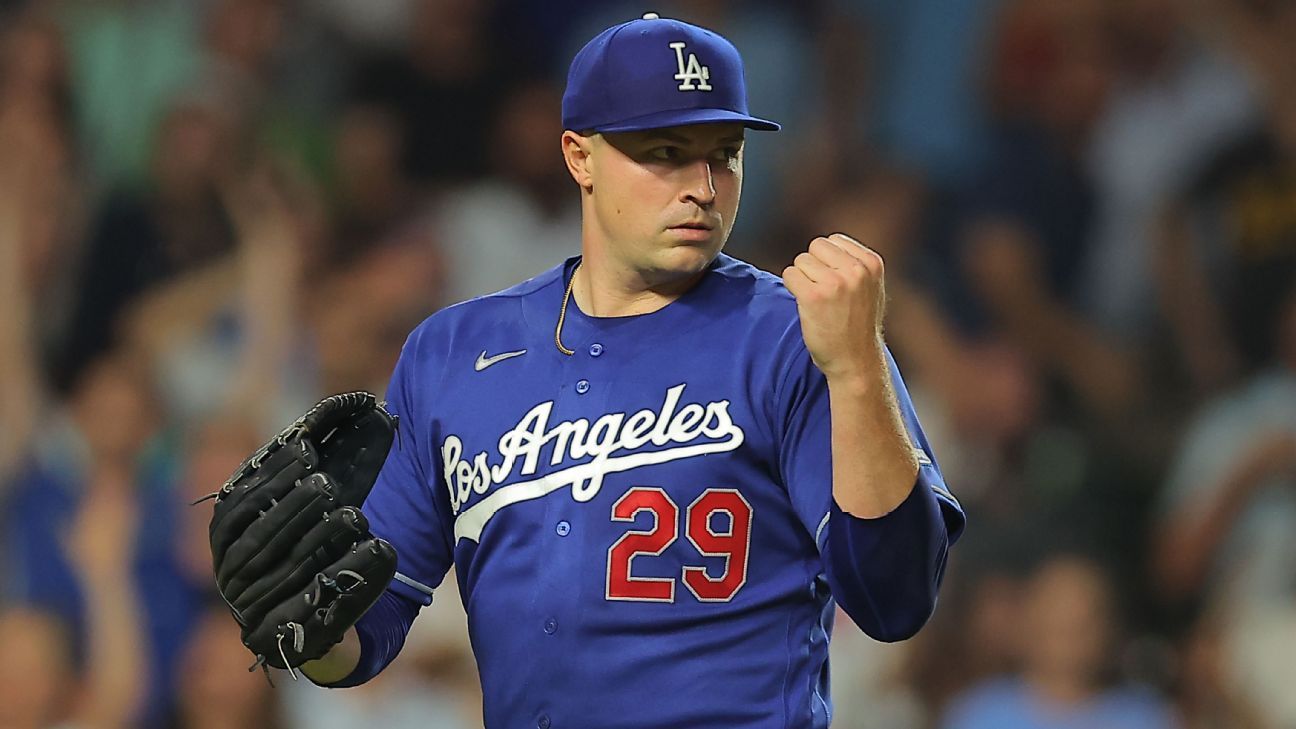
Baseball’s free-market system is the most honest in North American sports because it offers the fewest restrictions. Free agency really is free. No salary caps, no boundaries on how much one player can be paid, no artificial limitations on contract length. Just a true accounting of what an athlete’s performance is actually worth to the billionaires who decide such things.
For many, it’s a harrowing place to be because life on the margins in baseball is brutal. You stick around because maybe you’re Jake Bauers and you’ll find yourself at 31 guaranteed nearly $60 million on the back of one good season. But mostly it’s a grind.
Barely a quarter of players reach the necessary six years of service for free agency because teams control them well beyond those six full big league seasons. It’s years in the minor leagues. Options up and down. For some players, free agency doesn’t arrive until a dozen years after they were drafted. Most of that time is spent unable to negotiate their salaries. It is why Major League Baseball players care so much about free agency. It’s not just the spoils or riches. It’s that they earned it the honorable way.
All of this animates what happened Sunday afternoon and what’s going to be a focus of the next untold number of months in the baseball universe. Tarik Skubal is the best pitcher in the world. He is also a member of the MLB Players Association’s executive subcommittee, a group of eight players that will help guide the union’s other 1,192 through the lockout that will formalize baseball’s dark winter. He was the alpha and omega of free agency, not just because there was no player in this soon-to-be-truncated offseason in his echelon. No, it’s because true free agency began in 1976 with a pitcher, and Skubal was going to remind players why now should not be its end.
Some of the rhetoric around MLB’s push for a salary cap essentially blames superstars for baseball’s inequity problems. The salaries for younger players are low, the thinking goes, because so much money heads to the 1%. It is classic pro-cap narrative, anything to pit the players against one another, and in baseball, where the gaps among the top and bottom salaries are as profound as the chasms in overall payroll, the game’s best are made out to be the problem for the crime of being awesome.
Tarik Skubal is not the problem. He is what’s good about baseball. A late bloomer who went to a small college, underwent Tommy John surgery, got drafted in the ninth round, blitzed to the big leagues, weathered another arm surgery, won two Cy Young Awards, had a third surgery and reached free agency at 30 — eight years after the Detroit Tigers drafted him — to see what the market thought. It responded with $450 million over nine years. And even if one thinks the New York Mets were foolish to guarantee him that and only reinforced what’s wrong with the game, and that a salary cap is needed to rein in the wild spending, consider, for a moment, the implication: that a man should be limited in his ability to earn what a potential employer thinks he’s worth. That, working people might suggest, constitutes an actual problem.
As part of its cap plan, MLB wants to adopt the NBA’s maximum-salary rule. It is a direct assault on the game’s best players. The Skubal contract serves as a telling illustration of what a cap with a max would do to baseball. The free market regarded Skubal worthy of a deal for nine years. Under MLB’s proposed rules, free agents leaving their teams would be limited to five. The free market said Skubal was worth $450 million. That’s more than two times the $212 million maximum in MLB’s current cap projection for 2028. The free market made Skubal the first $50 million-a-year pitcher. His average annual value under a cap would top out at $42.4 million, a 15% haircut.
The point isn’t that $42 million a year and $50 million a year are still filthy rich either way; they unquestionably are. It’s that if a system that started rewarding players in 1976 when right-hander Andy Messersmith signed a three-year, $1 million contract and that 50 years later is now lavishing nine years and $450 million on Tarik Skubal, that system, for the players, is doing its job to consistently push the boundaries of what any individual merits.
Players merit it because the lords of the realm verify it with their offers, agreements and signatures. The particular lord in this case, Mets owner Steve Cohen, spent half a decade as the richest owner in MLB until Stan Kroenke bought the Los Angeles Angels in September. Between Cohen’s wealth and the inherent revenue advantages of larger markets, the Mets were positioned to thrive. In part because he’s in New York and craves stars, in part because he appreciates the rarity of excellence, but mostly because he can, Cohen operates at the top end of the free agent market with purpose. Two winters ago, he gave Juan Soto the richest contract in North American sports history: 15 years, $765 million. Now he’s got his pitching complement.
Cohen did not arrive at $450 million by accident. He did so because he was smitten with Skubal — the pitcher first and foremost, but the person, too — and because another team, the Toronto Blue Jays, was similarly taken and willing to give him more than $400 million. Which should be enough of an indication that Cohen isn’t operating in a vacuum. This is how a market works. A buyer assigns a price it is willing to pay for something. That is its value. It is, at its core, a simple, clean transaction.
Baseball’s quantification era has endeavored to make valuing a player more and more formulaic, optimization its north star. It killed off parts of the player population. In 2006, there were 101 players in MLB who were 36 or older. Over the past five seasons, there have never been more than 23. The numbers said older players are bad values. The market responded.
The inverse of that is the explosion in star salaries. Owners very clearly understand the game’s economics and the historical inefficiency of free agency. Since its advent, they’ve nevertheless found it impossible to help themselves from indulging. Striking that balance among teams willing to outspend their peers, players attempting to capture their full value and the potential in such a system for the game to feel like it’s only for the haves is tricky and delicate and prone to challenges.
Baseball currently faces one. The $400 million-plus gap between the Los Angeles Dodgers’ 2026 payroll and the Cleveland Guardians’ highlights a system run amok. There is fair, and there is too much, and the game’s current state of affairs tilts disproportionately toward the latter. MLB cannily saw an opportunity to use a system in need of real, substantive change as the appropriate time to call for a cap.
While MLB points to the other three major men’s professional leagues as evidence to the efficacy of a cap, whether it would increase competitive balance is unknowable. It would unquestionably lead to the perception of fairness, the gap between the $258.2 million ceiling and $180.2 million floor far narrower than currently exists. Still, baseball’s randomness is one of its defining characteristics, capable of turning the 19th-ranked payroll from the 30th-ranked market into the current World Series champion.
The Milwaukee Brewers are anomalous compared to the recent champions, and despite 2026 humorously responding to MLB’s cap push with three small-market, low-revenue teams among the postseason’s final four, the facts regarding playoff success among the moneyed over the past decade can’t be ignored. Regardless of the cause — cap advocates lampoon the Mets and Dodgers’ spending advantages, opponents accuse the owners who skimp on players of being the real issue — this is a matter with a wide swath of creative compromises.
MLB’s attempt at doing so includes inducements (earlier free agency for players 30 and older, a higher minimum salary, the elimination of the qualifying offer — all of which the players have sought) to counterbalance a 50/50 split of revenues that would give players a lower percentage of the pie than they currently receive. What MLB intended as a carrot registers with the players as a stick: In a capped system, there is a fixed amount of dollars, which makes everything a zero-sum game, meaning every additional dollar 30-year-old free agents and 21-year-old rookies reap would simply come from the pockets of other players.
What the capped system does, as much as anything, is limit choice. The free market encourages disadvantaged teams to explore the big, open sandbox that is Major League Baseball and utilize all of the tools available to mitigate those disadvantages. A sandbox with toys encourages creativity — and Milwaukee, Tampa Bay and Cleveland dabbled in that realm to establish themselves as perennial contenders. A sandbox with just sand is a bore.
It’s easy to characterize players as being driven solely by money, particularly in the wake of one procuring $450 million, but most just want to be paid what they’re worth, and they’re holding on to the current system not just because of the work their forebears did to negotiate and maintain it but because they like what they have and don’t want to give it up. That isn’t greed. It’s dignity.
If the game were in a worse place, perhaps players would be more sympathetic to owners’ concerns. Instead, they see baseball where it is: financially strong, with great stories and characters to carry a 162-game season and sell networks and streamers on a transformative television deal in 2028. They worry that in recent years the proportion of revenue spent on major league salaries has shrunk, and they worry that the significant uptick in off-field spending — technology, data, front offices — has further eroded their share. And they still believe that, in spite of those truths, the current system benefits them more than a cap and that it is their duty to stand behind it, or at least some derivation of it.
There are certain realities of this system, and one of those is that Tarik Skubal was always going to a high-spending team. The notion that the game’s best free agents gravitate almost exclusively to a handful of teams is difficult to square for the fanbases of those that don’t know the feeling of a superstar choosing them. But the idea that the Skubals of the world suddenly will choose Kansas City or Cincinnati or Pittsburgh in a capped system is hopeful at best and foolhardy at worst. As long as a top-to-bottom gap of nearly $80 million is in place, there will still be financial haves and have-nots. Even in a more equitable system, until a lower-revenue team proves itself a consistent winner, it will not turn into a destination overnight.
And that, players say, is the beauty of a free market: After years of having little say in their future, they get to dictate their own priorities. Skubal’s were never clearer than in January, when in his final year of arbitration — a system in which players can argue for what their salaries should be based on past comparables — he asked for a $32 million salary. The Tigers countered with $19 million. Skubal won, obliterating the previous record for a panel-judged case by more than $12 million.
He was willing to risk that money to help set a higher standard for future players — a far cry from the guy whose high salary is taking away money from the game’s lesser-funded classes. With his Mets deal, Skubal for the second time this year delivered clarity to his fellow players during a very confusing time. The lockout is coming at 11:59 p.m. on Dec. 1, and when it does, they can look to him as a reminder of free agency’s value, of their worth, of ensuring that as MLB presses forward with its cap, undaunted, players don’t look at Tarik Skubal like he’s the problem. He is, if anything, the reason to keep fighting.