
‘We Two Boys Together Clinging’ (1961)
David Hockney was one of the first widely popular artists of his time to make work with undisguised gay content, and one of the few to take a public stand against the censoring of homosexual imagery.
‘A Bigger Splash’ (1967)
In 1966, while teaching at the University of California, Los Angeles, Hockney met a student named Peter Schlesinger, who became his model, muse and lover. The many paintings and drawings he did of Schlesinger — in Los Angeles, in London and on their frequent travels — constitute a running chronicle of their relationship.
‘American Collectors (Fred and Marcia Weisman)’ (1968)
Hockney painted many psychologically pointed double portraits, including this one of the Weismans, Los Angeles art collectors. In it, Weisman stands sculpture-stiff with fists clenched in a business suit and looks much smaller than his pink-robed wife, whose snarling smile is echoed in the faces carved on a Native American totem pole planted nearby.
‘Mt. Fuji and Flowers’ (1972)
Hockney’s virtually nonstop art production — which ranged from painting and drawings to experimental printmaking, photography and photo-collage — kept him traveling through the United States, Europe and Asia, often fsimply to experience different kinds and conditions of light.
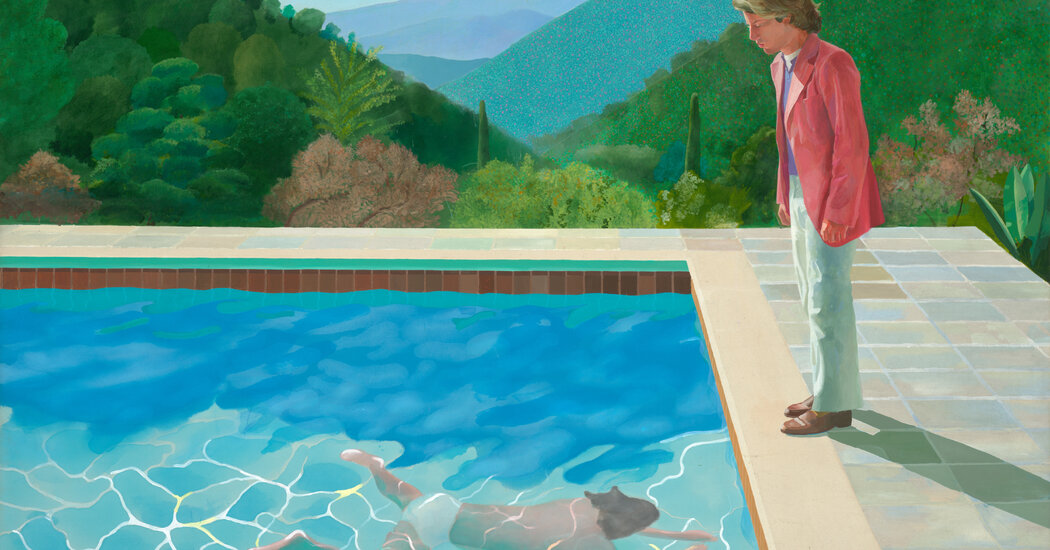
‘Portrait of an Artist (Pool with Two Figures)’ (1972)
Using photographs as sources, in this large 1972 painting, Hockney combined two of his recurrent visual themes of the time. One was the outdoor swimming pool, an emblem of the luxe-life culture he found in his adopted city of Los Angeles and (in this painting) in the South of France. The other was of male-coupledom. Hockney painted this picture just after an intense, long-term relationship with the younger artist Peter Schlesinger — the standing figure in the painting — had abruptly ended.
‘Artist and Model’ (1973-74)
The experience of seeing a major Picasso exhibition at the Tate Gallery in London in 1960 confirmed that artist as a personal hero to Hockney. After Picasso’s death in 1973, Hockney made etchings in the style of Picasso’s “Vollard Suite” (1930-37), imagining himself as a nude model meeting the modern master. In Hockney’s homage, he defined each man in a distinctive etching technique.
‘The Rake’s Progress’ (1975)
In 1975, the British director John Cox, at the Glyndebourne Festival, invited Hockney to create sets and costumes for Igor Stravinsky’s full-length opera, “A Rake’s Progress.” This exquisite production became one of the most renowned and admired of its day and led to Hockney’s designs for other stage works at New York’s Metropolitan Opera and elsewhere.
‘My Parents’ (1977)
Born in the Yorkshire area of England, Hockney maintained close ties to his parents, returning yearly to spend Christmas with them until the end of their lives. He shared their Labour Party politics and his father’s philosophically principled pacifism. His mother, to whom he was especially close, was a frequent subject of his portraits.
‘Mulholland Drive: The Road to the Studio’ (1980)
Hockney lived for many years in Los Angeles, long enough to refer to himself as an “English Los Angelino” and to create images in which, for many viewers, he captured the sun-soaked atmosphere of a city that looked and felt nothing like the England he’d grown up in.
‘Self-Portrait with Red Braces’ (2003)
At an early point Hockney made himself visually striking, with a high-color wardrobe of plaid suits, striped soccer jerseys, mismatched colored socks, owlish glasses and bleached blond hair. He retained a toned-down version of this distinctive look, complete with red suspenders, late into his life.
‘Rain on the Studio Window from “My Yorkshire”’ (2009)
A gregarious personality, Hockney was able to work while surrounded by people. At the same time, he frequently complained about distracting visitors and would periodically change studios and cities in search of quiet, periodically retreating to Yorkshire.

