
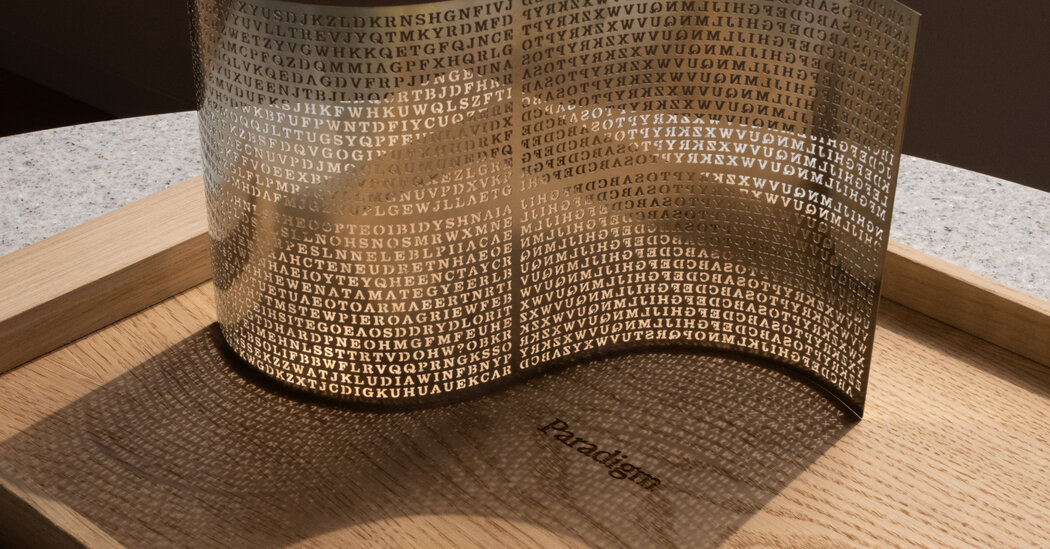
One of the world’s most beguiling secrets has a new online life — under new ownership.
Kryptos, a sculpture on the grounds of the Central Intelligence Agency’s headquarters in Virginia, contains four encrypted passages in letters cut through its undulating copper form. Since the work’s dedication in 1990, amateur and professional cryptographers have unlocked three of those passages, known within the community of Kryptos buffs as K1, K2 and K3.
But the fourth, K4, has stymied all comers, becoming an object of fascination — even obsession — for a worldwide network of would-be solvers.
The unsolved K4 code. The two solved passages in black have previously been revealed by the sculptor as clues.
The Kryptos sculptor, Jim Sanborn, has long tired of dealing with the thousands of inquiries from enthusiasts claiming to have teased the truth from the code. Last year, he put the secret of the sculpture up for auction, and in November an anonymous bidder won, with an offer of nearly $1 million.
The sale added yet another layer of mystery to Kryptos: Who was this bidder, and what would be done with the solution? If the winner kept it a secret, would those still hoping to solve the K4 have a way to confirm whether they succeeded?
Now the auction winner has come forward: Paradigm, a San Francisco investment and software firm that backs companies in fields like robotics, A.I. and prediction markets. “We are really into puzzles and problem-solving as a way of doing research,” explained Dan Robinson, the firm’s general partner.
The company is unveiling a new website to build interest in Kryptos and cryptography, with a 10-puzzle “capture-the-flag challenge” designed by Mr. Robinson to encourage members of the public to take on the K4 themselves. The first person to solve each of the 10 puzzles will receive $1,000.
Even though Mr. Robinson and his Paradigm partner, Matt Huang, have bought the plain text of the passage, “we decided not to ruin the mystery even for ourselves,” they said in a blog post announcing their initiative. Mr. Robinson, who has tried to crack the passage himself, said, “It didn’t feel right to buy the secret just so we could learn it. That would be skipping the steps.”
This presented a logistical problem: How could they build an interactive site for the public to try solving it without finding out the answer themselves? Also: How could they store the solution in such a way that hackers could not simply penetrate the site to steal it?
The answer, naturally, lay in encryption. First, the Paradigm team had Mr. Sanborn enter the plain text solution into a laptop. Then they used encryption to transform the text into a unique authentication code, which they uploaded to the cloud. Afterward, they deleted the unencrypted solution from the machine. Any purported K4 solution will go through the same hashing process, and if the two authentication codes match, the answer will be confirmed.
The cost of submission will be $1, a fee intended “to prevent people from just making a million guesses to try to crack it,” Mr. Robinson said. Mr. Sanborn had instituted a similar system to limit inquiries, charging $50.
Above: Kryptos’s first passage, K1, and its solution. The sculptor included an intentional misspelling (“iqlusion”) to “mix it up.”
To Mr. Robinson, this is more than a game; it reflects Paradigm’s way of doing business. Paradigm routinely puts online the tough problems it is wrestling with and invites the technologically adept to come up with solutions, putting those who do the best work on a leaderboard. Like Tom Sawyer convincing his unwitting friends to whitewash a fence, the company benefits from the free labor.
But those accepting the challenge can profit, as well: “Sometimes we hire them,” Mr. Robinson said, and “sometimes we invest in them.”
In their blog post, Mr. Robinson and Mr. Huang invited the public to use any and all methods, including A.I., to finally solve the 36-year-old mystery. So far, efforts to crack K4 using A.I. have failed, but that could change as users with expertise in training A.I. systems focus directly on improving cryptographic skills. “The clues are out there,” the two men write. “The tools are better than ever. And now there’s an automated system that verifies your solution instantly. It’s your turn to try to solve K4.”
Another Kryptos puzzle Mr. Sanborn created, which he calls K5, was also included in the auction package along with other artifacts, including a proof-of-concept copper sheet for the sculpture with letters punched through. In the post, Mr. Robinson and Mr. Huang said, “We plan to release K5 in the future.”
In an interview in early June, Mr. Sanborn declared himself pleased with their efforts. “It’s hard to build what they built without knowing the answer, but they did it — so I tip my hat to them.” He met with Mr. Robinson and his team after the auction, and they filmed a short video that is also on the site, along with a brief video message that will be played for the person who cracks K4.
Mr. Sanborn said that even after the auction, he received a dozen inquiring emails a day. With the new site in operation, he said he would stop responding substantively. “On one level, I’ll miss it,” he said. “On another level, it’s a distraction I don’t need at this point in my life.”
Now 80, Mr. Sanborn says he is trying to write a book, or a full accounting of his works known as a catalogue raisonné. “It’s best to do those endeavors while you’re still alive,” he deadpanned.

