
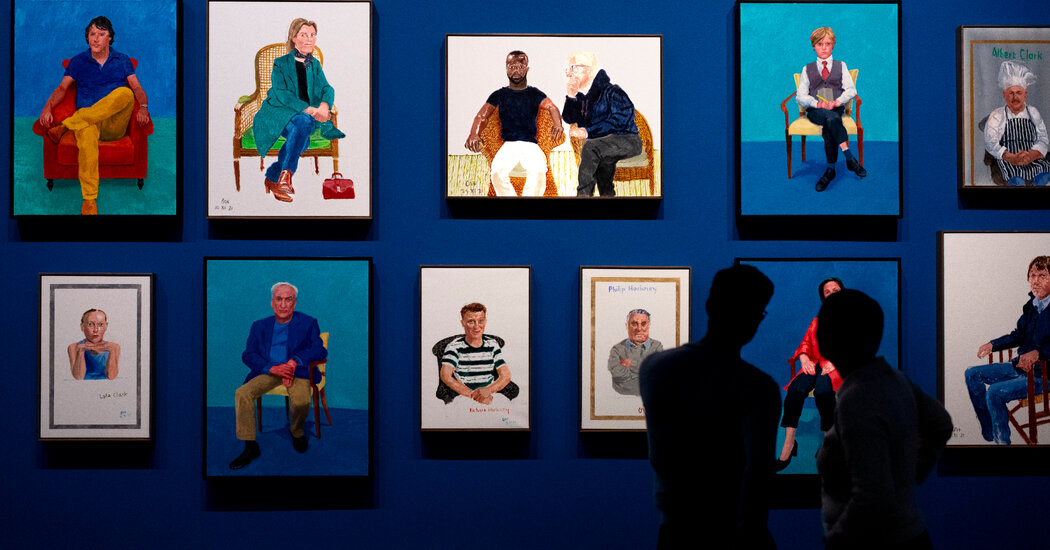
I first encountered David Hockney around 1964. I was about 20 at the time and working in London as a librarian at Thomas Agnew and Sons, a distinguished old master dealer to the British aristocracy. Walking to the gallery on Bond Street one day, I came to John Kasmin’s gallery where, alongside contemporary North American art, I first saw David’s work.
It was great to see these figurative paintings in the context of the abstract paintings by Frank Stella, Kenneth Noland and Morris Louis that were usually on show there. They were about real life.
In the early ’60s, David was beginning to become famous, not just for his painting, but as a personality. The now-little-known artist Patrick Procktor was a contemporary of David’s, and in those days, as far as the gay subculture and Pop Art were concerned, nobody knew who was more significant. But now we do.
In 1971, a friend introduced me to David personally at a dinner at what I think was the first or second night of London’s Hard Rock Café, a franchise that would subsequently sweep the world. We soon became friends of sorts, often mixing in the circle of Derek Jarman, a painter who became principally a filmmaker because David so dominated the territory of painting.
In 1977, when I became the exhibitions secretary at the Royal Academy of Arts, David was not yet a member. The Royal Academy was founded in 1768 as an artists’ society, and since the 19th century it has staged loan exhibitions in its magnificent central London galleries. It also stages an annual Summer Exhibition to show the work of its members and others chosen via submission.
When David was becoming truly famous and having exhibitions all over the world, he wanted to show some works in Summer Exhibition — but only if they were displayed more prominently than many of his co-members were comfortable with. I had to take four of them to Paris to see David’s retrospective at the Pompidou Center to convince them. In the end, somewhat reluctantly, they agreed to allow a group of his “Grand Canyon paintings” (1998) to be included.
In the meantime, he had drawn both me and my wife, Manuela Mena Marques, using his camera obscura technique. I had also, working with the artist Marco Livingstone, organized an exhibition of David’s at the Royal Academy in conjunction with the Museum of Fine Arts in Hamburg.
We were always friends but not close friends: I was not part of his intimate inner circle. But I visited David a couple of times in Yorkshire, the county in the northern England where he was born. I will never forget seeing the largest painting he ever did, “Bigger Trees Near Warter” (2007), which he hung in a warehouse that he had bought for the purpose, or accompanying him in a van as he filmed the grass alongside a road using nine cameras to create “Seven Yorkshire Landscapes” (2011), a work of art that, in my opinion, stands next to Albrecht Dürer’s 1503 watercolor “Great Piece of Turf.”
One morning in April 2023, David telephoned and asked me to join him in curating a show at the Fondation Louis Vuitton in Paris. I remember when I joined the Royal Academy, the great art historian Ernst Gombrich said to me: “Norman, I am so happy for you; you will learn so much.” Those words took on a whole new meaning working with David: Doing that exhibition in Paris, I really learned and discovered and began to understand him as a truly amazing artist.
Looking back on decades of activity, looking at his earliest paintings — among them a 1955 portrait of his father that we included in the Fondation Louis Vuitton show — one can see the degree to which David, as both a looker and a depictor, remained, like his much admired predecessor Pablo Picasso, both astonishingly consistent and extraordinarily varied.
Next to the portrait of his father, we hung a painting from 1956 called “Bolton Junction, Eccleshill” that showed a place in Yorkshire close to where he was living at the time. The work is a testament to how his sense of place, too, remained consistent whether painting swimming pools, as he was to do so famously in the late ’60s; Yorkshire landscapes, largely done in the first decade of the 21st century; or the paintings of Normandy of the past decade, which largely coincided with the years of the coronavirus pandemic. All of his works share a very particular sense of place, but equally, of time.
Something I perceived while hanging the Paris exhibition is the recurrent motif in his work of a road “going somewhere.” These roads seem instinctively be a part of his inner language — even in his sets for operas, or indeed in his extraordinary reinterpretations of old master paintings, whether by Fra Angelico, Claude Lorrain or William Hogarth, or later artists like van Gogh or Picasso.
David was always very conscious of standing on the shoulders of the art of the world, including Eastern painting — the Chinese and Japanese scroll, for example — and of course the art of his great European predecessors. There is, as well, the Egyptian style that he encountered early on while traveling. Such ancient forms of image making have their unique sense of time and place.
In his last years, when he was in poor health, David was still making new images and painting new portraits with wit and ever-present knowledge, all based on an extraordinary memory that never seemed to falter in spite of physical fragility. (He was proud of achieving the age 88 — after all, for decades, he smoked countless cigarettes, which for him were a veritable symbol of freedom.) Even with full-time nursing care, he painted with clarity of mind and a firmness of hand.
In the beautifully proportioned galleries at the Fondation Louis Vuitton, designed by Frank Gehry, we included some 450 of David’s works, which might sound overdone — but, in fact, is not. We could have easily doubled the size of the show. Even that would not have begun to scratch the surface of Hockney’s prodigious output of 70 years.

