
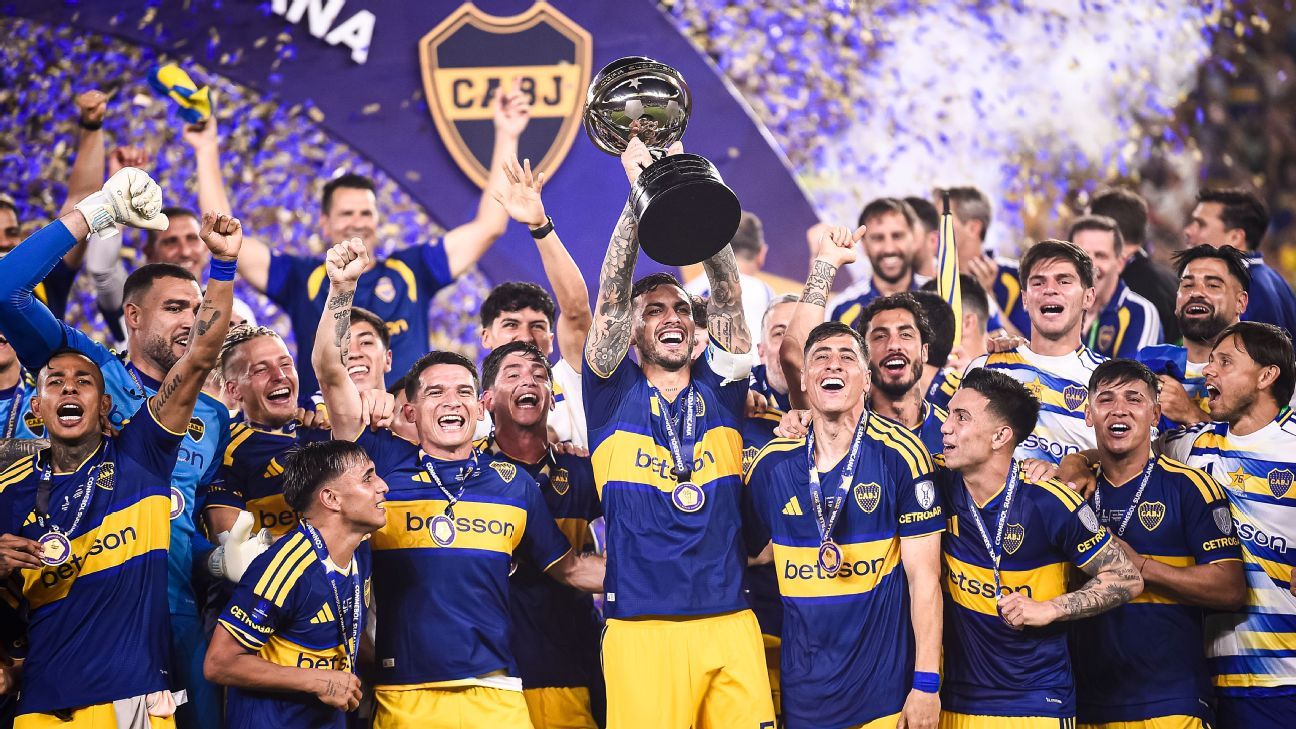
Are Boca Juniors … back?
The Buenos Aires giants won their first international title in almost two decades on Saturday, outclassing Brazilian side Atletico Mineiro with a 2-0 victory in Barranquilla, Colombia, to claim the Copa Sudamericana, the continent’s Europa League equivalent.
Domestically, things are going well. They claimed more points than anyone else in the league phase of the two championships that Argentina plays per year — which in itself is worthy of a title. They are in the final of the local cup, and through to the round of 16 of the Clausura, the tournament played in the second half of the year.
But it is this international triumph which stands out. Boca made themselves synonymous with continental success at the start of the century, winning the Copa Libertadores, the Champions League equivalent, four times between 2000 and 2007. They haven’t won it since. Instead, they’ve lost three finals, including the most painful of all: defeat to great local rivals River Plate in 2018.
Last year they suffered the humiliation of being knocked out of the Libertadores in the qualifying rounds. This year, they fell at the group stage, finishing third and therefore moving down into the Sudamericana.
The big test, then, will come next year. True, they have overcome three Brazilian sides in a row to win this Sudamericana title — Sao Paulo and Vasco da Gama before Atletico, but a glance at Brazil’s league table puts that in some perspective. These are not the top sides.
Seven Brazilians, plus the reigning champion in the event of a Brazilian win, go into the Libertadores. While Brazil has been dominating that competition, it has provided the beaten finalist in the last six versions of the Sudamericana.
The conclusion, then, is clear: Saturday’s win is all very well, but taking on the likes of Flamengo and Palmeiras is the real challenge. It is one that Boca look far more equipped to handle since a coaching change in the middle of the year.
The club’s former left back Rodolfo Arruabarrena returned for his second spell in charge and started putting the right pieces in the correct holes. The team is constructed around the midfield talent of World Cup winner Leandro Paredes, who runs the game at the heart of a classic midfield trio — one to get the ball, one to give it and one to go.
Paredes is the giver, distributing with quality and intelligence. Little Milton Delgado — one of a number of talented youngsters — is the ball winner, the unsung hero who marks, covers and keeps things simple in possession. That was once the role of Santiago Ascacibar, who a decade ago was seen as a possible successor to Javier Mascherano in the Argentina national team.
However, Ascacibar is now using his lung power to burst forward and arrive in the opposing penalty area as an element of surprise. He had already seen one goal disallowed for offside when he shot Boca into an early lead in Barranquilla.
The other match winner was Colombian winger Sebastian Villa, back for his second spell at the club after some off-the-field controversy. Strong as a horse, he ran Atletico ragged down the left flank and set up the clinching second goal for Uruguayan striker Miguel Merentiel.
One of the triumphs of Arruabarrana’s second spell has been his promotion of two youngsters. Centre back Facundo Herrera was imperious against Atletico – the second goal started with one of his many sweeping passes out of defence. Known universally as “Jagger” — there is a striking resemblance to the Rolling Stones frontman — there is a hard, no-nonsense edge to his game, and he looks to have a big future.
The same goes for winger Lionel Flores. Handed his senior debut late in July, Flores was already lining up for Argentina by early October. Right-footed, he can play either flank, and in addition to his one-vs.-one skills, he also seems to have the knack of seeing and executing the decisive early pass.
There are hopes that Flores could have something of a young Ángel Di María in him.
In the typical way of youngsters thrown in at the deep end, after a glorious start to his club career, Flores’ form has dipped a little in recent weeks, and he had to make do with 15 minutes off the bench in the big final. But there should be plenty of major occasions ahead for him — and for Tomás Aranda, a skillful, ball-playing No. 10, who is nursing his way back from injury and played a neat hour in Barranquilla before being replaced.
The big question, of course, is where these occasions will be? And what colour shirt will they be wearing?
The remorseless logic of football’s market points to a clear conclusion – the likes of Flores, Aranda, Herrera and Delgado will leave for Europe before long.
But it would be nice to think that Boca Juniors can keep the band together for a crack at next year’s Libertadores.


