
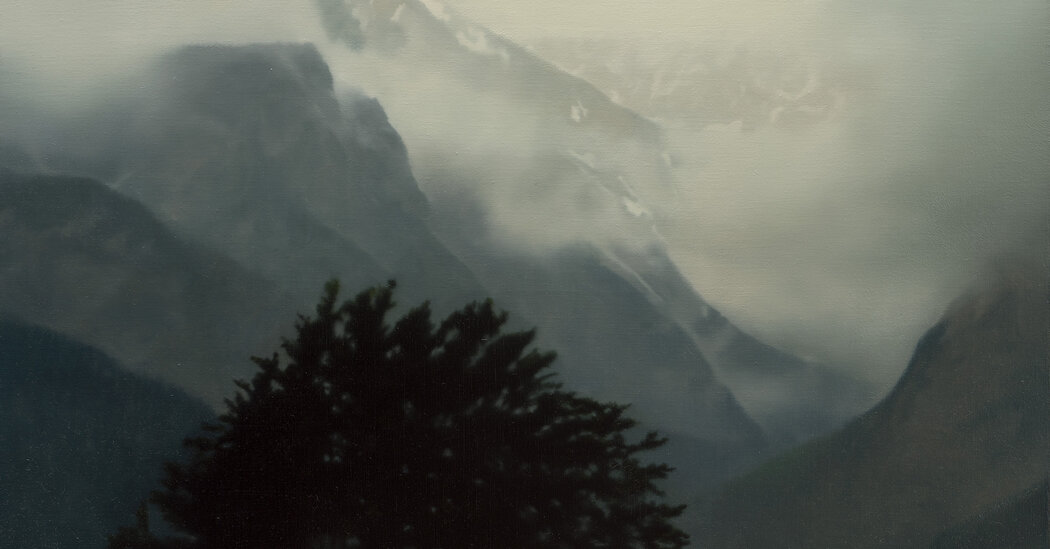
“Garmisch” is one of 26 paintings on view in “Gerhard Richter: Landschaften,” at David Zwirner in New York: a perfectly paced showcase of paintings from the 20th century that, at the same time, makes a direct argument about how to live in the 21st.
This 94-year-old heavyweight of German painting may feel commonplace to encounter now. His blurry, staticky pictures, some as famous as his Sonic Youth album cover and as expensive as an F-16 Falcon, have become milestones in his lifelong effort to face up to the void left by the last century’s political and ideological cataclysms.
But the landscapes in the Zwirner show reawakened something in me: the astonishment I first felt in front of Richter, before these strange, streaky pictures had become quite so familiar. They reawakened, too, my belief that Richter’s stutters and equivocations are among the finest models imaginable of how to push through a cultural or intellectual deadlock.
The paintings here include loans from significant public and private collections, some of which have not been seen in the United States for decades. Most are views of the sea, mountain, field or sky, in Germany, in Italy, that tease at the Romantic sublime but remain always clotted and motionless. Yet several of the landscapes at Zwirner are in fact “abstract pictures,” to borrow Richter’s proudly generic title, where confident gestures get negated and scraped away by a squeegee dragged across the surface.
“There is no difference between a panel of colors and a small, green landscape,” Richter said in 1973. And whether in figurative or abstract modes, Richter has always been aiming at the same target: a painting that is valid in the face of history. When kitsch and propaganda fill up every screen, when sincerity and irony seem equally toothless, there is still, in the fog, a path forward.
Richter was born in Dresden in 1932, and he had two artistic educations. The first was in East Germany, in the 1950s, where he learned mural painting in the strictly regulated style of socialist realism: heroic, idealized depictions of workers and commissars. In 1961, just a few months before the Berlin Wall went up, he defected to West Germany; he enrolled at the renowned Kunstakademie Düsseldorf, whose free-spirited professors (including the sculptor and performance artist Joseph Beuys) encouraged him to question authority and make art anew.
His fellow young artists in 1960s West Germany were pugnacious. Through Pop-inflected paintings and during druggy Happenings, they filleted the vapid consumer culture that accompanied the “economic miracle” of the postwar era, as well as the Nazi legacy that the Federal Republic had not fully expunged. Richter certainly shared his friends’ alienation, but he could never fully get behind an art that was a clear call for action. He had seen culture turn into propaganda twice already: first Nazi propaganda, then Communist propaganda.
And so his paintings would have to speak a less certain language: the language of permanent doubt.
He began to paint directly from photographs: family album pictures, clippings from newspapers or encyclopedias, and eventually images he shot himself. Frequently he would retain the dimensions and cropping of the source image. And then, as in this view of the Bay of Naples, he would gently smear the still-wet oils with a dry brush. Any remaining physical gesture, any mark that suggested certainty, would pass into a blur.
To blur details in a painting, of course, predates the camera by centuries. It was Leonardo’s favorite trick: occlude the landscape, or the face of the Mona Lisa, with an atmospheric mist.
But when Richter applied sfumato to his landscapes of the 1970s and 1980s, something else was going on, something less optical. He was not using the blur as Leonardo did, to mimic how the human eye would hazily perceive an iceberg offshore.
He could no longer paint an iceberg with uncritical optical accuracy — not after the sublime landscapes of so much German art and poetry had been repurposed for totalitarianism. In the early 19th century Caspar David Friedrich, an artist Richter loved, had pictured mountains and sea as sublime views of God’s creation, and landmarks of a not yet unified German state. But these same Romantics, with their celebration of feeling over reason and of an authentic German Volk, would become the idols of the next century’s fascists.
To a young artist like Richter, in a democratic postwar Germany, the icebreaker had already capsized: from Friedrich, past Wagner, to Auschwitz. And so softly, hazily, under Richter’s dry brush, an iceberg passes into memory.
The blur, then, was an act of productive ambivalence: of acknowledging what painting could not do — and what it could, despite it all. It compels you, when you are in front of one of Richter’s landscapes, to switch constantly between the cultural baggage you bring to a pre-existing image (often a photograph) and the sensual scrutiny of the facts of paint. And in that oscillation is the weight of history. “Buche (Beech Tree),” painted in 1987, offers one of this show’s most anodyne views of Germany. The heavy tree casts a shadow on the blurry path. The branches at right dissolve into blotchy clouds of green.
The fuzziness corrupts the landscape-as-image. But it redeems the landscape-as-painting. It turns the beech tree from a random snapshot into a collective memory. The beech tree is a witness, a bystander, a memorial.
A collection of them would be a beech forest, or Buchenwald.
A tree in a clearing, the sky above Venice, the sun setting over the sea: Such depictions were more innocent once. There were painters, not so long ago, who could depict a rolling field without having to think about blood-and-soil nationalism, or middle-class mass tourism, or average temperatures two degrees warmer than before the Industrial Revolution.
Landscape painting just didn’t enjoy that guiltlessness anymore, not in the time and place where Richter began painting, and certainly not now. (Which is why it was a cunning decision for the Zwirner gallery to title this show in German; these “Landschaften” are not just landscapes, but records of a break in civilization.)
Does that mean you give up, though? Take your easel to the barricades, set your canvas on fire? Not necessarily. Unlike in his early, sometimes sarcastic black-and-white photo paintings, Richter’s landscapes in color used blurring to restore — even if just partly — possibilities for painting that the world of total image was taking away.
In a view of Davos that Richter painted in 1981, he depicted the Swiss Alps with all the care that the German Romantics brought to these Alpine views, but sapped of passion and specificity. The magic mountain, Thomas Mann’s refuge of prewar European civilization, has been recast as an empty Kodak moment — or so it feels at first.
But the image starts to deliquesce at the ridgeline where the mountain meets the mist. A formlessness sets in around the pilot’s halo of the sun through the cloud cover.
If you can no longer reach the peak along the royal road, you can still ascend in a crab walk. And along this trickier path a new vista emerges: a kind of vacant sublime, a sublime in negation, that makes the most hackneyed view awesome once again.
What redeems Richter’s skepticism is the slow, human process of painting: the blur as evidence that we are more than the sum of our camera rolls. He wanted to paint the sea, the sky, the mountain, even while knowing it was impossible to do so without automatically painting the social meaning of the sea, the sky, the mountain. The blurred landscape — teasing us with the pleasures of the pastoral, and then letting it melt before our eyes — was nothing less than a moral argument for how to look and how to think when every route seemed barred. You had to do it ambivalently, self-critically, and while risking irrelevance or cliché. But it could be done.
And that same oscillation between faith and doubt in painting animates Richter’s abstract pictures. They share with the landscapes an abiding skepticism of the individual artist’s intentions — even as he still refuses to leave everything to chance or pre-manufacture.
The abstract spills and drips of postwar American painting, understood as heroic gestures of free men, were not possible for him. But the squeegee, like the blur, was so much more than a tool of cancellation.
Each erasure was a new mark of its own. Each “No, impossible” was a “Yes, still possible.” In abstraction or landscape, in intimate views or mural-scaled color charts, Richter was discovering how an old, slow medium like painting could still count.
Today we are cursed, even more than when Richter painted the works in this extraordinary show, to live in a time of extreme image hyperplasia. Computationally produced pictures (there is nothing “artificially intelligent” about them) are now inundating every pipe and orifice of our personal and political lives. The image produced by prompting a large language model glitches as it propagates. It has no roots, no referents. And as these A.I. models produce imagery at a crazed clip, they are hollowing out the very basis of depiction — worming through the last little faith we once had in images to reveal us the world as it is.
But Gerhard Richter has already shown us (has made a life of showing us) how to keep our grip amid out-of-control image overproduction. He has modeled for us how to look seriously, and create legitimately, when the image is in perpetual question.
Where the sea meets the sky, where the eye fails and every word sounds artificial, he insisted that individual doubt could be the wellspring of a new mode of vision. This is a doubt that tests what the truth is, even as history passes into vapor.
Gerhard Richter: Landschaften
Through July 10 at David Zwirner, 537 West 20th Street; 212-517-8677, davidzwirner.com.

