
The moon joy continues … sort of.
On Tuesday, NASA plans to announce the four astronauts who will make up the crew of Artemis III, the next mission in the agency’s program to return humans to the surface of the moon. But what should have been a celebratory event now comes in the wake of the explosion of New Glenn, a rocket built by the Jeff Bezos-owned space company Blue Origin. That failure caused damages that could push back the launch of Artemis III, or rule out Blue Origin’s participation in the mission.
Jared Isaacman, the NASA administrator, said in a social media post that the agency would be providing a much-anticipated “confidence update” on Artemis III during the crew announcement.
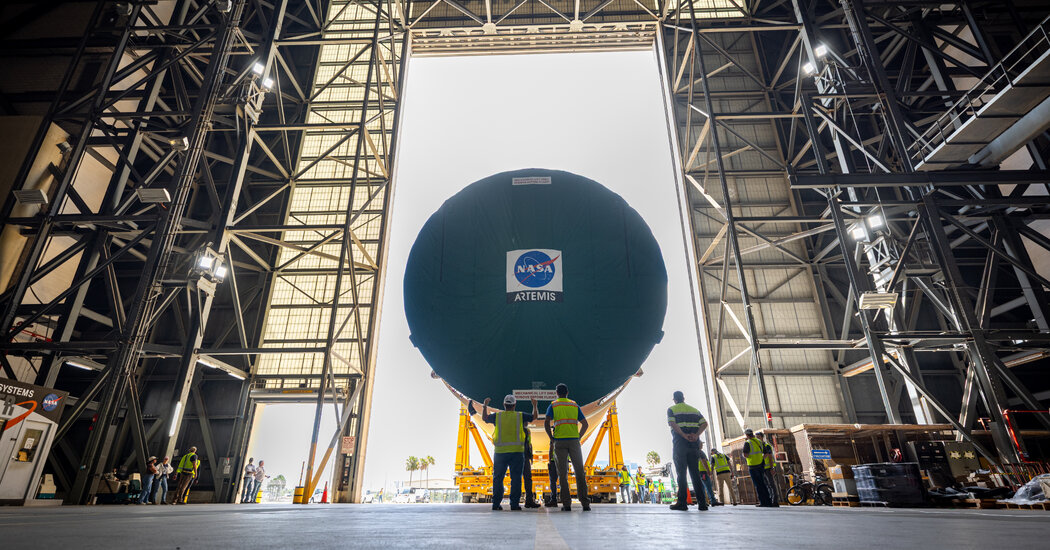
Artemis III is the third mission in NASA’s Artemis program, which aims to land humans on the moon in 2028. But the newly minted crew, which NASA will reveal at Johnson Space Center in Houston during an event at 11:30 a.m. Eastern time on Tuesday, won’t actually go to the moon. Instead, NASA plans to send them to low-Earth orbit by mid-2027 to test the ability of its spacecraft to rendezvous and dock with one or two lunar landers.
Those landers are being developed by Blue Origin and SpaceX, a rocket company founded by Elon Musk. The landers are expected to transfer astronauts from lunar orbit to the surface of the moon during the Artemis IV and V missions. NASA planned to test parts of this procedure during Artemis III.
The New Glenn rocket is supposed to carry Blue Origin’s lander to space. But the rocket blew up during a test fire at Cape Canaveral Space Force Station in Florida on May 28. That explosion damaged the only launchpad Blue Origin has available to fly New Glenn.
Experts say repairs could take months, if not longer. That’s a problem for the accelerated timeline NASA is aiming for with the Artemis program: If New Glenn has nowhere to launch from by the time Artemis III is ready to fly, the mission might need to be delayed. Or the agency might choose to test maneuvers solely with SpaceX’s lunar lander, though that company has experienced its own setbacks.
“If anyone can do it, they can,” said Casey Dreier, the chief of space policy at the Planetary Society, referring to SpaceX and its ability to be ready for the Artemis III mission in 2027. But, Mr. Dreier added, the company will “have to demonstrate a lot of capabilities that haven’t yet been attempted.”
Two days before the New Glenn explosion, NASA announced that it had tapped Blue Origin to use the rocket to send rovers to the moon as soon as 2028. An earlier version of Blue Origin’s lunar lander was also scheduled to launch on New Glenn later this year to send scientific instruments to the moon that would help lower the risk in future crewed landings.
NASA is working with Blue Origin to assess the cause of the rocket failure and recover the launchpad. “We will fly again before the end of this year,” Dave Limp, the chief executive of Blue Origin, wrote in a social media post.
Historical precedent suggests that it might take longer. In 2016, a SpaceX rocket exploded on a launchpad at Cape Canaveral; afterward, flights from that launchpad did not occur for nearly 16 months. A rocket flown by Orbital Sciences, now part of Northrop Grumman, exploded shortly after liftoff from a NASA facility in 2014, and it took nearly two years for that launchpad to be used again.
“It’s really hard to imagine them being back up in the air by the end of 2026, but anything is possible,” said Kathleen Curlee, a space research analyst at Georgetown University, referring to Blue Origin.
Artemis III was originally set to launch in 2028 and be the first NASA mission to land humans on the lunar surface in more than 50 years. But in February, the space agency announced that the mission would be moved to next year, and serve as a test flight before two lunar landing attempts in 2028. The shift makes Artemis III a simpler, less risky mission.
Still, the accelerated timeline leaves the Artemis III crew with no more than a year to bond and prepare for a somewhat undefined mission, if NASA meets its goal of launching the astronauts by mid-2027. (The Artemis II astronauts, who in April completed a 10-day journey around the moon, underwent three years of training.)
NASA’s process for selecting astronauts to fly on Artemis missions is secret. There are currently 37 active astronauts eligible for flight assignment. Three of them — Reid Wiseman, Victor Glover and Christina Koch — already flew on Artemis II.
NASA once committed to land the first woman, the first person of color and the first non-American astronaut on the lunar surface, and Artemis II was a step in that direction. Mr. Glover was the first Black man to visit the vicinity of the moon, and Ms. Koch became the first woman. Jeremy Hansen, the fourth Artemis II crew member, was the first Canadian.
But those astronauts were chosen in 2023, well before the second Trump administration took office and initiated a federal crackdown on diversity, equity and inclusion. Weeks after President Trump’s sweeping D.E.I. ban in 2025, NASA removed language from its website that pledged to land a diverse set of astronauts on the moon.
Tuesday’s announcement will reveal if Artemis III’s crew will reflect as broad a swath of society as the last one did.

