
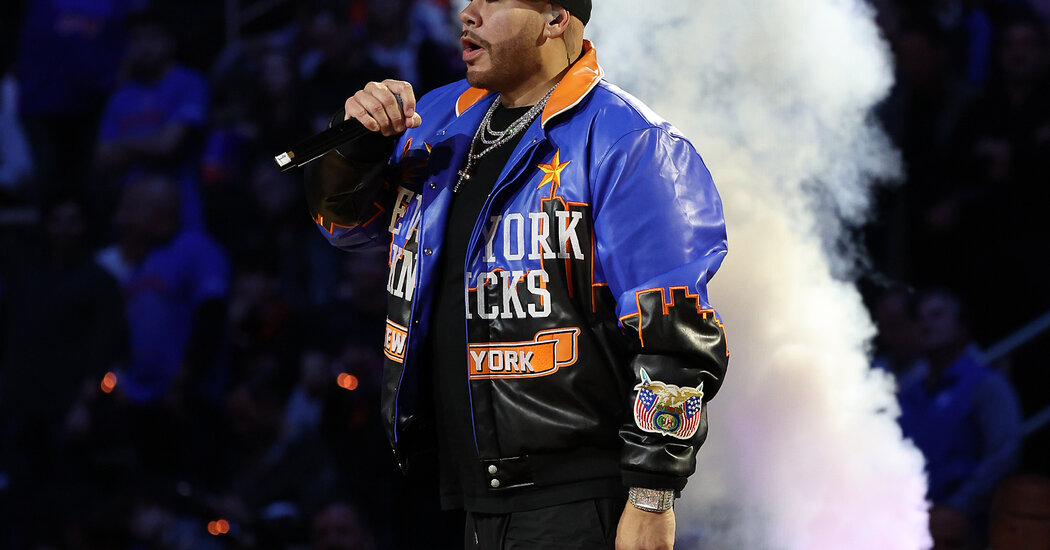
From his courtside seat at Knicks games, the rapper Fat Joe and the rest of the faithful at Madison Square Garden are serenaded with the sounds of New York hip-hop.
Often, Fat Joe hears his own banger Terror Squad’s “Lean Back” after a resounding defensive stop or heading into a timeout. “Every time I hear it, whether I’m at a game or watching on TV and it goes ‘ba-ba-ba,’ it’s unreal,” Fat Joe said.
A sports team’s deep playoff run, like the one that has propelled the Knicks to the N.B.A. finals, inevitably spawns accompanying theme songs, anthems and rallying cries from artists and producers hoping to channel the journey’s energy and capture eyeballs. Some are official, many are unofficial, and even more are looking to simply ride the wave of the team’s success.
The odes to the home team come from pioneers who uplifted the genre (Rakim), veteran superstars (Busta Rhymes), independent artists (Kyah Baby) and underground content creators who flood YouTube and TikTok using classic New York hip-hop loops.
“ “It’s the birthplace of hip-hop,” Fat Joe said. “Of course, from the pioneers to the youth, we’re going to support the Knicks, so it goes hand in hand.”
The Knicks last championship arrived in 1973, nearly the same time the embers of hip-hop were first being sparked in the Bronx. In hip-hop’s first mainstream hit, 1979’s “Rapper’s Delight,” the Sugarhill Gang’s Big Bank Hank declared: “I got a color TV so I can see the Knicks play basketball.” In 1984, the New York artist Kurtis Blow released the sport’s first genre-defining song, “Basketball,” which included shout outs to Knicks legends like Walt “Clyde” Frazier and Willis Reed.
“When you talk about young men in the late 1970s expressing themselves and the things they love and their obsessions, the Knicks are there,” said Dan Charnas, a professor at New York University and the author of the “The Big Payback: The History of the Business of Hip-Hop.”
The 1990s featured a synchronization between the Knicks and hip-hop that defined the city’s cultural landscape.
“We always speak about the Knicks in our raps, because we’re inspired by them to do what we do,” said Pete Rock, one of the sonic craftsmen of 1990s New York hip-hop.
The Pat Riley-led Knicks of the ’90s bruised their opponents, playing with a physicality that tested the game’s legality as they made annual deep playoff runs. Sonically, airwaves thumped with the boom-bap soundtracks and dynamic storytelling of Jay-Z, Nas, the Wu-Tang Clan and the Notorious B.I.G., who, in the 1997 song “I Got a Story to Tell,” described sleeping with a Knicks’ player’s girlfriend and later stealing from him.
“It was the most exciting era for hip-hop and for the culture of basketball,” Rock said. “A lot of the culture that represents hip-hop is through sports.”
At this era’s onset, Jesse Itzler and Dana Mozie combined to make the Knicks’ most enduring anthem, “Go New York Go,” a track seemingly on loop throughout Knicks games at Madison Square Garden.
At the time, Itzler did freelance work for a clothing brand owned by Nancy Grunfeld, the wife of Ernie Grunfeld, a former player and a Knicks executive at the time. Nancy knew of Itzler’s Knicks fandom and helped broker a meeting to pitch the Knicks on a theme song.
Itzler, an artist who then went by the name Jesse Jaymes, recorded the demo in his Upper East Side apartment. He wanted a chorus that matched hip-hop’s call-and-response tradition and came up with a hook both infectious and easily recalled: “Go New York, Go New York, Go! / Go New York, Go New York, Go!”
The track, Itzler believed, would be a hit after he turned it in. The initial reaction at the arena was muted. But the crowd warmed up to it throughout the Knicks’ 1994 playoff run and it stayed on the rotation of the influential radio station Hot 97.
“It evolved from an arena song to part of the fabric of the Knicks,” Itzler said.
He added: “I had no idea that was going to happen. I just wanted to get people to sing something during a timeout that would rally everybody and get them out of their seats and get something that was easy enough that everybody could chant, from 5 to 80 years old.”
The song’s success provided a launchpad for Itzler to create songs for other teams and leagues before becoming a successful entrepreneur and a part-owner of the Atlanta Hawks.
Over the years, the song has been remixed and updated with New York hip-hop icons like Doug E. Fresh, Q-Tip and Mobb Deep lending vocals.
“We done played it for so long that we actually like it, but I wouldn’t call it a masterpiece of a record,” Fat Joe said.
For much of the last generation, both the Knicks and the city’s once flourishing hip-hop scene fell on harder times.
The Knicks spent much of the 2000s cycling through institutional dysfunction, high payrolls, few wins and constant instability. The hip-hop spotlight had also left New York as Atlanta and the South became host to some of the most popular and innovative music.
Kyah Baby, an independent artist, is among those who feel like the city’s hip-hop scene flourishes when the Knicks thrive.
“I see a bunch of artists now making New York records, the New York sound is coming back, New York period is coming,” Kyah Baby said.
Last year, Rakim, Busta Rhymes, Styles P and Dave East teamed up for “Thank You New York Knicks,” a track that has reverberated during this run.
In an interview, East said Busta Rhymes asked him to join the track after Styles P and Rakim had already recorded their verses. It was an easy yes for him.
“I’m tired of watching other cities win,” East said. “The Yankees and the Giants have won, but I feel like on the basketball side of it, with New York City being the mecca of street basketball and just the game itself, we’re overdo for a win.”
East said the song would likely be updated if the Knicks win the championship.
“It has been probably the most exciting year with the Knicks in my life,” said East, a Harlem native who played college basketball. “I just turned 38, so this is heavy for me.”
Other tracks gaining traction this run include Skyzoo’s “Blue & Orange Everything” and “Big League (New York Knicks Anthem)” by Grafh.
Kyah Baby wrote the aggressive “New York Knicks Energy” during the team’s playoff run in 2023.
“I literally just woke up, threw my Frazier jersey on and went up the block to the park in my neighborhood and shot that video,” she said. “No makeup or nothing. I just shot it raw and put it out there to have visuals to match the song.”
As a child, Kyah Baby watched Spike Lee’s “Crooklyn.” The comedy-drama featured a story line about Knicks tickets and she always thought about what it would be like should the Knicks be champions during her lifetime.
“It’s been a while since the chip, but we’re going to do it again,” she says in “New York Knicks Energy.”
Kyah Baby updated her anthem for these Finals, which she expects the Knicks to win. “This team, it reminds me of myself and my career because being an independent artist is so hard. But it’s happening and waiting for your moment.”

