
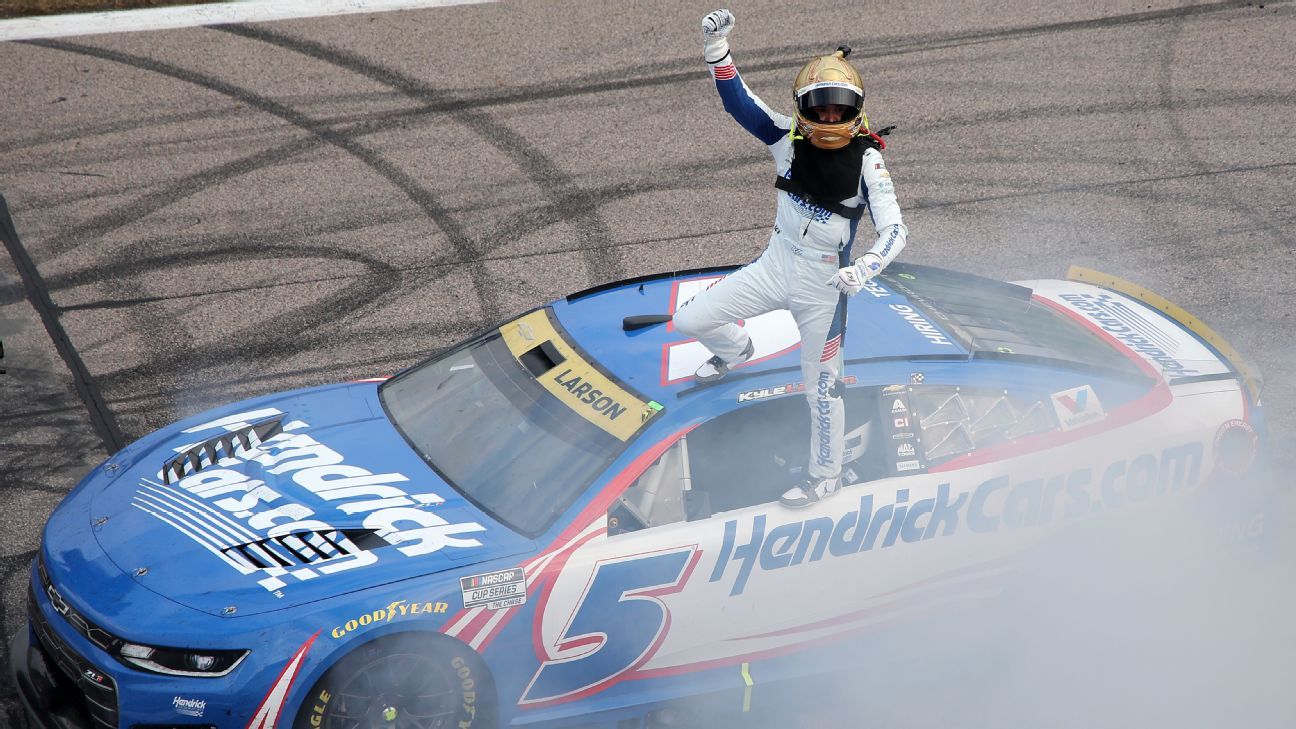
NASCAR Cup Series drivers thought they knew what to expect. It turns out the Chase format had a few surprises in store.
“There was always pressure with the other format, I thought, but this is consistent pressure throughout,” said now-three-time champion Kyle Larson of Hendrick Motorsports. “These 10 weeks feel longer than the other 10 weeks.”
Chase versus Playoffs. Or a sample size versus three race rounds.
NASCAR weighed those debates and more when it formed a committee after the 2024 season to discuss whether it was crowning its champion in the best possible way. A decision born from industry and fan criticism, increasing each fall, about the fairness and integrity of the system. Through those committee conversations, one prevailing thought was that winning needed to matter, but a driver’s body of work should mean more.
So, they reintroduced the Chase format, which had been implemented back in 2004 and used through 2013. Unlike the playoffs, the Chase keeps the final 10 races as the postseason portion of the schedule, but without the resets. Gone were the win-and-advance feature and three-race rounds that eliminated the four drivers with the fewest points.
It was one reset to begin the Chase and then game on.
“The emotions are definitely different from the aspect of there just are no more freebies,” said Christopher Bell, who finished runner-up this season. “Under the previous format, you have a good first race, and then the pressure is off. If you win the first race, then you’re on easy street. I guess on the flip side, if you have a bad first race, you do feel more pressure. But the fact that every race matters, and it’s not like these chunks before the reset, it’s a very different mentality.”
Bell was the posterchild of those emotions this season. The Joe Gibbs Racing driver went from winning the first race of the Chase and feeling like he was in contention, to riding the disappointment of other races slipping away, to feeling that his opportunity was gone halfway through the postseason, to licking his chops when Larson stumbled late in the postseason, to despondency when it was out of reach before the finale.
“I think it’s worked about how I expected and probably how all of us expected, with the exception of the win bonus,” Bell said. “The big talking point going into the postseason was where you needed to finish the regular season, where you needed to be seeded, and the win bonus really changes everyone’s opinion on it, and we’re seeing that firsthand now with all of the comers and goers that we’ve had in the standings since the start.
“I love it. I think there’s a lot to be gained and a lot to be lost, but with the number of points you get for a win, I don’t think you need a certain seeding going into the Chase. I think everyone has a shot if they perform well in the Chase.
“And the biggest thing is, we all want to agree on who the champion is, and with the previous format, I don’t think anyone would agree on who the champion is or if it was the correct champion. But looking at the points today, I think all of us would say the cream has risen to the top, and the right guy is leading the points.”
Larson tore through the postseason as the seventh seed. It took his team three weeks to take the point lead, and they never looked back, ending up with three wins and an average finish of 7.3. In the regular season? Larson had been winless.
“I’ve recognized how much winning is extra important, it seems, with the points,” Larson said. “Dude, it seems like you gain more points than what it actually says you gain. So, that’s been a lot of fun. … The points swing so much, and I didn’t really recognize that as much in the regular season, but in the Chase, with a little bit smaller sample size, it’s like wins seem way bigger.”
The good days mean more. The bad days hurt more. Some drivers have found that every weekend and every stage gets more emphasis.
It’s not exactly a win bonus, but it feels that way because NASCAR gave teams what they wanted: making wins matter more. A win is worth 55 points, a 15-point increase from previous formats. Those turned out to be valuable.
“It definitely gives more emphasis to the regular season, and honestly, more excitement down the stretch,” said Hendrick Motorsports’ William Byron. “I think if you had the Chase but didn’t have the win bonus, it would be a lot different. But I think the win bonus really shakes things up.
“It’s cool that you can save wherever you are in points based on winning, and I think that’s put an emphasis on running up front and getting stage points. There really is no secret formula that I’ve seen; it’s a matter of winning enough races and getting stage points. So, you have to really go in on the tracks you’re good at.”
In the words of 23XI Racing driver Bubba Wallace, “It rewards consistency.”
Wallace and the rest of the series saw that early in the season through his teammate Tyler Reddick. After the first ten races, Reddick had five wins and seven top-ten finishes. The reward was a 110-point lead and an early narrative of being untouchable as the No. 1 seed.
But those bad days then showed how much they hurt as Reddick stumbled through the summer. He lost the points lead and finished third as Denny Hamlin, who started winning in bunches and putting together consistent finishes, took the lead.
“I really enjoy racing under this format,” said Chase Briscoe of Joe Gibbs Racing. “I think the balance has been great. I do think that winning has mattered way more than any of us realized. We started this and all talked about how you had to be in the top five or six in points, and I feel like that’s gotten thrown out to a certain extent with how much volatility there’s been.”
And if nothing else, NASCAR inadvertently made its drivers pay more attention with a Chase format.
“I feel like I’ve found myself way more dialed into the points, even during the regular season,” Briscoe said. “If you have a bad week, you feel that way more now. Even a good week boosts you way more than it typically did.”
Ryan Blaney of Team Penske, who won the 2023 title under the playoff format, said, “I pay way more attention to the points week in and week out. Not only through the Chase but beforehand, way more than I ever did in previous years, because it’s so much more important and you know the guys you were racing. I think it puts pressure on you every week. You don’t have rounds of, ‘Hey, we already advanced to the next one.’ It keeps it exciting and exhilarating.
“You look at [Phoenix], the whole storyline is, ‘Oh, six more guys are back in it now, and they have a shot because the points leaders had a bad day.’ That stuff is really exciting for everybody watching and people involved in it. So, I’ve really enjoyed it. I think it’s good to have a lot of consistency in there. You need it. And winning has mattered probably more than it has when it was the playoffs.”
The emotional swing of the Chase and the points for winning were the surprises. Not a surprise? That the industry agrees the format is doing what it needs to do to produce a deserving champion.
“You have to have an elevated program, and you have to reduce those mistakes,” said Joe Gibbs Racing crew chief Adam Stevens. “That’s what this playoff format is about. And I would say that we all quite prefer this one compared to the old one.”


