
When Mark Kvamme, a former partner at Sequoia Capital, left Silicon Valley for Columbus, Ohio, in 2011, colleagues told him that he was making a career-ending mistake.
“Ohio is where venture capitalists go to die,” he recalled one of them saying.
Fifteen years later, Columbus, the state capital known as the headquarters for insurance companies and retail brands like Victoria’s Secret, has been transformed. The metropolitan area has become a critical hub for advanced manufacturing and artificial intelligence.
“Columbus is booming,” said Dennis DeMeyere, a former technical director at Google Cloud, who plans to open an A.I.-powered manufacturing company, Autonomous Production, near Columbus. “It’s wild. Everything is under construction. It feels like the Bay Area felt 13 or 14 years ago.”
Some of the most ambitious tech projects in the United States are rising from the farmlands outside the city. Mark Zuckerberg recently stopped by to check on the development of a Meta facility that will train advanced artificial intelligence models. Intel is constructing a $28 billion fabrication facility that will build some of its most advanced chips.
Palmer Luckey, the founder of the defense tech start-up Anduril, said he planned to buy a house here, to be close to the company’s $1 billion factory that will build autonomous drones for the U.S. military.
Not everyone is thrilled. Some residents have complained that the proliferation of high-tech facilities is a result of public subsidies for big tech companies. Others said they worried that the new facilities — which are highly automated — wouldn’t employ enough people to improve life for longtime residents.
Manufacturing employment nationwide remained relatively flat in recent years. Employers added 7,000 manufacturing jobs last month, according to the Labor Department. But the picture is different in central Ohio. Job growth in the manufacturing sector here rose 4.4 percent between 2021 and 2024, up from 2.7 percent in the four-year period before the pandemic, according to an analysis by the Brookings Institution’s metropolitan policy program.
The Columbus metro area ranks 46th out of 100 metro areas for manufacturing job growth, according to an analysis by Mark Muro, a senior fellow at the Brookings program.
Federal investment — most notably the 2022 CHIPS and Science Act — has helped propel construction in the Columbus area by providing billions in subsidies for domestic semiconductor production, Mr. Muro said.
“In a short period the Columbus metro has climbed substantially,” he said, adding that the region previously ranked 70th.
From Cleveland to Columbus
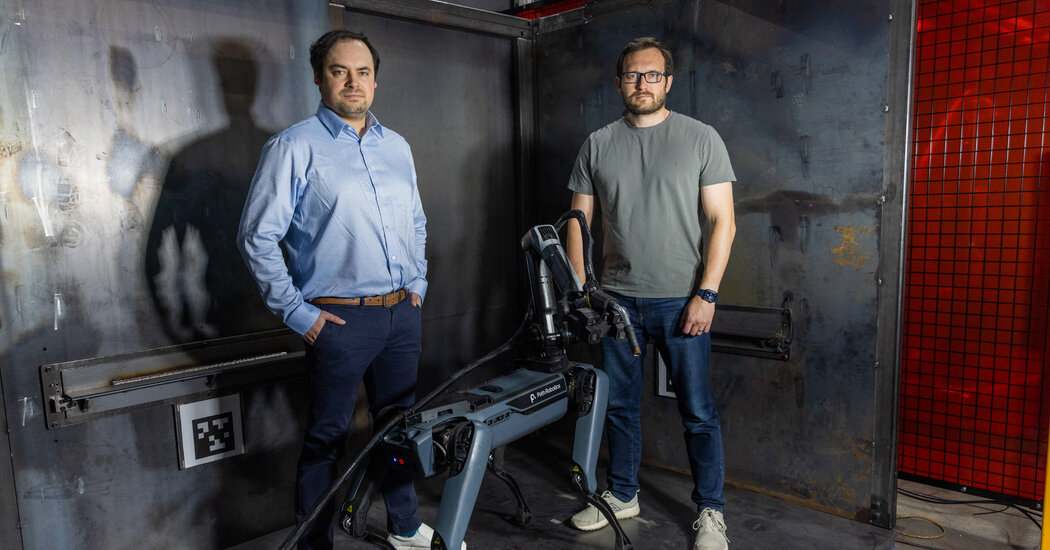
In a 200,000-square-foot factory on the west side of Columbus, Andy Lonsberry, chief executive of Path Robotics, demonstrated an autonomous robotic dog with a welding torch for a head. Using sensors invented by Path, the robot was able to identify the seam on a metal wall that it was supposed to weld. It aimed its torch, and sent sparks flying.
Path Robotics has raised $370 million from investors since 2018, and entered into a partnership with Huntington Ingalls Industries, the military shipbuilder, to tackle a shortage of welders, often a bottleneck in American manufacturing.
Mr. Lonsberry started Path with his brother Alex in Cleveland, where they both earned doctorates at Case Western Reserve University. They moved the company to Columbus in 2019 because of the fast-growing tech scene, the local incentives and the technical talent coming out of Ohio State University. The company employs 175 people, but plans to employ a total of 300 people by the end of the year.
“This is wildly valuable, to be able to coalesce a group in Columbus,” Mr. Lonsberry said.
The changes unfolding here are cultural as well as economic. An eclectic restaurant scene has sprung up in a city that was the home of the first Wendy’s restaurant. A $2 billion airport terminal is being built to secure more direct international flights for business travelers.
The Columbus metro area, home to more than 2.2 million people, grew by 21,312 people between 2024 and 2025, according to census data.
Connect Housing Blocks, one of the largest manufacturers of modular homes in the country, is helping to house the newcomers. At its factory in the Columbus neighborhood of South Linden, a worker fed a ribbon of light-gauge steel into a machine that bent it and drilled it, creating a metal stud to frame a wall. On the assembly line, the walls became rooms, and rooms became sleek apartments, which waited to be trucked to a site and stacked like Legos.
The company’s founder, Brad DeHays, a real estate developer, began building housing this way when it became too difficult to hire skilled tradesmen. Apartments built in the factory cost about $90,000 less per unit than those constructed in the traditional way, Mr. DeHays said.
The Drive for Funding
Mr. Kvamme (pronounced KWA-me), the former Sequoia Capital partner, evangelizes about Ohio with the zealousness of a convert. He was asked to lead economic development for state by John Kasich, the Republican governor at the time, in 2011. He intended to stay for only six months, but became enamored with manufacturing when he began touring factories around the state.
Under the Kasich administration, Mr. Kvamme created JobsOhio, a private organization funded by state proceeds from liquor sales. The group played a role in attracting companies, including Intel and Anduril, which are expected to employ thousands of people. It has also been embroiled in controversy, including a scandal that cost the president of Ohio State his job.
Mr. Kvamme now runs The O.H.I.O. Fund, a private fund that has raised $647 million to invest in businesses in the state. His portfolio includes Connect Housing Blocks and Eagle Wireless, a Cleveland-area manufacturer of cellular modules, tiny electronic components that had previously been mostly produced in China.
“There was nobody making these in America,” Mr. Kvamme said of the modules. “Now, we’re doing 20,000 of them a week.” He keeps one in his pocket, just to show what Ohio is capable of, and recently showed one to Vice President JD Vance, a former Ohio senator.
“The tone has shifted,” Mr. Kvamme said of his colleagues in Silicon Valley who questioned his decision to move to Ohio. “About three years ago, everyone started saying, ‘Mark, you’re the smartest guy on the planet.’”
Cutting Red Tape
For years, Ohio officials have aggressively courted companies by offering grants, low taxes and light regulation. Many businesses that set up shop here get a high level of cooperation from local government officials and educational institutions, a tradition that is often referred to as the “Columbus Way.”
Amgen built a biologic drug assembly and packaging facility in New Albany — a 20-minute drive east of Columbus — in 26 months, from the groundbreaking to approval by the Food and Drug Administration. “It was the fastest in our 45-year history,” said Esteban Santos, Amgen’s executive vice president of operations.
New Albany officials met weekly with Amgen to ensure that the company didn’t wait for inspectors or permits. Columbus State, a two-year community college, worked with the company to develop a curriculum that prepared students to take jobs in the plant while it was still under construction. Amgen is now embarking on a $900 million expansion, Mr. Santos said.
“They know how to get through all the red tape,” Mr. Kvamme said of officials in Ohio. He compared it with California, where, he said, getting permission to build can drag out for years.
However, the very things that attracted large companies to the area — the speed of construction and relationships with government officials — has raised concern from ordinary people who said they didn’t have much input about what was being built in their communities.
In December, state lawmakers passed a bill that forbids the release of information submitted by companies seeking tax breaks or other economic development incentives. That has made it more difficult for the public to weigh in.
Jessica Baker, a real estate agent from Williamsburg, about 95 miles south of Columbus, is spearheading a statewide campaign to ban large data centers. She said local officials across the state often refused to answer questions about massive development projects because they had signed nondisclosure agreements with the companies.
In a May hearing about the issue, she complained that residents were “left in the dark while massive industrial projects moved forward behind closed doors.”
A bill that would bar certain officials from signing such nondisclosure agreements was filed in February by two Republican state representatives, including Brian Stewart of Ashville, who represents Pickaway County, where Anduril has built its factory.
“People were just as angry about the nondisclosures that were signed as they are about a potential data center,” said Adam Bird, the other sponsor of the bill, who represents New Richmond in southern Ohio.
Pari Sabety, a former budget director for Ted Strickland, Ohio’s last Democratic governor, said economic development in Columbus often served big business but not the community itself.
“They have used the ‘Columbus Way’ as their moniker to extract unending subsidies from the city and the state for highly profitable companies,” she said.

