
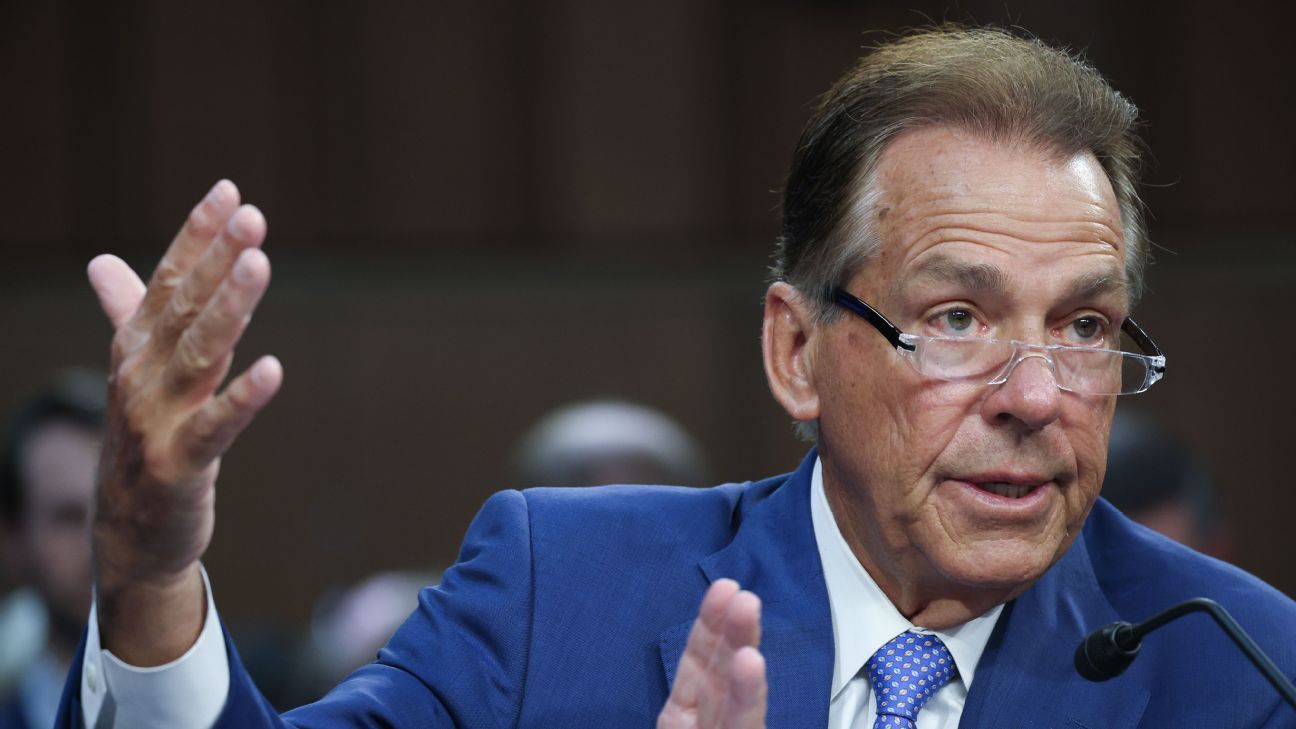
WASHINGTON — Former Alabama coach Nick Saban faced several United States senators Wednesday morning in a historic hearing on Capitol Hill and pleaded for Congress to “bring order to a system that badly needs fixing” in the NIL and transfer portal era.
“Congress does not need to micromanage college athletics,” Saban said in a nearly packed room during the Senate Commerce, Science and Transportation Committee hearing. “Congress does need to fix the mess in the courts and create a national framework so the people inside college sports can enforce fair rules. Without that legal certainty, every rule becomes another lawsuit, every standard becomes another risk, and the system keeps drifting toward a professional model.”
Saban testified his support for the Protect College Sports Act, along with Notre Dame athletic director Pete Bevacqua, Pac-12 commissioner Teresa Gould, West Virginia president Gordon Gee and Utah defensive end Lance Holtzclaw. While Holtzclaw provided a player’s perspective on agents, the portal and coaching changes, the athletic leaders spoke with a sense of urgency and warned of dire consequences like more Olympic sports being cut if federal legislation isn’t passed soon.
“We’ve seen the data,” Gould said. “The threats are real.”
The Protect College Sports Act, written after months of negotiation between Sen. Ted Cruz (R-Texas) and Sen. Maria Cantwell (D-Washington), would provide the NCAA with an antitrust exemption to enforce several rules that have been challenged in court in recent years. Those rules would include:
• Limiting athletes to transferring schools only one time without penalty;
• Limiting athlete eligibility to a maximum of five years;
• Prohibiting former professional athletes from playing in college;
• Prohibiting schools from poaching a coach from another school during their sport’s season (Cruz called this the “Lane Kiffin rule,” referring to LSU‘s hiring of Kiffin from Ole Miss in November.)
Saban said the bill “isn’t perfect and I’m sure many, many adjustments need to be made,” but he still supports it.
“I think it should be nonpartisan,” Saban said. “It’s that important in terms of college athletics, in terms of the future for young people. It protects athletes, it protects opportunity, it protects competitive balance, it protects the sports that do not always generate revenue but still matter. It gives college athletes a chance to move forward with rules that are clear, national and enforceable. For these reasons, I support the College Sports Act, and urge Congress to act.”
The NCAA and its schools have been lobbying Congress for a new federal law since a Supreme Court ruling in 2021 made clear that the multibillion-dollar industry is not exempt from antitrust laws, which prevent competitors from colluding to keep down costs. Tuesday’s hearing was the third in the past five years that addressed NIL, but nobody has been able to get a bill to the floor for a vote.
Cruz told ESPN he’s “quite confident” this legislation can pass. He said it’s the only bipartisan bill that exists and called it “the last best hope we have to save college sports.” It would need 60 votes to pass the Senate (53 Republicans means they would need at least seven Democrats).
The bill, which is also sponsored by Sens. Eric Schmitt (R-Missouri) and Chris Coons (D-Delaware), would give the NCAA and the College Sports Commission legal cover to enforce a spending cap for how much each school can pay its athletes.
Saban said that in his first year with a collective, Alabama had $2.7 million in NIL funds, and it has since increased to $10 million, $17 million and $24 million.
“Now you have schools that have close to $40 million rosters,” Saban said.
Bevacqua said a “realistic” cap is needed, and the current $20.5 million House settlement cap per school is “too low.”
“The concept of a cap emanating from the House settlement, in my opinion, is a fallacy,” Bevacqua said. “There is no cap. It’s an equation. … You’re going to have a generation of student-athletes, thousands of cases, that are finishing their college journey without a college degree, with money that is fleeting, so by the time they’re 25, they’ve torn through that money and it’s kind of a good luck for the rest of your life.”
The new bill doesn’t address whether college-athletes should be considered employees, with Cruz telling ESPN that references to “student-athletes” throughout was “a deliberate choice” and “a compromise that I had to make to get bipartisan support.”
Bevacqua cautioned that further financial disparity could eventually result in a “super league” that includes the wealthiest college football programs in the country.
“If you continue to have all of your resources pooled into football with escalating roster fees, and not knowing where that ends, I believe the inevitable outcome is there’s going to be a small handful of schools that will differentiate themselves from others and play football at a super league level,” Bevacqua said. “I don’t think it’s good for college football to be a mini-NFL. That’s not the spirit of college football.”
Cantwell said she believes the ACC and Big 12 sent letters supporting the bill because they fear schools in their conferences could get pilfered by the SEC and Big Ten. Cantwell said Congress “can and should write better rules that put athletes first and keep our institutions strong,” and that’s what the bill does.
On the eve of the hearing, the SEC issued a joint statement with the Big Ten saying they “do not support” the bill “as drafted” because it “leaves critical issues unresolved,” including not “meaningfully” preempting state laws with a federal one, which has long been considered a key element for a measure to get support from the NCAA and the conferences.
Saban opened his testimony by stating he’s “not representing any conference or any team.”
“This bill recognizes the difference between real NIL and disguised pay-for-play,” Saban said. “It gives student-athletes a federal right to earn NIL compensation, but it also creates contract, agent and enforcement rules so the system has integrity.”
Saban also said he supports the bill’s approach to transfers and eligibility.
“Athletes should have real freedom,” Saban said. “A young person should not be trapped in a bad situation. But unlimited transfer freedom, combined with pay-for-play incentives, has created something very close to unlimited free agency without contracts, without rules, and without stability. That makes it harder to build teams and harder to develop young people.”

