
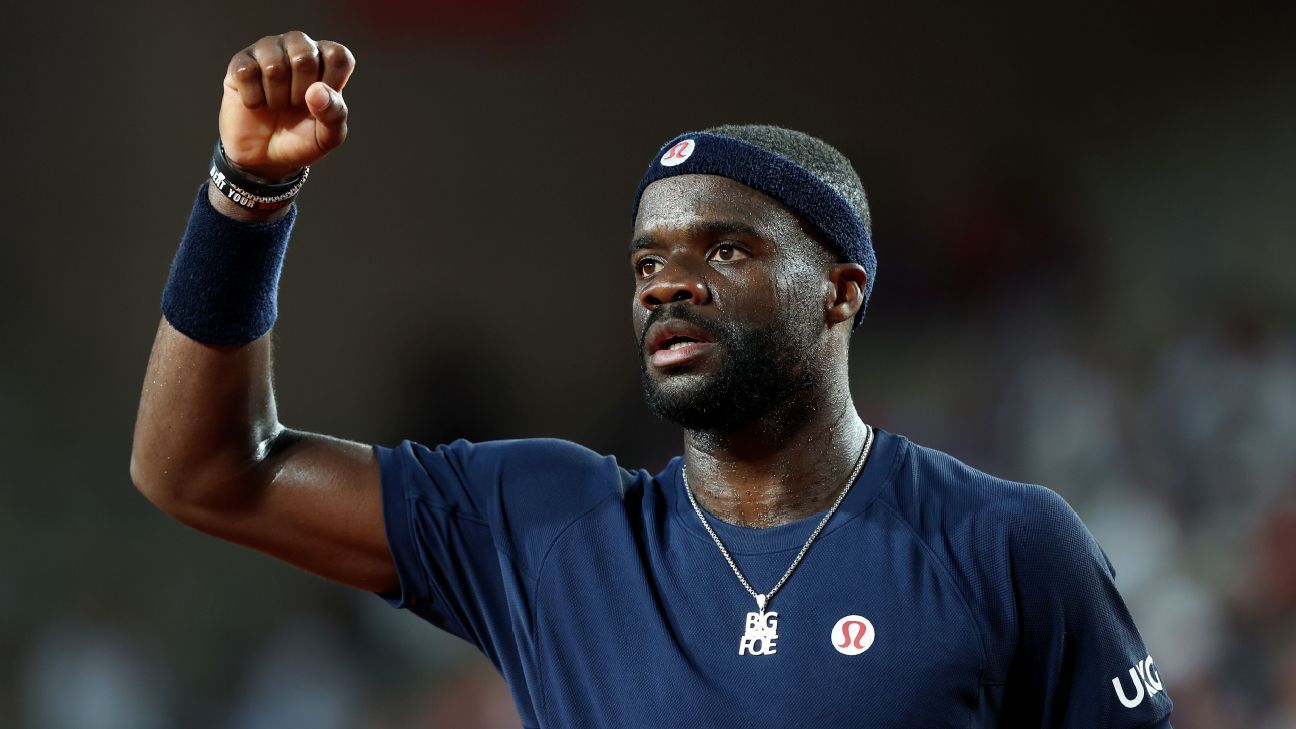
PARIS — It will take some time for Frances Tiafoe to process what happened to him at the French Open on Monday night, to deal with the physical pain of almost 5½ hours on court and the mental anguish of letting slip a two sets to love and 4-1 lead before losing to Matteo Arnaldi of Italy.
The disappointment of being so close to reaching back-to-back Roland-Garros quarterfinals will doubtless linger. Usually one of the most comfortable players with the media, Tiafoe did not do the customary postmatch news conference after the Arnaldi match, which finished at nearly 1 a.m. But when the pain begins to subside, he will surely realize just how far he has come in the past year.
“I hate it for Frances,” Andy Roddick, the last American man to win a Slam title, in 2003, said on his “Served” podcast. “He probably won’t be able to hear anything positive from this for a while. It hopefully has a limited hangover. [But I would tell him], you didn’t have this physicality in your body a year ago. You were prepared for the opportunity physically.”
A prodigious talent, Tiafoe was tipped for the top from a young age and has twice made the semifinals at the US Open. But despite his achievements, there has also been criticism that he has relied on his talent too much, that he was not willing to give absolutely everything to fulfill his potential.
It was late in 2025, not long after an early loss at the US Open, that those closest to Tiafoe shared with him some home truths. If he didn’t change, they said, he would never achieve his dreams. Chastened, he took a leap and hired Mark Kovacs, a performance physiologist and biomechanics specialist. Kovacs, who has known Tiafoe since he was working at the USTA when Tiafoe was 12, set about revolutionizing his physical prowess and his attitude.
After his bruising five-set win over Hubert Hurkacz in Round 2 in Paris, Tiafoe explained what Kovacs had done, from instigating discipline in his training to simply ensuring that he showed up on time.
“[We’ve had] a lot of conversations, trying to be real, man,” Tiafoe said. “What are you really trying to do, what are you trying to get out of it? Just stop hiding behind your talent, stop hiding behind the gift. Don’t use the gift as a disadvantage; try to use it as an advantage. A lot of times you can get away with stuff because you’re so gifted. But use the gift the right way; squeeze a lemon and see what you can get out of it.
“[Success] doesn’t happen just because you locked in for a little bit and all of a sudden all the chips will fall where you want them to be. You can guarantee yourself to not do it if you just continue the way I was kind of going. Now I’m giving myself a chance, and things like today happened.”
Former women’s world No. 1 Lindsay Davenport knows Kovacs well, having hired him to help her son, Jagger Leach, who is making his way on the professional tour. “I know he wouldn’t have taken the job if things weren’t changing,” she told a small group of reporters at Roland Garros.
“If you hear their stories about last fall and what a dark and deep place Frances was in, but what he was willing to turn over to try and give it his best shot — it’s not easy sometimes for players or people, personalities to do that — but he has kind of shifted everything in his life to revolve around tennis.
“I know it was a huge step for him to take. I know he’s been totally committed, I know everybody on that team is on the same page. I am a huge fan of the whole team.”
Tiafoe needed just under three hours to get through the first round, before playing for four hours, 43 minutes in Round 2 and four hours in Round 3. His five-hour, 26-minute epic against Arnaldi meant he spent almost 17 hours on the court in four matches.
John McEnroe, another former world No. 1, said he felt Tiafoe had turned the corner.
“He’s finally decided that you’ve got to get as fit as possible,” McEnroe said at Roland Garros. “It looks to me like that is paying off, obviously. It’s awesome. He’s great for the game. You saw him fade against [Taylor] Fritz late in that [2024 semifinal] match in the Open. It’s happened a few times. I think that hit him really hard and finally, I don’t want to say he came to his senses, because to make that type of commitment is big, but it’s paying off, I believe.”
With Carlos Alcaraz missing through injury, Jannik Sinner wilting in the heat in the second round and Novak Djokovic going out in Round 3, the path was cleared for Tiafoe, and others, to come through. That he failed to convert a hugely dominant position will hurt badly, but the sacrifices he has made since calling on Kovacs for help will surely pay dividends in the long run.

