
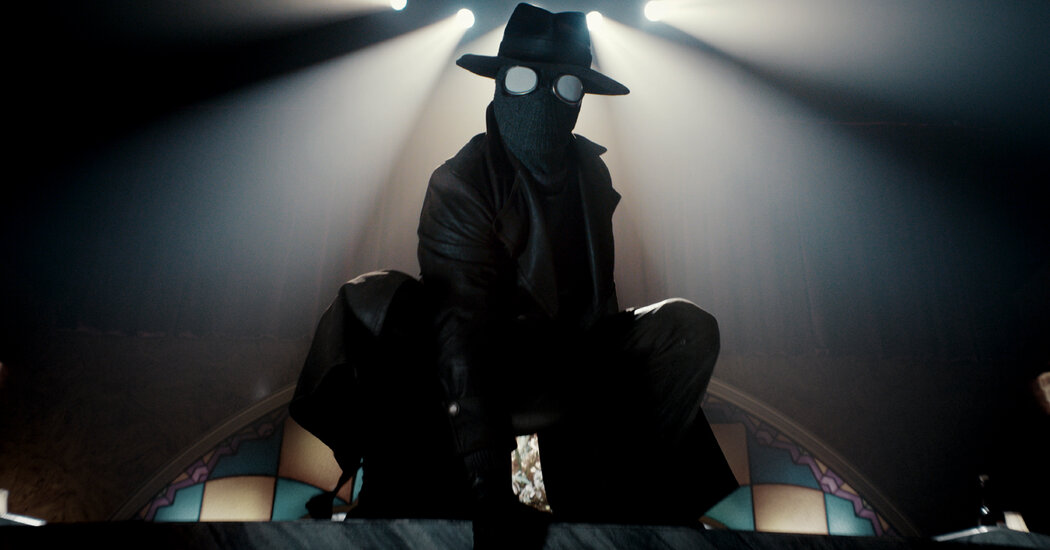
“Spider-Noir” does have the advantage of being easygoing and in on its own jokes; that, along with the production design, can lull you into submission. Its evocation of film noir is barely skin deep — and in its visual quotations from films like “The Night of the Hunter” and “The Lady From Shanghai,” it’s exactly skin deep — but it’s not off-putting.
The show has one real source of suspense: waiting to see what Cage will do, given the opportunity to play a human with insect genes. Cage and the writers, fully aware of his wild-man reputation, toy with our expectations — he plays Reilly straight, for the most part, but on a few occasions the inner spider breaks out, and Cage delivers the twitching, prancing, grimacing display that we might, against our better natures, hope for.
Cage’s Reilly is less of a cynic or romantic than he is a ham, and the script plays this up. When Reilly goes on a drunken, Eugene O’Neill-style rant in a saloon, there is a moment of silence before the barflies laugh in his face. Cage’s own preparation for the role is satirized when Reilly practices his Cagney while watching the noir “Great Guy.”
It’s all fun, in a minor way, but it doesn’t have much to do with film noir. Bogart, Cagney and Robinson were stylized performers; so is Cage, but in a modern, more self-aware and self-mocking fashion. Putting himself in their surroundings is more of a stunt, or a thought experiment, than a dramatic exercise.
What does come through, because of the relative restraint of the performance, is Cage’s inherent likability — the quality he sometimes seems to be running away from. Overall, it’s a pleasure spending eight episodes in his company.

