
-
James Olley
Close
James Olley
Senior Writer, ESPN FC
-
Bill Connelly
Close
Bill Connelly
ESPN Staff Writer
- Bill Connelly is a writer for ESPN. He covers college football, soccer and tennis. He has been at ESPN since 2019.
Multiple Authors
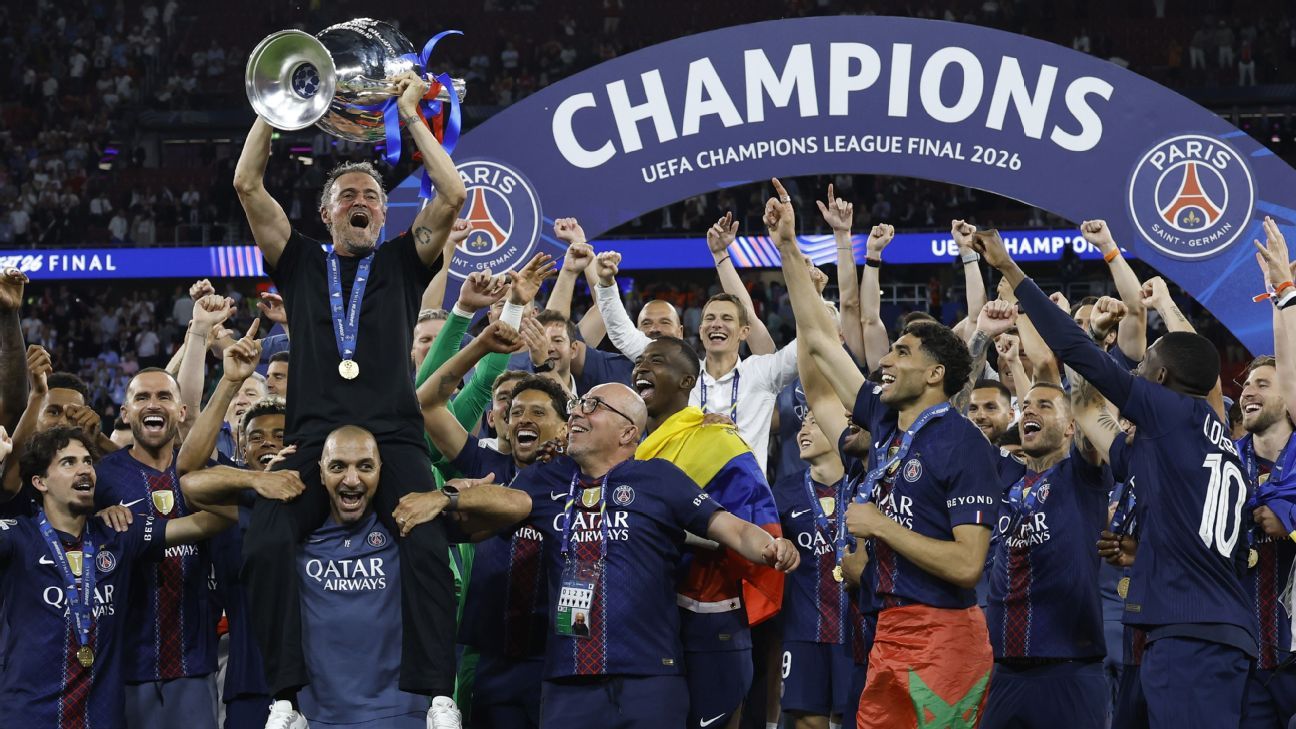
BUDAPEST, Hungary — Paris Saint-Germain sealed back-to-back Champions League glory in a penalty shootout win against Arsenal after Eberechi Eze and Gabriel Magalhães both missed the target following a 1-1 draw after 120 minutes at the Puskas Arena.
After defeating Internazionale 5-0 in Munich last year to win their first Champions League title, PSG became only the second team (after Real Madrid) since the competition was restructured in 1992 to defend their crown.
Arsenal had taken the lead in the sixth minute with a Kai Havertz goal, but PSG equalized via a second-half Ousmane Dembélé penalty. The Ligue 1 champions dominated the game but were unable to finish off Mikel Arteta’s side until the penalty shootout.
Eze sent his penalty wide before David Raya saved from Nuno Mendes, but Gabriel’s effort flew over the crossbar to hand PSG a 4-3 shootout win, securing coach Luis Enrique’s third Champions League title as a coach. — Mark Ogden
 This was the right outcome…
We can go and parse it down to incidents: Nuno Mendes colliding with Noni Madueke, Bukayo Saka being beaten by millimeters to the ball by Matvey Safonov, the drama of the spot kicks when anything can happen and sometimes does. Each of those could have gone Arsenal’s way — none of them did, and in a low-scoring sport, that can make all the difference.
But the eye test and the numbers tell a different story. It’s football and Paris Saint Germain played football, as in “played with the ball and did things with it,” which is kinda the essence of the sport. No four-year-old in the back garden leaves it lying on the ground and practices his defensive movements.
merciless. Seventy-four percent possession. Twenty-one shots on goal (to 7). An expected goals count of 1.77 (to 0.44). Safonov, the PSG keeper, made zero saves because he only faced one shot — Havertz’s sixth-minute strike — on target. If there were figure skating, with gold medals awarded on points, there would be only one winner.
It’s not that PSG were flawless, because they weren’t. The early Arsenal goal and clogged middle saw them struggle for ideas and chances in the first half.
But … they adjusted.
Desire Doue moved inside, a centerforward sui generis and Ousmane Dembele moved wide, finding space and creativity until the muscular injury that forced him to limp off late in the second half. Joao Neves dropped more often alongside Vitinha when Arsenal opted for the low block, nullifying the press and offering up another passing outlet. And the introduction of a fresh-as-a-daisy Bradley “Speedy” Barcola led to two gilt-edged transition chances against an exhausted William Saliba.
Beyond the substitutions, PSG simply looked more confident, more grown-up, more been there/done that. Because, well, they had just a year ago, in fact, when they beat Inter.
They weren’t going to lose this game in terms of football, and they weren’t going to lose it mentally. Only randomness and misfortune was going to beat them. And on Saturday night, at the Puskas Arena, those things took a night off. — Gab Marcotti
 … but Arsenal had the right idea
If we’re being honest, Arsenal played this one about right. Once they got the lucky break and brilliant early goal from Havertz, the plan was clearly to eat up as much of the clock as possible and force PSG to burn as much energy as possible to even the match. The more open the match was, the worse it was likely to work out for them.
Considering it took until midway through the second half, and considering Khvicha Kvaratskhelia and Ousmane Dembele were both subbed out at the end of regulation — where the match went to penalties, and Arsenal had the only keeper who made a save — you could say it worked out well.
PSG still came closer to a winner before penalties, however, in part because they had Vitinha and Arsenal did not. Despite coming out after 105 minutes, he finished the game with the most touches (162), pass completions (141), passes received (127), carries (133), carry distance (671 meters) and progressive carries (22). He also had the most shot attempts (four), though none were on goal.
It felt like Vitinha was always on the ball. He was the primary reason why PSG kept the field tilted properly and were almost never in danger in transition. To Arsenal’s credit, the Gunners limited the quality of PSG’s opportunities, and David Raya’s excellence in goal helped to send the game to a shootout. But Vitinha was a maestro. — Bill Connelly
Arsenal’s squad depth comes up fractionally short
The whole point of Arsenal’s £250million investment on eight new players last summer was to give Arteta the tools to compete on four fronts. Saturday’s final was the 63rd game of a mammoth season that has tested it to the limit, so much so that Arteta made six changes here — including completely altering the starting forward line — and yet they still had Piero Hincapié struggling through extra time, palpably injured, with no more changes left to make.
In the end, they fell agonisingly short of becoming European champions by the smallest of margins.
Once this squad was assembled, the question was whether Arteta would handle it effectively. After winning the Premier League title and reaching their first Champions League Final in 20 years, he can feel thoroughly vindicated on that front. It is only with hindsight that he may regret not having more first-choice penalty takers on the field at the end.
By substituting Martin Odegaard, Bukayo Saka, Leandro Trossard and Kai Havertz, Arsenal were denied the chance to turn to four probable takers. Gabriel Magalhaes may never have taken the fifth penalty otherwise. Regardless, when the dust settles, Arsenal can go into the summer reflecting on the ground they have made up in Europe and safe in the knowledge the hard work has been done in squad-building terms – improvements are necessary, but marginal.
Maybe, you might suggest, focusing on more quality in the final third. — James Olley
PSG looked more prepared for penalties too
Once a game gets to spot-kicks, we’re told it’s all in the head. And the sports psychology/body language types come out of the woodwork.
How much this impacts a guy striking a ball from 12 yards out against a keeper rooted behind the line until the last possible moment is still part of the old school vs. new school debate, but it certainly looked as if David Raya was full-on new school, and the contrasting reactions of the two keepers was striking. Matvey Safonov picked himself up and trotted off to the two sides. Raya made it his business to collect the ball and meet the next Arsenal penalty-taker, handing it to him along with words of encouragement. It’s presumably part of the whole marginal gains thing.
Maybe, if Arsenal had won the shootout, we’d be talking about that. Instead, we have little choice but to talk about the fact that, of the five players who have taken penalties in games for Arsenal over the past two seasons, just one, Viktor Gyökeres, was still out there. The others (Bukayo Saka, Kai Havertz, Martin Odegaard and Leandro Trossard) had all started, and all come off, by the time extra-time began.
There’s no doubt Arteta had plenty of faith in the guys he had left and to be fair, Declan Rice, Gabriel Martinelli and Gyokeres too fine penalties. Eberechi Eze and Gabriel however, not so much. The former, who was an accomplished taker at Crystal Palace, opted for the baby step/stutter/deception routine and did everything right except for the shot, which rolled wide of Safonov’s post. The latter smashed his spot-kick over the bar.
By contrast, PSG looked relaxed and confident in each their kicks and each was well-taken, even the Nuno Mendes one that David Raya prodigiously saved. It’s fine margins. But if you live by the fine margins, the set pieces and the details, you have to get them right. — Marcotti
Luis Enrique joins the greats with third win
Luis Enrique joined an elite club of coaches with three or more European Cups / Champions League titles by guiding PSG to their second success in the competition.
Only Carlo Ancelotti, who has won five with AC Milan and Real Madrid, now stands ahead of the former Barcelona coach in the Champions League Hall of Fame. Pep Guardiola (Barcelona 2, Man City 1), Zinedine Zidane (Real Madrid) and Bob Paisley (Liverpool) are the coaches who now sit level with Luis Enrique, who won the first of his Champions Leagues with Barca in 2015.
The challenge for the Spaniard now is whether he can move ahead of the pack by winning a fourth, and then catching Ancelotti with a fifth.
Guardiola is now out of the game after leaving City at the end of the season, while Zidane is expected to join Brazil coach Ancelotti in the international arena by taking the France job after the World Cup. Luis Enrique could have the field to himself with his outstanding PSG team in the years ahead. — Ogden
History-making goes to the winners
One of Arteta’s most familiar refrains this season has been calling on his team to “write a new chapter” in their history. They did so domestically in 2025-26, but their wait for a maiden Champions League crown goes on.
Twenty years after their only previous appearance in a final, this iteration of Arsenal went closer than Arsene Wenger’s side by taking the game to penalties and, in a cruel irony, technically remain unbeaten in normal time all season in Europe. They only conceded seven goals.
The question becomes whether this is the way forward for Arsenal.
Havertz’s early goal may have contributed to the pattern of this game, but it has been the Gunners’ way all season to play fine-margin football, relying on their resilient defending to make the difference. Gabriel and William Saliba have been stalwarts in that regard, and so it is particularly harsh that the former missed the decisive kick.
But what now? If Arsenal are to kick on from here, dominate at home and win the Champions League, they may consider whether shifting to a more attacking approach could be the way forward. PSG dominated here — as they usually do — and the temptation in the immediate aftermath is to suggest Arsenal have the talent and now experience to be more expansive, particularly now they are unburdened from the 22-year wait for a Premier League title.
It will be a fascinating element of where Arteta takes this team next to see which way they go. Having come so close to grinding it out, Arteta may choose to double down. — Olley
A word on João Neves
The only thing that Joao Neves didn’t do in Saturday’s attritional final was taking a penalty. For the rest, he did it all. Some say he is still running somewhere in the streets of Budapest. Running after the ball, running to close a gap, to mark an Arsenal player.
At 21, he has added a second Champions League trophy to his cabinet at home and he was at the heart of it all, even more than last season. This final was cagey, tense and tight, because PSG had to find a different way to be victorious; lucky for Luis Enrique, the young Portuguese was perfect. He is the player you need in a game like this because you play with 12 men when Neves is in this kind of form.
His stats are mind blowing: 111 touches, 88% passing completion, 6 recoveries, 77% of ground duels won, 60% of aerial duels won, 7 passes in the final 3rd, 11 touches in the Arsenal box. He was everywhere and did everything. He is the emphasis of a team player with an intelligence way above average.
Of all the players recruited in the last few years by Paris, he is one of the most important. Let’s rename him Jewel Neves shall we? — Julien Laurens
Chronic time-wasting dents Arsenal’s image
Arsenal are a great team, as proven by their Premier League title, but they are not helping their reputation with the way that they play — specifically their time-wasting. Mikel Arteta’s team aren’t easy on the eye — we all know that — but there is an art to defending and they have certainly mastered that this season.
The issue with the Gunners, and they showed it time and again in Budapest, is their readiness to kill the game either by time-wasting or attempting to deceive the officials to win free-kicks. PSG coach Luis Enrique repeatedly pointed to the watch on his wrist as Arsenal wasted time with throw-ins and goal-kicks during the initial 90 minutes. Arteta’s side then held up the start of the second half by sauntering out of the tunnel and onto the pitch two minutes after PSG.
Within the first minute of the second-half, defender Cristhian Mosquera was booked for delaying a throw-in, but the time-wasting continued. Meanwhile, Kai Havertz and Leandro Trossard were repeat offenders when it came to falling down a little too easily in an effort to win a free-kick.
Throughout the first 90 minutes, Arsenal delayed play for a total 25 minutes and 56 seconds and that number was no surprise. So come on, Arsenal: leave out the time-wasting and histrionics. Nobody wants to see it. — Ogden

