
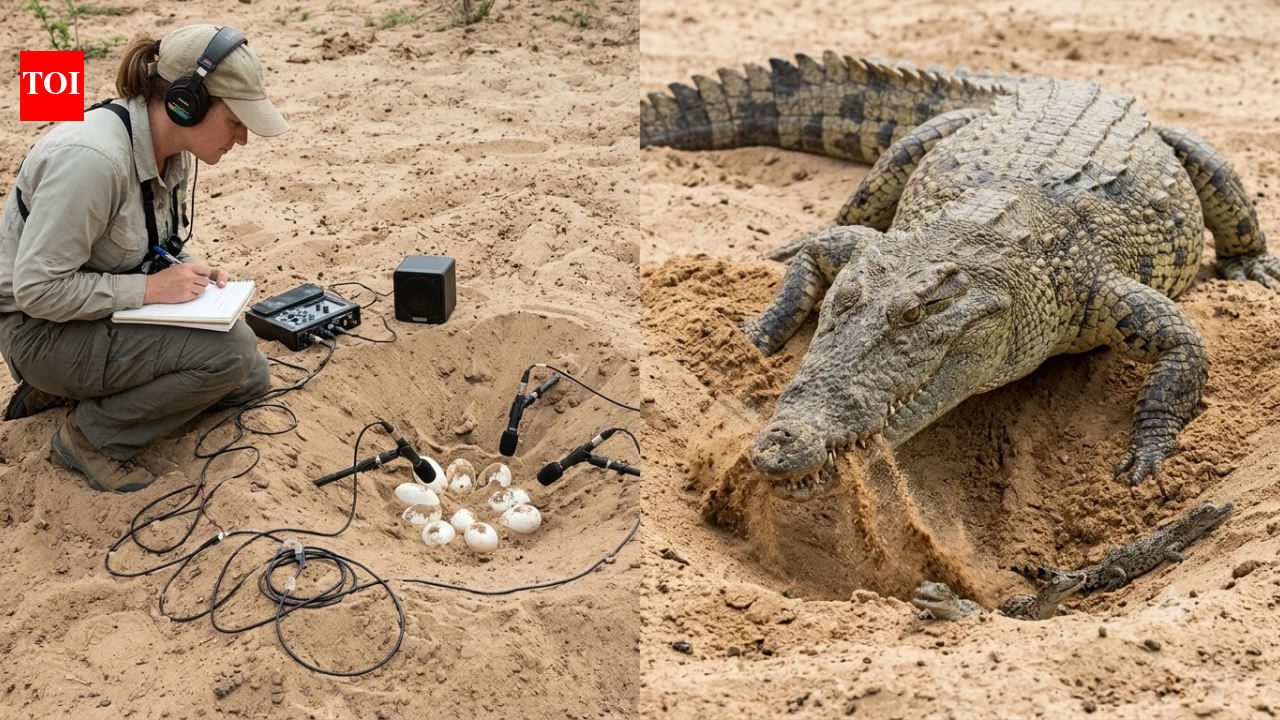
A crocodile nest can remain undisturbed for hours even after the young inside the eggs begin making sounds. The mother may hear them, turn towards the nest or shift her position, yet still leave the eggs covered. Scientists investigating this behaviour in Nile crocodiles have found that the timing of these calls matters. According to the study published in Animal Behaviour, titled, Crocodile mothers’ response to hatching calls’, their experiments involved playing recordings of unborn crocodiles vocalising from inside their eggs and observing how the mothers responded. The females did not begin digging simply because they heard a call. They waited until the sounds became continuous, suggesting that the adults use a particular pattern of communication to decide when their offspring are ready to emerge.
How hatching calls help crocodile embryos communicate before birth
For Nile crocodiles (Crocodylus niloticus), communication between offspring and parents begins before the young have broken through their shells. Embryos nearing the end of their development produce distinctive vocal sounds while still inside their eggs. These are known as hatching calls, and they serve more than one purpose.The sounds can be heard by other embryos in the nest as well as by the female guarding it. Within the clutch, calls help coordinate the timing of hatching, allowing young crocodiles to emerge around the same period rather than at widely separated intervals. The mother also responds to these sounds, eventually helping the hatchlings by uncovering the nest.
What makes mother crocodiles respond to calls from their unborn young
There is often a gap between the first sounds produced by embryos and the moment the female begins opening the nest. That delay raised a question for scientists: if the mother can hear the calls, what determines when she decides to act?To investigate, researchers used recordings of hatching calls and played them to female Nile crocodiles. By controlling the sounds presented to the animals, they could examine whether particular patterns of vocalisation prompted different responses.The females were capable of detecting even individual calls. When they heard isolated sounds, they sometimes turned their heads or moved their bodies towards the source. These reactions indicated that the vocalisations had caught their attention. But listening and digging were two different responses.An occasional call was not enough to make a female uncover the nest. The behaviour changed when the recordings consisted of sustained sequences of calls, continuing for several tens of seconds. It was this prolonged pattern that prompted the females to begin digging.
Continuous calling appears to signal that the hatchlings are ready
The difference between a scattered series of sounds and a sustained burst may help explain why crocodile mothers do not respond to every call they hear. Embryos within a nest do not all begin vocalising at the same time. Some may start calling while others are still developing, meaning that the sounds can initially be intermittent. Waiting for calls to become continuous may give the female a more reliable indication that several embryos are reaching the hatching stage. The sustained noise could therefore act as a signal that enough of the clutch is ready for the mother to intervene.The response also has implications for synchronised hatching. When several embryos vocalise in succession, the mother receives a stronger indication that hatching is under way across the nest. Her decision to dig at that point may help the young emerge within a closer time frame.
Role of communication in crocodile parenting before birth
The findings suggest that crocodile mothers do not simply become more likely to dig every time they hear another call. Instead, their response appears to depend on whether the vocal activity reaches a particular threshold.A mother may register individual sounds and react to them without taking any action that disturbs the nest. Digging begins only after the calls continue for long enough, indicating that the pattern and duration of the signals matter alongside their presence.For Nile crocodiles, the sounds coming from beneath the ground are not necessarily an immediate instruction to dig. The mother appears to wait for a more sustained chorus before deciding that it is time to uncover the eggs.


