
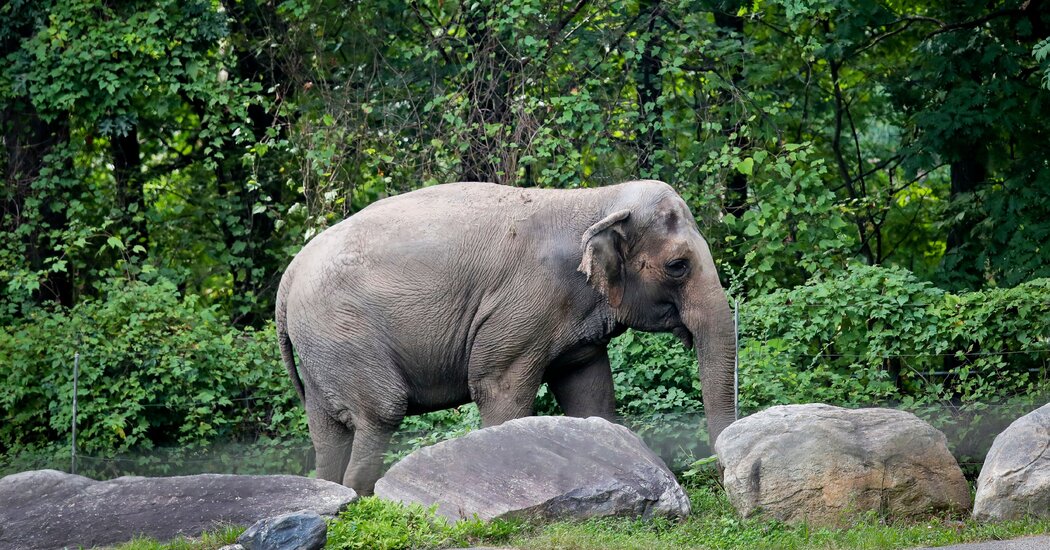
Happy, a 55-year-old Asian elephant who had lived at the Bronx Zoo since 1977 and whose uncommon intelligence thrust her into an unusual legal dispute over whether she was entitled to a fundamental human right, has been euthanized, zoo officials said.
Happy’s death, on Tuesday, came after a period of hospice care prompted by a recent deterioration in her health, including a falloff in kidney or liver function, zoo officials said in a news release late Wednesday.
“Following ongoing assessments of her condition and quality of life, this difficult decision was made when it became clear that her age-related conditions had progressed,” Craig Piper, the zoo’s interim director, said in a statement.
Nearly four years ago, New York’s highest court rejected, by a 5-to-2 vote, an animal-advocacy organization’s argument that Happy was being illegally detained at the zoo and should be transferred to an elephant sanctuary.
The ruling ended what appeared to be the first case of its kind in the English-speaking world to reach so high a court.
The organization behind the case, the Nonhuman Rights Project, had argued that the bedrock legal principle of habeas corpus, which people assert to protect their bodily liberty and to contest illegal confinement, should be extended to autonomous, cognitively complex animals like elephants.
The group, which had failed to win freedom for two chimpanzees under the same concept, took Happy on as its cause in 2018, after she distinguished herself as especially cognitively advanced even for a species known for intelligence.
In 2005, she passed a mirror self-recognition test, touching an X marked on her head with her trunk while looking in a mirror, making her the first elephant to show such a degree of self-awareness. (Only human infants, apes and dolphins had done it before.)
Christopher Berry, the Nonhuman Rights Project’s executive director, said in a statement on Thursday that the elephant’s “suffering” would “not be in vain.”
“Happy will always be remembered as the elephant who opened the courtroom doors for legal rights for animals,” Mr. Berry said. “Two judges from the New York Court of Appeals issued powerful dissenting opinions in support of her right to liberty.”

